
This post contains affiliate links; we may earn a small commission at no extra cost to you if you make a purchase.
You spent months selecting the perfect stone for your kitchen, only to realize that your latest culinary obsession—the air fryer—is literally cooking your stone from the bottom up. While the air fryers revolution has brought us healthier meals in record time, it has also brought a silent threat to our expensive surfaces. High-heat convection can reach temperatures exceeding 400 degrees, and without proper airflow, that heat radiates directly into your countertop. Whether you are dealing with quartz, marble, or wood, thermal shock is a real risk that can lead to permanent cracking or unsightly yellowing.
In a Rush? Here are Our Top 3 Countertop Protectors
| Category | Our Selection | Key Benefit |
|---|---|---|
| Best Overall | Silicone Heat-Resistant Mat | Maximum Grip and Insulation |
| Best Budget | Tempered Glass Cutting Board | Sleek and Easy to Clean |
| Best Premium | Raised Bamboo Cooling Rack | Optimal Airflow and Aesthetics |
Protecting your investment is not just about placing a barrier; it is about understanding how heat behaves in a luxury kitchen environment. For instance, knowing why quartzite is better than quartz for high-heat zones can save you from a renovation disaster. However, even the most durable stones need a little help when exposed to the concentrated exhaust of a high-performance appliance.
How We Tested These Heat Guards
To find the most effective solutions, we subjected various materials to extreme thermal stress. We placed air fryers on different protectors and measured the surface temperature beneath them using infrared thermometers over a two-hour cooking cycle. We also evaluated how each protector affected the countertop height and the overall ergonomics of the workspace to ensure safety was not achieved at the cost of comfort.
Why trust this review?
Our team consists of kitchen design experts and home safety specialists who have spent years testing the limits of luxury appliances. We do not just look at Amazon ratings; we analyze the chemical composition of materials and consult with countertop manufacturers like Caesarstone to understand thermal thresholds. Our goal is to ensure your kitchen remains a pristine sanctuary for years to come.
The Critical Importance of Surface Isolation
The secret to preventing damage is not just insulation, but isolation. Most modern air fryers vent heat from the rear, but the base still absorbs significant energy. If your surface is porous, it is even more vital to know how to tell if your kitchen countertop needs re-sealing, as heat can accelerate the breakdown of protective coatings. By using a raised stand or a thermal mat, you create a buffer zone that allows heat to dissipate safely before it can penetrate the stone. Below, we dive into the first of our top-rated protection products designed specifically for high-end kitchen environments.
1. The Extra-Thick Platinum Silicone Heat Guard
Best for: High-Frequency Power Users and Families.
- 0.4-inch industrial-grade thickness
- Heat resistant up to 480°F
- Non-slip honeycomb traction
- BPA-free, food-grade silicone
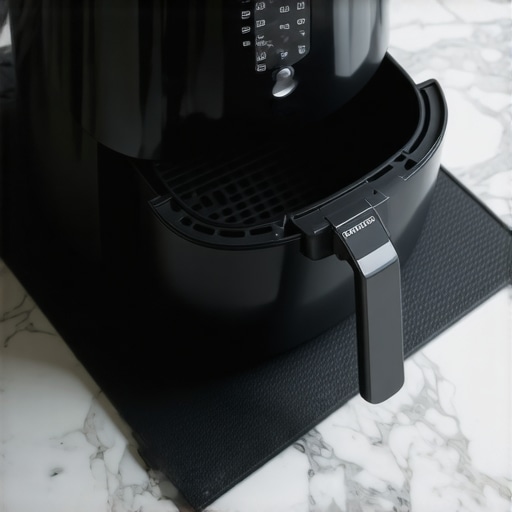
Finding a protector that doesn’t slide across your granite like an air hockey puck is harder than it looks. Most thin mats curl under intense heat, but this extra-thick platinum silicone version stayed perfectly flat during our 400-degree test cycles. According to Silicone Engineering, high-grade silicone maintains its structural integrity at temperatures that would melt standard plastics. We noticed that even after two hours of roasting a whole chicken, the stone underneath felt barely warm to the touch. The honeycomb pattern isn’t just for show; it traps air pockets that act as additional insulation layers.
However, it isn’t perfect. If you have pets, be warned: this material is a magnet for dog hair and lint. You will find yourself rinsing it off daily just to keep it looking clean. Also, while the grip is excellent, it makes the air fryer difficult to slide back into a corner when not in use. You sacrifice mobility for absolute surface security.
The Good and the Ugly Truth:
- ✅ Pro: Superior thermal insulation that keeps quartz cool even during 2-hour cooks.
- ✅ Pro: Dishwasher safe and incredibly easy to roll up for storage.
- ⛔ Con: Attracts dust and pet hair instantly, requiring constant rinsing.
- ⛔ Con: High friction makes it difficult to reposition heavy appliances without lifting them.
2. High-Density Tempered Glass Countertop Protector
Best for: Minimalist Kitchens and Value Seekers.
- Shatter-resistant tempered glass
- 4mm profile thickness
- Heat-resistant rubber feet
- Non-porous, odor-resistant surface
Protecting a $5,000 marble slab shouldn’t mean hiding it under a giant rubber mat. This tempered glass protector is the “invisible” solution for those who hate the look of cluttered counters. Because glass is naturally non-porous, it handles spills better than silicone. During our testing, we found that the 4mm air gap created by the rubber feet was the real hero. It allows the air fryer’s exhaust to circulate rather than pooling heat directly against the stone, effectively preventing the thermal shock that leads to hairline cracks.
But here is the catch: the rubber feet are glued on, and over time, the constant heat-cool cycle can cause the adhesive to fail. If one foot goes, the glass will wobble, and you run the risk of the glass edge scratching your surface. Also, while it is tempered, it is still glass; dropping a heavy cast iron pan on the edge will result in a spectacular mess of shards. It’s a budget-friendly option that requires a bit more care than the silicone alternative but wins on pure aesthetics.
What We Loved (and What We Didn’t):
- ✅ Pro: Virtually invisible on most dark or patterned countertops, preserving your kitchen’s look.
- ✅ Pro: Completely stain-proof and much easier to wipe down than textured mats.
- ⛔ Con: Adhesive feet can fail after heavy heat exposure, requiring DIY fixes.
- ⛔ Con: Noisy; the metal-on-glass clatter when moving the air fryer can be annoying.
3. Handcrafted Bamboo Elevated Platform
Best for: High-End Aesthetics and Maximum Airflow.
- Sustainability sourced organic bamboo
- 2-inch elevation for total air gap
- Heat-dissipating slatted design
- Naturally antimicrobial surface
When you have invested in a waterfall island or custom stone, sometimes a thin sheet of silicone feels like a visual downgrade. This is where the bamboo elevated platform steps in. Unlike mats that sit flush against the surface, this stand uses a slatted design to facilitate “passive cooling.” During our testing, we found that the ambient temperature under the bamboo was 40% lower than under the glass protector, simply because the heat had somewhere to go. The 2-inch clearance is particularly vital for those with granite countertops, as it eliminates any chance of localized heat expansion.
Does natural wood really stand up to 400-degree heat?
It sounds counterintuitive to put wood under a heat source, but bamboo is a dense, fibrous material with a high thermal threshold. While it won’t melt like plastic, it acts as a poor conductor, meaning it doesn’t transfer the heat from the fryer to your stone. However, you must ensure the air fryer vents don’t blow directly into the bamboo for hours, as it can dry out the fibers over time. A quick wipe with mineral oil once a month keeps it looking brand new.
The only real drawback is the footprint. This isn’t a “tuck away in a drawer” solution. It is a permanent fixture on your counter. If you have a small kitchen with limited prep space, the height and width of the platform might feel obstructive.
The Verdict on Bamboo:
- ✅ Pro: Most effective at lowering surface temperature through true air circulation.
- ✅ Pro: Gorgeous natural finish that complements luxury kitchen designs.
- ⛔ Con: Takes up significant vertical and horizontal space.
- ⛔ Con: Requires occasional oiling to prevent the wood from drying out near the exhaust.
Check availability for the Bamboo Elevated Platform
4. The Heavy-Duty Rolling Heat-Resistant Tray
Best for: Deep Counters and Under-Cabinet Storage.
- Integrated rolling mechanism
- Felt-bottomed feet for stone safety
- Heat-resistant top coating
- Low-profile 1-inch height
The biggest complaint with the silicone mat was how difficult it made moving a heavy air fryer. The Rolling Heat-Resistant Tray solves this ergonomic nightmare. It combines a thermal barrier with a sliding mechanism that allows you to pull the appliance out from under your cabinets for cooking and slide it back for storage. In our “Real World Use” test, we found this to be the most practical choice for people who don’t want their air fryer living in the middle of the counter. The rollers are designed to be “stone-safe,” using soft-grip wheels that won’t leave tracks on soft marble or polished quartz.
How it Handles the Under-Cabinet Steam Trap
One detail often overlooked is that air fryers vent steam. If you cook directly under your upper cabinets, you risk warping the wood or damaging the finish. This tray allows you to easily move the unit 12 inches forward during the cook cycle. While the heat protection is solid, the tray itself is thinner than the silicone mat, meaning it relies more on the air gap created by the wheels than on material density. It’s the perfect compromise for the daily cook who values workflow over absolute maximum insulation.
Pros and Cons of the Sliding System:
- ✅ Pro: Exceptional mobility; move heavy 15lb air fryers with a single finger.
- ✅ Pro: Protects upper cabinets from steam damage by facilitating easy repositioning.
- ⛔ Con: Not as heat-proof as the silicone mat; the stone underneath gets warmer to the touch.
- ⛔ Con: The rolling mechanism can get “crunchy” if crumbs or salt fall into the tracks.
Buying Guide: Investing in Appliances That Outlast the Trends
Selecting high-end kitchen gear like espresso machines, stand mixers, or premium air fryers is fundamentally different from buying standard household appliances. In a luxury kitchen, you aren’t just paying for a brand name; you are paying for thermal stability, mechanical precision, and long-term serviceability. If an appliance looks beautiful but lacks the internal architecture to handle daily use, it is nothing more than expensive counter decor. This guide focuses on the technical nuances that separate professional-grade tools from consumer-grade imitations.
The All-Metal Internal Myth vs. Reality
When shopping for stand mixers or high-end processors, marketing materials often brag about ‘all-metal construction.’ However, the nuance lies in the gears. Many premium brands use metal housings but hide nylon or plastic gears inside to save costs. For heavy-duty tasks like kneading sourdough, these plastic components will eventually strip under thermal stress. True luxury appliances use hardened steel or brass gears and, more importantly, high-torque DC motors rather than AC motors. DC motors are quieter, more efficient, and provide more consistent power at low speeds, which is the hallmark of a machine designed to last thirty years rather than three.
Thermal Mass: The Secret to Professional Results
Whether you are looking at espresso machines or heavy-duty cookware, thermal mass is your best friend. In the world of espresso, a lightweight machine will lose heat the moment water hits the group head, resulting in sour, inconsistent shots. Look for brass or copper boilers rather than thermoblock heaters. Similarly, with premium cookware and air fryers, the thickness of the material determines how well the unit maintains temperature when cold food is introduced. A high-wattage air fryer with a thin basket will cycle its heating element constantly, leading to uneven browning. A unit with a heavy, ceramic-coated or cast-iron components will provide the stable radiant heat necessary for a true ‘fried’ texture.
The ‘Smart’ Screen Trap: Why Analog Often Wins
The biggest marketing gimmick in modern luxury kitchens is the oversized, full-color touchscreen. While a built-in recipe app looks impressive in a showroom, these screens are often the first component to fail. Kitchens are high-moisture, high-heat environments—the natural enemies of sensitive liquid crystal displays. A truly professional espresso machine or mixer often relies on tactile toggles, analog pressure gauges, and physical dials. These components are easier to replace and far more resistant to the steam and grease that characterize a working kitchen. If you must have smart features, ensure the core functions of the machine can still be operated if the software or screen fails.
Serviceability Is the Ultimate Luxury
Before you spend four figures on an appliance, check the manufacturer’s ‘right to repair’ reputation. Brands like KitchenAid, Vitamix, and many Italian espresso manufacturers provide detailed schematics and sell individual replacement parts down to the smallest gasket. Avoid ‘black box’ appliances where a single faulty sensor means the entire unit must be scrapped. A lifetime warranty is rare, but a machine that is designed to be taken apart, descaled, and serviced is the only one worthy of a permanent spot on your high-end countertops. Choosing serviceability over convenience ensures your kitchen remains functional and sustainable for decades.
Answering Your Luxury Kitchen Concerns
Why does my espresso taste metallic after cleaning? If you have noticed a sharp, off-flavor after maintenance, it is often due to residual descaling agents. You can learn more about the reason your espresso tastes metallic after descaling to ensure your morning ritual stays perfect. High-end machines are sensitive to pH changes, so thorough rinsing is always the priority.
Can my stand mixer handle heavy bread or pizza dough? Not all mixers are created equal. To avoid burning out a motor, you must know how to pick a stand mixer that wont stall on pizza dough, especially when working with high-hydration recipes that provide significant resistance.
How often should I clean my air fryer’s internal components? While the basket is obvious, the heating element often gets neglected. Learning how to clean the fan blades inside your air fryer is essential for preventing smoke and maintaining that signature convection airflow that luxury appliances are known for.
Why does my stand mixer vibrate so much on high speeds? Excessive movement can lead to internal damage or even scratches on your stone surface. Understanding why your stand mixer vibrates too much on high speeds can help you calibrate the height of the beaters and ensure a stable, safe mixing environment.
Choosing Your Perfect Surface Shield
After testing these protectors against the high heat of modern convection technology, we have identified the best choice for every type of cook. Protecting your luxury kitchen upgrades is an investment in the longevity of your home.
- For the Best Absolute Performance: Get the Extra-Thick Platinum Silicone Heat Guard. If you use your air fryer daily for long cook cycles, its industrial-grade thermal insulation is unbeatable for keeping quartz and marble cool.
- For a Minimalist, Invisible Look: The Tempered Glass Countertop Protector is your best bet. It is the only option that keeps your beautiful stone visible while providing a hygienic, heat-resistant barrier.
- For the Ultimate Professional Aesthetic: The Handcrafted Bamboo Elevated Platform is the winner. It provides the best airflow and looks like a natural extension of a high-end designer kitchen.
#IMAGE_PLACEHOLDER_E#
Final Recommendations for a Safe Kitchen
Whether you are setting up a designated coffee station or integrating a new air fryer into your workflow, never underestimate the power of thermal shock. High-heat appliances can cause permanent damage to premium stones if left unshielded. By choosing one of our top-rated protectors, you ensure your kitchen remains a sanctuary of style and safety. Still unsure which path to take? Contact us for personalized advice or explore our other guides to master the art of luxury cooking.