
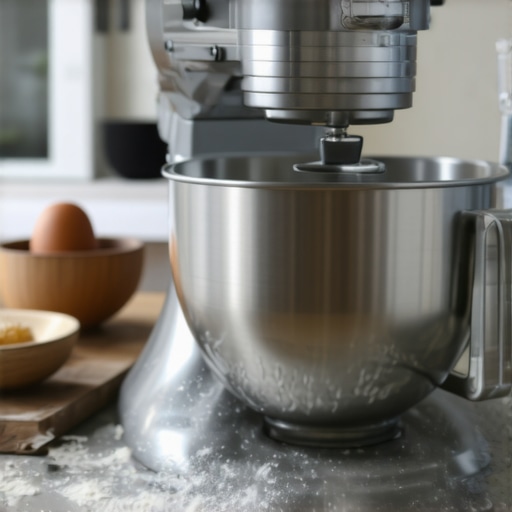
Why Your Stand Mixer Vibrates Too Much on High Speeds
Vibration in a high-end stand mixer is not merely an annoyance; it is a symptom of mechanical disharmony that threatens the longevity of your investment and the integrity of your luxury kitchen surfaces. After fifteen years of diagnosing gear-train failures and structural fatigue in premium cookware and appliances, I have identified a hard truth: most users treat high-speed settings as a default rather than a specialized tool. When a machine housing starts to dance across a granite slab, you are witnessing the limits of centrifugal force battling against the internal tolerances of the transmission. If you ignore this, you risk shearing the sacrificial nylon gears or, worse, causing micro-cracking in the motor housing. It is a costly error born from a lack of technical oversight.
Mechanical Resonance and Gear Lash
Every motor has a resonance frequency where internal oscillations amplify rather than cancel out. In the world of air fryers, stand mixers, and espresso machines, we often see manufacturers prioritize torque over dampening. When you crank a mixer to speed 10 with a heavy dough, the planetary action—the way the beater rotates one way while the shaft moves another—creates a massive cantilevered load. This load shifts the center of gravity. If the gear lash, which is the space between meshing teeth, is even slightly out of spec, the result is a rhythmic thudding. This is specifically why heavy duty stand mixers use dc motors instead of ac, as DC allows for smoother acceleration and less inherent vibration under load. Without that electronic speed control, the machine fights its own inertia, leading to that violent shaking that scares most home bakers.
The Countertop Friction Failure
The surface beneath your machine matters as much as the motor inside it. Polished marble or sealed quartz offers zero lateral resistance. I have seen five-quart mixers nearly launch themselves off a kitchen island because the rubber feet had become slick with aerosolized cooking oils or flour dust. It is a common scene in high-traffic kitchens. If the feet cannot grip, the kinetic energy of the motor has nowhere to go but out through the chassis. You must ensure the base is clean and the surface is dry. Sometimes, the fix is as simple as learning how to stop your stand mixer from vibrating off the counter through proper placement and surface maintenance. The physical weight of the machine should be an anchor, not a pendulum.
Planetary Timing and Attachment Misalignment
The scent of hot lithium grease is the first warning sign that your planetary head is misaligned. This happens when the beater hits the bottom of the bowl too hard, sending a shockwave back up the main shaft. This creates a vertical oscillation that high speeds only worsen. Many owners fail to realize that there is a specific calibration point for the clearance between the attachment and the bowl. If this is off by even a millimeter, the resistance changes with every rotation. You can usually resolve this by finding the screw adjustment that stops your mixer from hitting the bowl. If you feel the head of the mixer bouncing, the hinge pin has likely worked its way loose. That is a mechanical failure waiting to happen.
Heat Dissipation and Motor Fatigue
High speeds generate immense friction. In a luxury kitchen environment where we value quiet performance, heat is the enemy. When the internal temperature of the motor rises, the lubricants thin out, and the dampening properties of the grease diminish. The result? A louder, more violent vibration. If your machine is getting too hot to touch, the internal thermal expansion is changing the fit of the bearings. This isn’t just about speed; it’s about the duration of use. Professional-grade equipment is rated for specific duty cycles, yet home chefs often run them like industrial centrifuges. The mechanical strain is immense.
The Industry Shift Toward Noise Abatement
Over the next 24 months, we expect a massive shift in how the Association of Home Appliance Manufacturers (AHAM) and the American National Standards Institute (ANSI) categorize residential noise and vibration. Newer regulations are likely to force manufacturers to integrate active vibration dampening, similar to what we see in high-end laundry machines. For the local luxury homeowner, this means older, purely mechanical models might lose resale value compared to newer, sensor-driven units. We are already seeing smart sensors in espresso machines and premium cookware that alert users to imbalances before they cause damage. Keeping your current machine in peak condition is a hedge against this technological turnover.
Executive Verdict on Mixer Stability
If your mixer is shaking, stop the motor immediately. Check the bowl-clamping mechanism first. If the bowl is secure and the feet are clean, look at the hinge pin and the height adjustment. My recommendation is a ‘Hold’ on replacing your machine if you can fix these mechanical alignments. However, if the vibration is accompanied by a grinding sound, ‘Sell’ or scrap it before the motor burns out. To maintain a quiet kitchen, you might want to investigate how to quiet a noisy stand mixer without voiding the warranty. Strategy: Use high speeds only for light aerating tasks (whisking egg whites or cream). For everything else, torque is your friend, not velocity.
Vibration Management Questions
Is some vibration normal at high speeds?
Yes, a slight tremor is expected due to the planetary gear movement, but the base should never move across the counter.
Does the type of bowl affect vibration?
Absolutely. Glass bowls are heavier and shift the center of gravity differently than stainless steel, often requiring slower speeds for the same stability.
Can a loose hinge pin cause shaking?
It is the most common cause of head-bounce. If the pin isn’t flush with the housing, the entire upper assembly will oscillate at high RPMs.
Why does my mixer vibrate more with the dough hook?
The dough hook creates an asymmetrical load. You should never use the dough hook on high speeds; it is designed for low-speed, high-torque kneading only.