
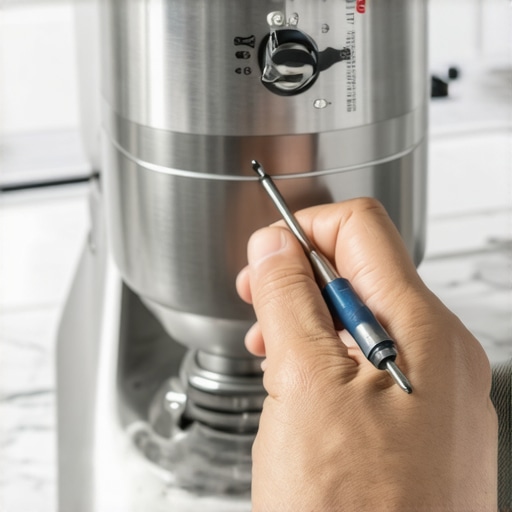
How to Stop Your Stand Mixer from Making a Clicking Sound
That rhythmic, metallic snap echoing through your luxury kitchen isn’t a personality trait of your appliance; it is a mechanical distress signal. After fifteen years of diagnosing high-end kitchen hardware and seeing the internal carnage of neglected transmissions, I can tell you that ignoring a click is an expensive gamble. Most home chefs assume a bit of noise is par for the course when kneading heavy dough. They are wrong. A clicking sound indicates a breach in the precise tolerances required for planetary rotation. If you hear it, the clock is ticking on your gear teeth. The result? Avoidable failure. This is not about surface aesthetics. This is about the structural integrity of a machine that should last three decades, not three years.
The Engineering Reality of Gear Synchronization
To stop the noise, you must grasp why it exists. Inside the head of a premium stand mixer, a worm gear drives a follower gear, which in turn rotates the planetary assembly. This system relies on a ‘sacrificial’ gear—often made of high-strength nylon—to protect the motor from burning out if the attachment hits an obstruction. When this gear begins to strip, or when the grease migrates away from the contact points, the teeth lose their seat. This creates a gap. Every time the gears attempt to mesh under load, they slip and slam back into place. That slam is your clicking sound. Many users make the mistake of pushing their machines too hard, but often the issue is simply a loose planetary pin. This pin holds the attachment shaft in place. If it wanders even a millimeter, it strikes the internal housing with every revolution. Before you buy a new machine, check if you need to pick a stand mixer that won’t stall under the pressure of high-torque tasks, as persistent stalling often precedes mechanical misalignment.
Why Standard Maintenance Fails
Most DIY guides suggest ‘just add grease.’ That is amateur advice that leads to motor overheating. Over-packing a transmission with grease creates parasitic drag, forcing the motor to work harder and increasing the internal temperature. You need the right viscosity, specifically a food-grade Benalene 330 or equivalent. I have seen countless machines ruined because an owner used automotive grease that separated, leaking oil into the flour bowl. The smell of scorched lithium is a scent you don’t forget. If your machine is older, you might also be dealing with a loose speed control lever. While it seems unrelated, a loose stand mixer speed control lever can cause the motor to hunt for the correct RPM, creating a jittery torque delivery that manifests as a click in the planetary housing. Proper maintenance requires a full degrease, inspection of the teeth for ‘pitting,’ and a precise re-application of lubricant only where the friction occurs.
[IMAGE_PLACEHOLDER]
The Risk of Mechanical Fatigue
The messy reality of kitchen appliance repair is that clicking often hides a deeper ‘operational risk.’ If the click is accompanied by excessive movement in the mixer head, you are looking at a hinge pin failure. The weight of the industrial-grade steel and the force of the motor create massive leverage. If the neck screw is loose, the entire head bounces. This ruins the ‘dime test’—the industry standard for bowl-to-beater clearance. When the beater hits the bottom of the bowl, the shock travels directly back into the transmission. This is why vibration on high speeds is a precursor to gear failure. You aren’t just hearing a noise; you are hearing the metal-on-metal impact of a beater being driven into a stainless steel basin. According to the Association of Home Appliance Manufacturers (AHAM), mechanical fatigue is the primary cause of early retirement for countertop appliances. If you feel the machine getting hot, you are already past the point of simple adjustment; read more on why stand mixers get too hot to understand the thermal limits of your hardware.
Market Corrections and the Future of Small Appliances
Looking at the next 24 months, I anticipate a significant shift toward DC motors in the premium segment. Unlike traditional AC motors, DC motors offer higher torque at lower speeds and are inherently quieter. However, they use sophisticated control boards that are sensitive to voltage spikes. The ‘clicking’ we see in newer digital models is often an electronic relay firing repeatedly because of a sensor mismatch. As global supply chains fluctuate, the quality of cast gears is also becoming variable. We are seeing a return to ‘serviceable engineering’ where brands allow users to replace the worm gear without voiding the entire warranty. This is a win for the consumer who values durability over disposability. If you are investing in a luxury kitchen in 2025, you must prioritize machines with all-metal gear trains, but remember that even metal needs alignment.
The Executive Verdict
If your mixer clicks, do not finish the batch of dough. Stop immediately. If the click is rhythmic and fast, it is a gear tooth. If it is slow and corresponds to the planetary rotation, it is the planetary pin or the bowl height. My recommendation is a ‘Buy’ on repair for any machine over the $400 mark. These units are built to be rebuilt. If you are in a situation where the clicking is accompanied by the smell of ozone, the motor is failing—sell it for parts and upgrade. Strategic maintenance today saves a total loss tomorrow. Tighten the neck screw, verify the beater height, and use only enough grease to coat the teeth. That is the only way to protect your investment.
Frequently Asked Questions
Is it safe to use a clicking stand mixer?
No. While it likely won’t explode, the clicking indicates that metal or nylon shards are being shaved off the gears. These particles can eventually work their way out of the transmission housing and, in extreme cases of seal failure, contaminate your food.
Can I fix the clicking by just changing the grease?
Only if the clicking is caused by ‘dry’ gears. If the teeth are already stripped or the planetary pin is bent, new grease is just a temporary bandage on a structural wound. You must inspect the hardware first.
Why does my mixer only click when making bread?
Bread dough provides high resistance, which puts maximum torque on the gears. This force pushes the gears to the very edge of their alignment. If they are slightly loose, the load ‘opens’ the gap, causing them to slip and click. Under light loads like cake batter, the gap stays closed.
How much does it cost to fix a clicking gear?
A replacement worm gear usually costs between $15 and $30. If you do the labor yourself, it is an inexpensive fix. A professional repair shop may charge $100 to $150, which is still significantly cheaper than a new premium mixer.