
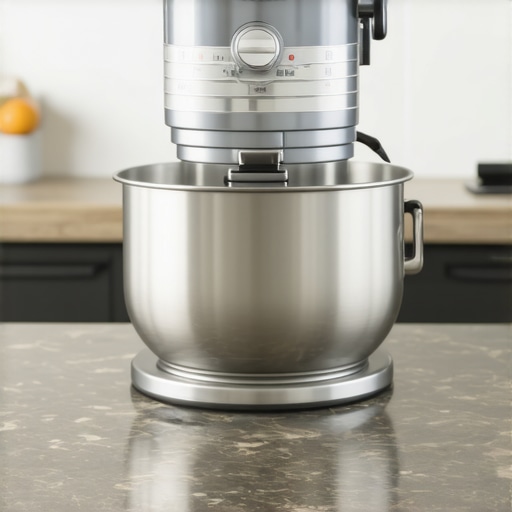
How to Stop Your Stand Mixer from Creeping Across Granite Counters
Place a thirty-pound cast-iron mixer spinning at high speeds on a highly polished igneous rock surface, and physics will eventually demand a tax. After managing premium kitchen appliance integrations and custom installations for over fifteen years, I have seen five-thousand-dollar custom stone islands ruined because an unattended high-wattage mixer shook itself right off the edge. This is not just an annoying kitchen quirk. It is a severe structural risk to both your luxury appliances and your expensive stonework.
When you are preparing dense artisan breads, the physical forces at play are immense. The motor operates under intense resistance, transferring energy downward. On a sealed, ultra-smooth granite surface, there is almost zero coefficient of friction to resist this lateral kinetic energy. The result? A slow, dangerous migration toward the counter edge. If your machine walks, you are not just risking a dropped mixer; you risk chipping your polished granite edges. To understand this dynamic better, it is helpful to look at why your stand mixer walks across the counter during bread prep, which explains the mechanical oscillation behind this exact phenomenon.
The Mechanical Reality of Planetary Action
To stop the movement, we must understand the mechanical forces involved. Planetary mixing action does not just rotate the attachment; it orbits the entire shaft around the bowl. This dual-axis movement creates asymmetric torque. When kneading high-hydration doughs, this torque translates into violent lateral thrusts. If the rubber feet on the bottom of your appliance are worn, hardened, or coated in a fine layer of flour dust, they lose their grip. They slide on the microscopic imperfections of the granite sealing agent.
Many homeowners try to solve this by placing a thick silicone mat under the machine. This is a partial fix that often introduces secondary problems. Thick mats allow too much vertical oscillation, which can cause the internal gears to wear out prematurely. The machine must remain relatively rigid. A dense, low-profile gripping pad is far superior because it dampens high-frequency vibrations without allowing the housing to pitch back and forth. For those struggling with internal heat buildup during these heavy tasks, understanding why your stand mixer is getting hot during bread kneading can help you balance structural stability with motor longevity.
The Mechanical Failure Points
What breaks when you ignore a creeping mixer? First, the planetary gear system takes the brunt of the abuse. If the mixer is vibrating excessively because it is sitting on an uneven or slippery surface, the internal shafts can fall out of alignment. You will hear a metallic grinding sound, followed by grease dripping into your mixing bowl. According to the National Kitchen & Bath Association (NKBA), appliance stability is a primary factor in preventing premature motor failure and countertop chipping. If the machine falls, the structural damage to your granite edge can cost thousands to professionally polish out and repair.
Furthermore, an unstable machine puts massive stress on the hinge pin of tilt-head models. Over time, the lock lever will fail to hold the motor head securely in place. If you are experiencing this issue, learning how to fix a loose stand mixer hinge in ten minutes is a straightforward way to restore mechanical integrity before a major accident occurs.
Future Proofing the Luxury Prep Station
Looking ahead to the next 12 to 24 months, high-end kitchen design is moving toward dedicated, integrated prep zones. Homeowners are moving away from multi-purpose open counters in favor of recessed appliance stations. These dedicated zones feature integrated clamping systems or recessed silicone landing pads flush-mounted directly into the stone. By creating a physical recess, designers are eliminating the possibility of appliance migration entirely.
Additionally, smart appliances are beginning to integrate accelerometer sensors. These sensors detect abnormal lateral movement and automatically throttle the motor speed if the machine begins to walk. Until these smart systems are standard in every high-end home, physical stabilization remains the owner’s responsibility.
The Executive Verdict
If you own a heavy stand mixer and polished granite countertops, do not rely on cheap towel tricks or bulky rubber trays. Invest in a dedicated, ultra-low-profile, non-slip neoprene stabilization mat. Ensure the rubber feet of your mixer are thoroughly cleaned with isopropyl alcohol once a month to remove grease and flour residue. If your mixer still vibrates excessively even on a stable surface, you should immediately check how to stop your stand mixer from vibrating on high speed to calibrate your machine’s balance.
Frequently Asked Questions
Q: Can I use a wooden cutting board as a base to stop the sliding?
A: Only if the wooden board itself has high-friction rubber feet. Placing a heavy mixer on a bare wooden board will often cause both the board and the mixer to slide together across the granite.
Q: Why does my mixer only creep when making bread?
A: Bread dough has high elasticity and density, which creates massive physical resistance against the dough hook. This resistance translates into high lateral torque, whereas lighter tasks like whipping cream create almost no lateral force.
Q: Will cleaning my granite counters with polish make the creeping worse?
A: Yes. Many stone polishes contain synthetic waxes or silicones that reduce surface friction. If you polish your counters, wipe the specific area where your mixer sits with a damp microfiber cloth to remove the slippery residue.