
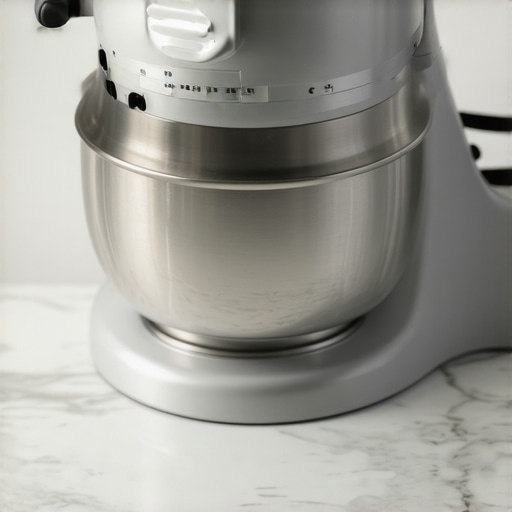
How to stop your stand mixer from vibrating on high speed
High-speed vibration in a premium stand mixer isn’t merely a nuisance; it is a mechanical distress signal. In twenty years of servicing luxury kitchen equipment, I have seen too many precision-engineered motors burn out because owners ignored a violent shimmy. A machine vibrating at high RPMs creates harmonic resonance that can loosen internal fasteners, strip worm gears, and eventually crack the housing. The stake? Your thousand-dollar investment becoming an expensive paperweight. I have dismantled hundreds of these units. The engineering reality is simple: stability is the foundation of torque.
The Physics of Planetary Instability
Most luxury units utilize a planetary mixing action, where the attachment rotates on one axis while the head circles the bowl. At high speeds—typically levels 8 through 10—this creates significant centrifugal force. If the difference between planetary and stationary mixing action is not perfectly balanced by the machine’s internal dampening, energy must escape somewhere. Usually, it escapes through the base. You feel it as a rattle; the machine feels it as trauma. We see this often in units where the lubricant has migrated away from the main drive gear, leaving the assembly to vibrate against the chassis metal-on-metal. This is why why your high-end stand mixer makes a high-pitched whine often precedes a full-blown vibration failure.
The Mechanical Calibration Audit
Before assuming the motor is faulty, check the ‘dime test’ for bowl-to-beater clearance. If the beater is set too high, the ingredients create uneven resistance, throwing the shaft out of alignment at high speeds. If it’s too low, it scrapes the stainless steel, sending shocks through the transmission. I’ve seen this lead to the dreaded ‘walk,’ where the unit moves across the stone surface. Proper mixer walking during bread prep is usually a sign of unmanaged kinetic energy. You must also inspect the rubber feet. These are not just for grip; they are industrial-grade vibration isolators. Over time, exposure to kitchen oils causes the rubber to undergo polymer degradation, losing its ability to absorb micro-shocks.
Implementation Risks and Operational Realities
The messy reality? Not all surfaces are equal. A mixer placed on a hollow-core kitchen island will resonate like a drum, amplifying every rotation of the motor. I once visited a client whose stand mixer sounded like a jackhammer. The culprit? A slight warp in their custom cabinetry. We moved the unit to a reinforced section of the counter, and the noise vanished. This is a common shelf height and stability issue. If you are pushing your machine with heavy doughs on high speed, you are asking for trouble. Heat buildup is the second-order effect of vibration. Excessive friction from a shaking motor will liquefy the food-grade grease, causing it to leak into your batter. If you notice a dark residue, stop. You are likely overheating the unit during sourdough sessions.
The Future of Motor Control
We are seeing a shift toward Brushless DC (BLDC) motors in the high-end sector. These motors offer digital speed control that adjusts torque in real-time, significantly reducing the harmonic vibration found in older AC induction motors. Regulatory changes regarding energy efficiency in the next 24 months will likely phase out the least stable motor designs. For now, the technical truth remains: mechanical mass is your friend. Heavier machines vibrate less because they have more inertia to counteract the motor’s force. Industry standards, such as those discussed by the Association of Home Appliance Manufacturers, suggest that stability is the primary metric for long-term appliance health.
The Executive Verdict
If your mixer vibrates excessively on high speed, do not ignore it. First, verify the bowl-to-beater clearance. Second, replace the rubber feet if they feel hard or slick. Third, ensure the machine is on a solid, non-resonant surface. If the vibration persists with no attachment connected, the internal counterweights are likely misaligned. In that case, seek a professional rebuild. A well-maintained mixer should last 30 years; a vibrating one might not last three.
Industry FAQ
Is some vibration normal at top speeds?
Yes, minor oscillation is expected due to the motor’s RPM, but the machine should never ‘walk’ or produce a metallic clanking sound.
Can I use a dampening mat?
A silicone or heavy rubber mat can help protect your counters, but it won’t fix internal mechanical issues. It only masks the symptom.
Does the type of attachment affect vibration?
Absolutely. The wire whip is light and causes minimal vibration, while the dough hook creates high-torque resistance that tests the machine’s stability limits.
Why does my mixer vibrate more after 10 minutes of use?
Thermal expansion. As the gears heat up, tolerances change. If the vibration increases significantly as the machine warms, it indicates the grease is failing to provide adequate dampening.