
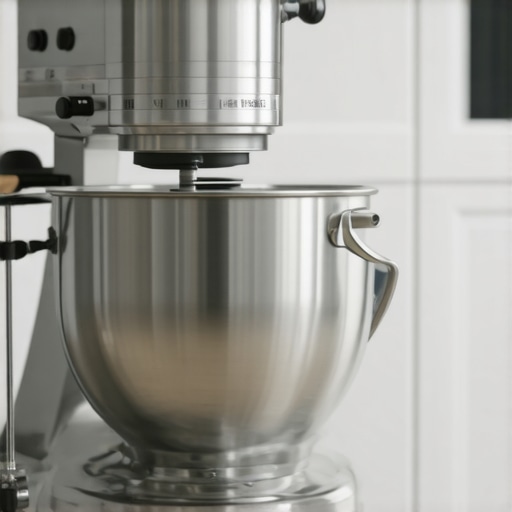
A 30-pound professional stand mixer perched on a flimsy, hollow-core cart is a recipe for catastrophic equipment failure. After fifteen years of diagnosing why expensive machinery ends up in the scrap heap, I have seen the same error repeated: homeowners treat a high-torque appliance like a stationary lamp. It is not. When that motor engages with eight cups of heavy flour, the energy has to go somewhere. If your cart lacks the structural integrity to dampen those vibrations, the energy translates into lateral movement, potential tipping, and inevitable gear-stripping. Putting a luxury appliance on a sub-standard mobile platform is an expensive gamble you will eventually lose.
How to Balance a Heavy Stand Mixer on a Movable Cart
Balance is a function of the center of gravity and the dampening coefficient of the mounting surface. To keep a heavy mixer from migrating, you must lower the center of gravity. Most retail carts are top-heavy by design. To counteract this, the bottom shelf needs a significant counterweight—think cast iron cookware or heavy stones—to ensure the tipping point remains well below the mixer’s base. You also need to address the interface between the mixer feet and the cart top. Standard melamine surfaces are too slick. I recommend a recessed industrial-grade rubber matting that creates a high-friction pocket. This doesn’t just stop the ‘walk’; it absorbs the high-frequency micro-shudders that loosen internal screws over time. You should also understand how to stop your stand mixer from vibrating on high speed to prevent long-term damage to the motor housing.
Structural Physics of Mobile Bases
Static load capacity is a vanity metric. What matters is the dynamic load—the force exerted when the mixer is at peak oscillation. Most ‘luxury’ carts use aesthetic casters that fail under torque. You need industrial-grade, dual-locking casters. These do not just lock the wheel; they lock the swivel axis. A wheel that can still pivot while ‘locked’ will allow the cart to shimmy, creating a resonance loop that can lead to a literal walk across your kitchen. I have seen mixers dive off carts because of a 2mm swivel gap. It’s a violent, expensive sound. The clatter of metal on tile. The snap of a planetary gear. This is why many professional setups are moving toward the cabinet depth secret for storing large appliances rather than relying on unstable rolling platforms.
The Engineering Reality
The frame of the cart must be welded or secured with high-tensile bolts. Cheap cam-lock furniture will vibrate itself to pieces within six months of heavy bread kneading. Think about the energy transfer. When the dough hook hits a dry pocket of flour, the torque spike is immense. If the cart frame has even a fraction of a millimeter of ‘give,’ it acts like a spring, amplifying the vibration rather than grounding it. This is specifically problematic when your stand mixer walks across the counter during bread prep. The solution is often adding a 3/4-inch plywood or butcher block substrate to the top of the cart to increase the mass of the mounting plane. According to the Association of Home Appliance Manufacturers (AHAM), stability is a primary safety metric for heavy-duty appliances, yet many third-party carts ignore these specifications entirely.
Implementation Risks and The Smell of Failure
I once walked into a client’s kitchen to the smell of ozone and burning grease. They had mounted a pro-sumer mixer on a beautiful, spindly brass cart. The cart wasn’t just shaking; it was acting as a resonator. The constant vibration had caused the motor brushes to wear unevenly, and the oil from the gearbox had started to weep through the gaskets. You could feel the heat radiating off the cart’s metal legs. It was a total loss. The failure wasn’t the mixer; it was the physics of the support. If you hear a rhythmic ‘clack’ during a mix, your cart is failing. That sound is the metal fatigue of the cart’s joints. If you find your stand mixer motor struggles with bread dough, it might not be the motor at all—it could be the energy loss through an unstable base making the motor work twice as hard to maintain RPM.
Market Corrections and Future Tech
The industry is shifting. We are seeing a move away from the ‘island on wheels’ toward heavy-duty, dampening-integrated workstations. In the next 24 months, expect to see more carts featuring hydraulic stabilizers that drop the cart onto fixed rubber feet once it reaches its destination. These systems decouple the wheels from the frame during operation. For now, the best strategy is over-engineering. If your mixer weighs 30 pounds, your cart should be rated for at least 200 pounds of static weight to handle the dynamic forces involved. The National Kitchen & Bath Association (NKBA) standards for professional-grade residential kitchens are increasingly emphasizing dedicated, high-mass zones for heavy-duty prep for this very reason.
The Executive Verdict
If you cannot afford a heavy-duty, industrial-grade cart with 360-degree locking casters and a solid wood or metal top, do not put your mixer on wheels. A cheap cart is a liability, not a convenience. For those in high-volume baking environments, the only logical path is a cart with a low center of gravity and a high-mass top. My recommendation? Buy an industrial stainless steel prep table and retro-fit it with premium casters. It’s not as ‘pretty’ as a luxury kitchen cart, but it won’t drop your $800 mixer on the floor. Strategy: Fix the base, ground the energy, and protect the motor. Anything less is just waiting for a crash.
Frequently Asked Questions
Can I use a rug under the cart to stop it from moving?
No. A rug adds a layer of compression that actually increases the risk of the cart tipping. You want a hard, level surface and locking casters that make direct contact with the floor.
How do I know if my cart is too light?
If you can feel the cart vibrate by touching the legs while the mixer is on speed 4, it lacks the necessary mass to dampen the motor’s energy.
Are three-wheeled carts stable enough for mixers?
Absolutely not. Tripod bases have a significantly smaller stability triangle. For heavy-duty mixing, a four-point wide-stance base is the only safe configuration.