
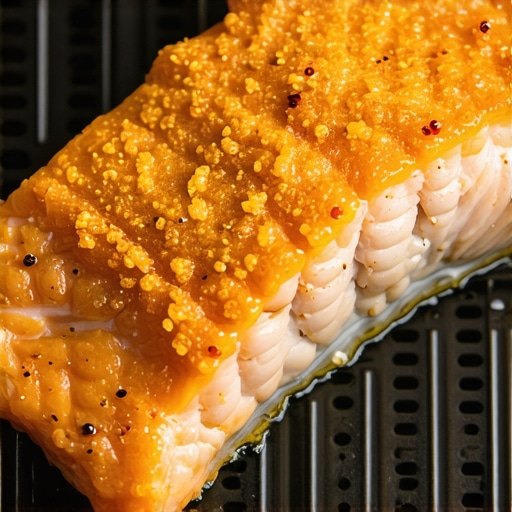
How to Achieve the Perfect Sear on Your Air Fryer Salmon Fillets
Most home cooks treat the air fryer like a simplified microwave that happens to blow air. This fundamental misunderstanding of high-velocity convection is why your salmon comes out looking gray and uninspired rather than sporting a glass-shatter crisp skin. After 15 years in the premium kitchen industry, I have seen every imaginable failure in thermal execution. The stake here is not just a ruined dinner; it is the degradation of high-quality ingredients. When you spend $40 a pound on King Salmon, failing to respect the Maillard reaction is a financial and culinary negligence that no luxury kitchen should permit. To get this right, you must ignore the ‘pre-set’ buttons and master the boundary layer of air surrounding the protein.
The Physics of Convection and Moisture Desiccation
Air fryers operate through intense thermal transfer. Unlike a traditional oven where air sits relatively stagnant, these machines utilize high-RPM fans to strip away the cool air pocket surrounding cold food. This is the fan speed secret that dictates success or failure. If the surface of your salmon is even slightly damp, the energy produced by the heating element is wasted on the latent heat of evaporation. Instead of searing, you are steaming. To fix this, you must physically desiccate the skin. Use heavy-duty paper towels. Press hard. Then, leave it uncovered in the refrigerator for 30 minutes. This creates a pellicle, a tacky surface that catches the heat and transforms it into a golden crust. This isn’t a suggestion; it is a thermal requirement.
The Thermal Mass Reality
A common mistake is placing cold fish into a cold basket. Even the most advanced air fryers have limited thermal mass compared to a heavy cast iron skillet. You must preheat the unit for at least eight minutes at its highest setting. You want the basket itself to act as a conductive heat source the moment the fish makes contact. The result? Immediate protein denaturation. If you skip this, the internal temperature of the salmon will rise toward its 145-degree limit (as per USDA food safety standards) before the exterior has even begun to caramelize. You end up with overcooked, chalky fish. The technical truth is that your air fryer is a radiation and convection hybrid; use both to your advantage.
Managing Operational Risks and Smoke Points
I have seen luxury kitchens covered in a fine film of polymerized grease because a homeowner used the wrong fat. Extra virgin olive oil is for finishing, not for 400-degree high-velocity air. It breaks down, smokes, and leaves a bitter residue. Use avocado oil or clarified butter. These have smoke points that can withstand the intense environment near the heating element. Also, consider the cleanliness of your machine. If the coils are coated in old grease, your heat distribution is compromised. You must regularly deep clean the interior heating element to maintain thermal efficiency. I once had a client complain about uneven searing, only to find three months of bacon grease insulating her heating coils. It is a fire hazard and a culinary disaster.
The Market Shift Toward Precision Thermal Control
We are entering an era where ‘dumb’ air fryers are being phased out in favor of units with PID controllers and multi-stage programming. In the next 12 to 24 months, expect to see machines that can modulate fan speed mid-cycle to optimize the crust-to-crumb ratio. However, these electronic aids are no substitute for an understanding of thermodynamics. The second-order effect of this tech surge is a loss of fundamental cooking skills. Don’t be the person who relies on a sensor to tell you when a fillet is done. Use a calibrated instant-read thermometer. Pull the salmon at 125 degrees for a medium-rare finish after carry-over cooking. The engineering is there to assist you, not replace your judgment.
The Executive Verdict
If you want a restaurant-grade sear, stop using the basket as a container and start using it as a specialized heat exchanger. If you are working with fatty salmon like Sockeye or King, go high and fast. If you are working with leaner Coho, lower the temperature slightly but increase the preheat time. Do not use aerosol sprays; the propellants will ruin the non-stick coating of your premium basket over time. Instead, lightly brush the oil directly onto the protein. Follow these steps and you will move from ‘making dinner’ to ‘executing a technical process.’
Common Engineering Hurdles in Salmon Preparation
Does the skin always need to be on?
Yes. The skin acts as an insulator for the delicate flesh and provides the structural integrity needed for a high-heat sear. Without it, the salmon will likely fragment and dry out.
Why does my salmon smell ‘fishy’ in the air fryer?
This is usually caused by trimethylamine (TMA) release. It happens when the fish is not fresh or when it is cooked too slowly. High-heat, fast searing locks in flavors and minimizes odor dispersal.
Can I use parchment paper?
Only if it is perforated. Blocking the airflow defeats the purpose of the convection fan and results in a soggy bottom. For the best sear, place the fish directly on the preheated metal rack.