
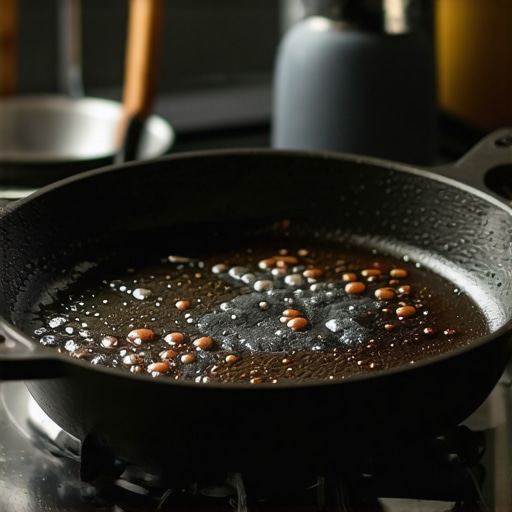
The Thermal Mass Secret: Why Heavy Pans Actually Sear Better
The weight of a premium skillet is frequently mistaken for mere aesthetic heft or a signal of brand status. It is neither. Thermal mass is the thermodynamic gatekeeper of the Maillard reaction. After fifteen years in the luxury kitchen equipment industry, I have watched countless home cooks blame their technique or their ingredient sourcing when the failure was actually a matter of basic physics. If your cookware lacks the density to store energy, your sear is doomed before the flame is even lit. Choosing high-performance premium cookware is a strategic investment in heat retention.
The Thermodynamic Reality of Surface Contact
When a cold piece of protein—say, a dry-aged ribeye—hits a hot pan, a massive energy transfer occurs instantly. This is thermal shock. Thin pans suffer from what I call ‘thermal collapse.’ The surface temperature drops so precipitously that the moisture in the meat cannot evaporate fast enough to sear; instead, it boils in its own juices. You end up with that grey, unappealing texture rather than a mahogany crust. High-mass pans, particularly those utilizing 5-ply construction, act as a battery for heat. They possess the kinetic reserve to maintain high temperatures despite the introduction of cold mass. This is exactly why 5-ply cladding matters more than the logo etched into the handle. Aluminum and copper cores provide the conductivity, but the sheer volume of metal provides the stability.
The Engineering Reality of Heat Distribution
Uniformity is the enemy of the cheap pan. On a high-BTU gas range or a precision induction hob, a thin pan will develop hotspots directly above the heating element. The result? Scorched garlic in the center and raw onions at the edges. A heavy pan utilizes its thickness to dissipate energy laterally. This lateral movement ensures that the entire cooking surface acts as a singular, consistent heat source. In a luxury kitchen, where appliances like heavy bottomed pots are standard, the synergy between high-wattage output and pan density is what separates professional results from domestic frustration. We are talking about specific heat capacity—the amount of heat per unit mass required to raise the temperature by one degree. Carbon steel and cast iron excel here, though 5-ply stainless remains the versatile king for acidic sauces.
Why Standard Methods Fail in High-End Environments
I recently visited a client who had just installed a $15,000 induction suite but complained that her pan-fried fish always stuck. The culprit? Lightweight, ‘modern’ non-stick pans. These pans heat up fast—too fast—and have zero stay-power. The moment the fish touched the surface, the pan cooled, the proteins bonded to the coating, and the sear failed. I’ve seen this ‘operational risk’ play out in hundreds of homes. People buy for speed, but they sacrifice the ‘recovery time’ of the metal. If you want that crunch, you need the weight. The clank of a 3mm copper core pan hitting a stone countertop isn’t just noise; it’s the sound of a tool that can handle a 500-degree environment without flinching. This is the same principle applied to why heavy bottomed pots prevent scorched sauces; they insulate the delicate sugars from the raw aggression of the burner.
Market Corrections and Future Equipment Trends
The industry is shifting toward precision. Over the next 24 months, we expect to see more integration between the cooktop and the vessel. Sensors are becoming more common, but no sensor can compensate for a lack of material. Regulatory changes regarding PFOAs are also pushing consumers back toward ‘legacy’ materials like carbon steel and high-density stainless. The smart money is moving away from disposable, thin-gauge sets and toward individual, high-mass pieces that offer a lifetime of service. This isn’t just a trend; it’s a return to engineering sanity. Modern disruptors are focusing on ‘smart’ cladding, but the fundamental need for mass remains unchanged. A 12-inch skillet should feel substantial. If it feels like a toy, it will cook like one.
Executive Verdict on Cookware Investment
If you are operating a high-performance kitchen, my recommendation is a ‘Buy’ on high-gauge carbon steel for searing and 5-ply stainless for general utility. Sell your thin, stamped aluminum sets immediately; they are hindering your ROI on quality ingredients. Prioritize wall thickness and handle rivets over flashy exterior finishes. The goal is thermal equilibrium. When the pan stays hot, the food stays perfect. It is as simple and as difficult as that.
Frequently Asked Questions
Does a heavier pan take longer to preheat?
Yes. Because it has more mass, it requires more energy to reach the target temperature. However, once it gets there, it is much harder to cool down, which is the key to a perfect sear.
Is cast iron better than 5-ply stainless?
Cast iron has higher thermal mass but lower conductivity. It holds heat longer but spreads it less evenly. 5-ply is often better for delicate items that require precise control, while cast iron is the ‘sledgehammer’ for steaks.
Why does my heavy pan still warp?
Warping usually occurs from thermal shock—running a hot pan under cold water. Even a heavy pan can’t fight physics if the molecular structure is forced to contract too quickly.
Are heavy pans compatible with all cooktops?
Generally, yes. However, on glass-top induction or electric ranges, you must ensure the pan has a perfectly flat bottom to maximize surface contact and prevent scratching.