
How to Spot the Signs of a Failing Espresso Machine Pump
A dead pump is the silent killer of the morning ritual. I have spent the last fifteen years elbow-deep in the guts of high-end Italian machines, and I can tell you this: the pump doesn’t just ‘stop.’ It screams, it stutters, and it fails in stages that most owners ignore until their luxury investment becomes a very heavy paperweight. Pressure is the lifeblood of extraction. Without the mechanical force to push water through a compressed puck at a consistent nine bars, you aren’t making espresso; you’re making expensive, lukewarm tea. Neglecting the early warning signs leads to catastrophic electrical shorts. The pump motor works harder as internal scale builds up, drawing more current than the control board was designed to handle. The result? Total system failure.
The Engineering Reality of Pressure Loss
Espresso machines generally rely on one of two technologies: vibratory pumps or rotary vane pumps. Vibratory pumps use a piston and a spring, oscillating at sixty times per second. They are simple, loud, and prone to mechanical fatigue. Rotary pumps are the industry gold standard, using a motor-driven set of vanes to create immediate, consistent pressure. When these components begin to degrade, the first sign is rarely a total blackout. Instead, you see a lack of consistency. If you notice why your espresso shot flows too fast regardless of grind, your pump might be failing to maintain the necessary resistance against the puck. The bypass valve, intended to regulate pressure, may be stuck open, bleeding off the force needed for a proper extraction. This is an engineering reality: mechanical parts have a finite cycle life. According to the Specialty Coffee Association, maintaining precise pressure is a fundamental requirement for the technical definition of espresso.
The Mechanics of Cavitation and Heat Soak
Inside the machine, the pump faces two primary enemies: air and heat. Cavitation occurs when vapor bubbles form in the water due to pressure drops, leading to microscopic ‘explosions’ that pit the internal metal surfaces of the pump. You will hear this as a sharp, rattling sound that differs from the usual hum. If your machine is older, you might also experience how to fix the steam pressure drop on a manual machine, which often points back to a failing pump’s inability to refill the boiler while under load. Heat soak is the second silent killer. In many compact luxury kitchen setups, the pump is tucked too close to the boiler. Over years of operation, the plastic housing of a vibratory pump can warp, or the motor windings in a rotary unit can lose their insulation. The smell is unmistakable—a metallic, ozone-heavy scent that signals an impending electrical short. I have seen countless machines where the owner ignored a ‘lazy’ start-up, only to find the internal wiring scorched. This is why the voltage mistake that shortens your espresso machines lifespan is so dangerous; a struggling pump draws excessive amperage, heating the entire circuit.
Sensory Failure Markers and Tactical Diagnosis
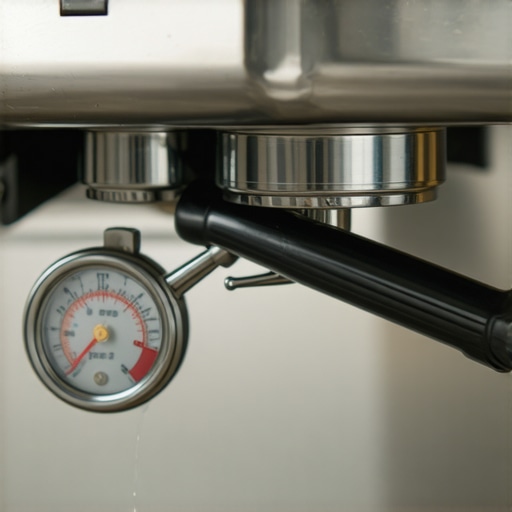
You need to use your senses. A healthy pump has a rhythmic, confident thrum. A failing one sounds hollow, like it is gasping for air. If you see the brew gauge fluttering like a nervous heartbeat, the internal check valve is likely failing. Sometimes, the issue is purely chemical. I’ve noticed that the reason your espresso tastes metallic after descaling is often because loosened lime scale has migrated directly into the pump’s intake, grinding against the precision-machined vanes. The weight of industrial-grade steel won’t save a pump from the abrasive reality of calcium carbonate. You should also check the discharge line. If there is a constant drip into the drip tray while the machine is idling, your pump’s expansion valve is likely shot, indicating it has been over-stressed for months. This isn’t just about the coffee; it is about the structural integrity of your plumbing. Standards set by ASTM International regarding fluid dynamics emphasize that pressure fluctuations in closed systems inevitably lead to component fatigue.
Market Corrections and Strategic Foresight
The industry is shifting. In the next 24 months, we will see a move away from traditional AC vibratory pumps toward brushless DC motors with integrated pressure sensors. These ‘smart pumps’ will be able to detect their own failure before the user ever tastes a bad shot. For the local luxury homeowner, this means older, purely mechanical machines will become more expensive to service as parts production shifts. The second-order effect? A surge in the value of ‘repairable’ heritage machines like the E61 groups. If you are sitting on a high-end manual machine, your pump is your most frequent point of failure, but also your easiest fix. Do not wait for the pump to seize. If your machine is more than five years old and has never had a pump swap, you are living on borrowed time.
The Executive Verdict
If your machine is exhibiting fluctuating pressure, increased noise levels, or a metallic smell, the pump is the primary suspect. My recommendation: Hold off on buying a new machine if the frame and boiler are sound, but Buy a high-quality replacement pump immediately. For vibratory machines, upgrade to a brass-output pump to avoid the cracking issues common with plastic threads. For rotary machines, ensure your water filtration is removing 99% of minerals to prevent vane scoring. If you are in a situation where the machine hums but no water flows, do not keep the power on—you will fry the control board. Pull the plug, check the intake filter, and prepare for a swap.
Frequently Asked Questions
Q: Can a clogged filter mimic a failing pump?
A: Yes. A calcium-clogged group head screen will restrict flow, making the pump sound strained. Always clean your screen before blaming the hardware.
Q: How long should a professional-grade pump last?
A: In a home environment, a vibratory pump lasts 5-7 years. A rotary pump, if fed filtered water, can easily go 10-15 years without a rebuild.
Q: Is a noisy pump always a sign of failure?
A: Not necessarily. Vibratory pumps are naturally loud. However, a change in the pitch or a new ‘rattle’ is a definitive warning sign of mechanical distress.
Q: Why does my pump work for the first shot but fail on the second?
A: This is usually thermal expansion. As the pump heats up, internal components expand. If they are already worn, they will seize or lose prime only once the machine is at operating temperature.