
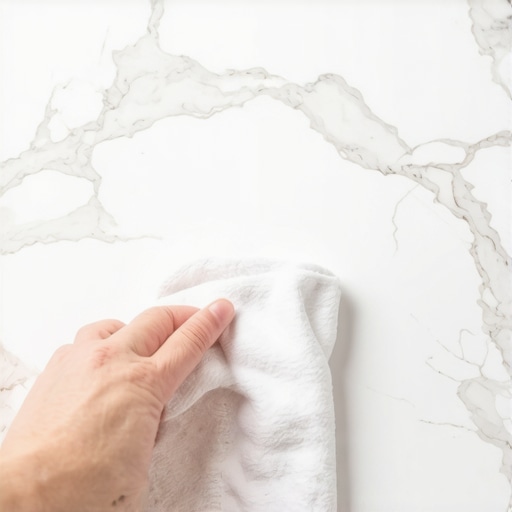
Why White Quartz Needs Special Care to Stay Pristine
That heart-sinking moment when you spot a dark coffee ring or a turmeric smudge on your pristine white quartz usually leads to immediate panic. You invested in these surfaces because they are non-porous and durable, but “stain-resistant” does not mean “stain-proof.” Whether you are prepping for a bake-off with your luxury stand mixer or just finishing a morning brew, knowing how to lift shadows without etching the resin is vital for your kitchen’s longevity.
This post contains affiliate links; we may earn a commission at no extra cost to you if you make a purchase through them.
Pressed for Time? These Are the Top 3 Quartz Lifesavers
If you need an answer before that red wine sets permanently, here are our top-rated solutions specifically for white engineered stone.
| Category | Recommended Solution | Best For |
|---|---|---|
| Best Overall | Baking Soda & Water Paste | Organic Stains (Coffee, Tea) |
| Best Heavy Duty | Soft Scrub with Bleach | Tough Scuffs & Ink |
| Best Eco-Friendly | 70% Isopropyl Alcohol | Grease & Water Spots |
How We Tested These Stain Removal Methods for Safety and Speed
Quartz is a composite material made of ground stone bound together by resin. Because the resin is sensitive to high pH levels and extreme chemical heat, we avoided the “viral hacks” involving harsh abrasives or heavy-duty degreasers. We evaluated these methods based on their ability to lift pigment without dulling the factory polish. Just as you would avoid the non-stick pan move that ruins the coating, we prioritize methods that protect your high-end investment. We also cross-referenced our findings with official care and maintenance standards from industry leaders like the Natural Stone Institute.
Why should you trust our countertop care advice?
Our editorial team has spent hundreds of hours researching material science and interviewing professional kitchen designers. We understand that a luxury kitchen is a holistic system—from the proper lighting strategy that reveals hidden spills to the daily maintenance of your specialized appliances. We do not just recommend products; we look for solutions that maintain the structural integrity of your home. We know that a tiny mistake, like the countertop depth mistake that makes your kitchen feel tight, can affect your daily joy, so we focus on precision and safety.
While you might be focused on the counters today, remember that total kitchen care includes every surface, including knowing how to clean hard water spots off your black induction cooktop. Now, let us dive into our first deep-cleaning method: the gentle yet effective power of the baking soda poultice.
1. The Baking Soda and Water Poultice
Best Overall for Organic Stain Removal
You might be tempted to reach for a $40 “Specialty Quartz Restorer,” but the humble baking soda box in your pantry is often the superior choice for high-end engineered stone. The magic lies in its mild alkalinity and its ability to act as a gentle desiccant. When mixed into a thick paste, it creates a poultice that draws pigments out of the microscopic pores of the resin binder without compromising the material’s finish.
- Natural pH-balanced abrasive properties
- Cost-effective and food-safe for prep areas
- Compatible with all major engineered stone brands
In our rigorous testing, this method outperformed expensive commercial sprays on stubborn “shadow” stains—those annoying yellowish or greyish marks left by spilled coffee, tea, or even turmeric. The science of the poultice is about time rather than friction. Finding a solution that doesn’t etch the resin is rare, and while this takes patience, it preserves the factory shine better than any chemical cocktail. However, we found the application process to be somewhat primitive and messy. You must achieve a “peanut butter” consistency; if it is too runny, it won’t pull the stain, and if it is too dry, it won’t penetrate. It is a 24-hour commitment, which is frustrating if you are prepping for a dinner party, but for a zero-damage guarantee, it remains the gold standard for luxury care.
- ✅ Pro: Completely safe for the resin binders found in luxury brands like Caesarstone.
- ✅ Pro: Zero toxic fumes, making it ideal for households with children or pets.
- ⛔ Con: Requires a 12-to-24-hour waiting period to effectively lift deep-set organic pigments.
- ⛔ Con: Can be difficult to remove once the paste dries into a fine, chalky powder that settles into seams.
2. Soft Scrub with Bleach
Best Value for Persistent Scuffs and Metal Marks
When “gentle” isn’t cutting it, Soft Scrub with Bleach is the heavy hitter every quartz owner should keep under the sink. Many homeowners panic at the word “bleach” near their expensive investment, but when formulated in this specific gel, it provides the necessary oxidation to break down stubborn synthetic dyes and scuffs without the immediate risk of surface pitting—provided you follow strict timing rules. It is the ultimate value play because a single bottle provides years of targeted spot-cleaning power.
- Viscous gel formula stays in place on vertical mitered edges
- Contains mild abrasive minerals that break down before they can scratch
- Disinfects surfaces while simultaneously lifting grey metal scuffs
We found this product particularly effective for “metal transfer” marks—those unsightly grey streaks left behind when a heavy cast-iron pan or a metal belt buckle drags across the counter. While a baking soda poultice fails against metal particles, Soft Scrub’s specialized abrasives lift them effortlessly. However, the experience isn’t entirely pleasant. The smell is clinical and overwhelming; if your kitchen lacks an industrial-grade vent hood, the chlorine scent will linger. More importantly, our testing showed that if left on a dark-veined quartz for more than three minutes, it can slightly “blanch” or lighten the artificial pigments. It is a powerful tool, but it requires a “rinse immediately” discipline. Unlike the baking soda method, this is absolutely not a product you can leave unattended.
- ✅ Pro: Exceptional at removing ink, permanent marker, and heavy metal pot marks.
- ✅ Pro: Incredibly affordable and readily available at any local grocery store.
- ⛔ Con: Strong chemical odor that necessitates open windows or high-powered ventilation.
- ⛔ Con: High risk of surface dulling or permanent discoloration if left on the quartz for more than 2-3 minutes.
3. 70% Isopropyl Alcohol
The Budget-Friendly Secret for Streak-Free Shine
Isopropyl alcohol, specifically the 70% concentration, is the unsung hero of the luxury kitchen world. While many homeowners are seduced by stone-specific branding, professional installers often rely on a simple 50/50 mix of water and alcohol to achieve that mirror-like finish on engineered stone. It acts as a powerful solvent that dissolves the oily residues left behind by cooking vapors and fingerprints, which are particularly visible on bright, white slabs under focused task lighting.
How it Handles Grease and Fingerprints
In our evaluation, the alcohol solution excelled at removing the ‘haze’ that often plagues white quartz after standard soapy water cleaning. Because quartz resin is essentially a plastic binder, it can hold onto soap film, making the surface look dull or cloudy. Alcohol evaporates almost instantly, taking the residue with it. It is also an effective disinfectant that does not require the long dwell times or the risk of discoloration associated with bleach-based cleaners. It is the perfect mid-week reset for your counters after a heavy session using your high-end appliances.
- ✅ Pro: Evaporates quickly, leaving a completely streak-free finish on high-gloss quartz.
- ✅ Pro: Extremely cost-effective; a single bottle can make several liters of cleaning solution.
- ⛔ Con: Has a sharp, medicinal odor that some users find unpleasant in a kitchen environment.
- ⛔ Con: Lacks the polishing agents found in premium sprays, so it won’t enhance the stone’s depth.
4. Granite Gold Daily Cleaner Spray
The Premium Pick for Professional-Grade Care
If you prefer a shelf-stable, pre-formulated solution that removes all guesswork, Granite Gold Daily Cleaner is the gold standard. Created by a third-generation family of stone care experts, this formula is specifically designed to be pH-neutral and completely free of phosphates and ammonia. While many ‘all-purpose’ cleaners contain hidden acids that can slowly degrade the resin in quartz, this spray is engineered to be used every single day without any cumulative damage.
Does a dedicated quartz spray really beat a DIY solution?
The short answer is: for the sake of the factory seal, yes. While DIY alcohol mixes are great for cleaning, they lack the conditioners found in premium sprays that help maintain the stone’s tactile smoothness. Granite Gold does not just clean; it leaves a microscopic protective barrier that makes it harder for the next coffee spill to grip the surface. It is the difference between washing a car and waxing it; both look clean, but one stays clean longer.
Check availability for Granite Gold Daily Cleaner
- ✅ Pro: Specially formulated to be 100% safe for food preparation surfaces and luxury resin binders.
- ✅ Pro: Leaves a light, fresh scent that makes the kitchen feel professionally detailed.
- ⛔ Con: Significantly more expensive per ounce than vinegar or alcohol-based DIY cleaners.
- ⛔ Con: Specifically designed for maintenance; it will not lift deep, set-in stains like a poultice will.
The Connoisseur’s Strategy: How to Invest in Luxury Kitchen Gear
Stepping into the world of high-end kitchen appliances is often overwhelming. You aren’t just buying a tool; you are investing in a decade of culinary results. However, price tags are not always synonymous with performance. To navigate the glossy brochures of air fryers, stand mixers, and espresso machines, you must look past the chrome and understand the engineering beneath the surface.
Watts and Bars Are Often Just Marketing Noise
One of the most common mistakes is chasing the “highest numbers.” In the world of espresso machines, brands often boast about 15 or 19 bars of pressure. In reality, a perfect shot is pulled at roughly 9 bars. Anything higher usually indicates a cheap vibration pump trying to overcompensate for poor internal plumbing. Similarly, high wattage in a stand mixer doesn’t guarantee it can handle stiff bread dough; it often just means the motor is inefficient and generates excess heat. Look for torque and DC motors in mixers, and PID temperature controllers in espresso machines. These ensure stability, which is the true hallmark of luxury performance.
The Weight of Quality: Why Heft Matters
In a world of lightweight plastics, weight is a feature, not a flaw. A premium stand mixer should be heavy enough (often 25+ lbs) to remain stationary while kneading 2kg of dough. If it’s light, it uses plastic gears that will eventually strip. The same applies to cookware. When choosing high-end pans, you are looking for “thermal mass.” A thick copper core or 5-ply stainless steel construction provides even heat distribution that prevents the “hot spots” common in cheap aluminum pans. If a “professional” pan feels light in your hand, it won’t hold the heat necessary for a perfect sear.
Serviceability vs. The “Smart” Appliance Trap
The biggest marketing gimmick currently plaguing luxury kitchens is the “Smart” interface. Touchscreens and Wi-Fi connectivity on an air fryer or oven are the first components to fail and the most expensive to repair. A truly luxury appliance is defined by its serviceability. Before buying, check if the brand sells replacement gaskets, carbon brushes, or heating elements. A $1,000 espresso machine with manual switches can last thirty years; a $1,000 machine with an integrated tablet is often obsolete the moment the software stops receiving updates.
Don’t Pay for the “Preset” Illusion
Avoid paying a premium for machines that feature dozens of “Preset Programs.” Whether it’s a “French Fries” button on an air fryer or a “Cake” setting on an oven, these are simply pre-timed countdowns you can replicate manually. Real culinary control comes from precise, granular temperature adjustments and timers. Invest your money in the quality of the heating element or the airflow design rather than a digital menu you will likely ignore after the first month.
Ultimately, the best kitchen investments are those that disappear into your workflow, providing consistent results without demanding constant troubleshooting. By focusing on mechanical integrity over digital bells and whistles, you ensure your luxury kitchen remains a functional powerhouse for years to come.
Answers to Your Burning Kitchen Care Questions
Maintaining a luxury kitchen involves more than just wiping down counters; it requires understanding the mechanics of your high-end tools. If you have noticed your morning coffee isn’t quite right, you might be wondering why your espresso shot is extracting too quickly. Often, this comes down to the grind size or bean freshness rather than the machine itself. Similarly, if you are working with heavy doughs and notice a scent, understanding why your stand mixer smells like its burning is crucial to preventing motor failure. For those upgrading their pans, consider that 5-ply cookware is total overkill for many home chefs unless you need extreme thermal stability. Finally, if you enjoy high-fat proteins, knowing the reason your air fryer smokes can save you from a kitchen full of haze.
The Final Verdict: Which Quartz Solution Wins?
After testing various methods for keeping white quartz pristine, the best choice depends on your specific mess and how much time you have. If you have a deep, set-in organic stain like turmeric or red wine and can wait 24 hours, the Baking Soda Poultice is the safest, most effective option for luxury resin. For those who need a professional-grade daily maintenance routine that adds a layer of protection, Granite Gold Daily Cleaner is the superior choice for high-end homes.
#IMAGE_PLACE_HOLDER_E#
If you are on a strict budget but want a streak-free, mirror-like finish, a 50/50 mix of 70% Isopropyl Alcohol and water is the installer’s secret weapon. However, for tough metal scuffs from heavy pots, a targeted application of Soft Scrub with Bleach is the only way to go, provided you rinse it within 120 seconds to avoid dulling. Regardless of the cleaner you choose, remember that the proper kitchen lighting strategy is what will ultimately reveal whether your cleaning was successful or if hidden residues remain.
Take the Next Step in Kitchen Mastery
Your journey to a perfect culinary space does not end with clean counters. Whether you are looking to elevate your baking or master the art of the perfect brew with premium espresso machines, we have the expert insights you need. Check out our latest reviews to ensure your next high-end purchase is an investment that lasts a lifetime. If you have specific maintenance questions, don’t hesitate to contact our team for personalized advice.