
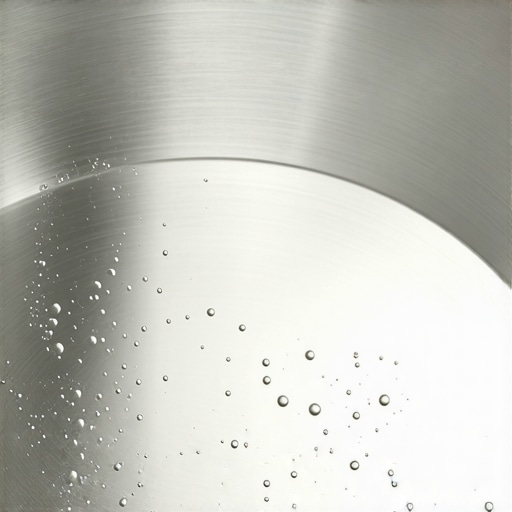
The Saltwater Test for Finding Leaks in Your Induction Pan
Most home chefs operating a luxury kitchen believe their premium cookware is a solid, immortal block of metal. It is not. After running this company for 15 years, I have seen the most expensive 5-ply skillets fail not from the outside, but from the inside. We are talking about delamination. This occurs when the layers of stainless steel, aluminum, or copper begin to separate due to thermal shock or manufacturing defects. When these layers part ways, your induction cooktop no longer sees a unified target; it sees a fractured circuit. The result? Thermal inefficiency. Energy that should be turning into heat instead manifests as high-pitched resonance or vibration. If you suspect your pan is losing its edge, the saltwater test is the industry standard for verifying structural integrity.
Physics of Clad Failure
Induction cooking relies on electromagnetism. The copper coil beneath the glass surface creates a magnetic field that induces an eddy current in the pan. For this to work efficiently, the material must be consistent. In high-end clad stainless steel, the bond between the magnetic exterior and the conductive core must be absolute. When a pan ‘leaks’ energy, it is often because air gaps have formed between these layers. Saltwater acts as a diagnostic tool because of its high conductivity and its ability to penetrate microscopic fissures that pure water might miss. We use a highly saturated brine solution to create a specific thermal load. If the pan has internal structural voids, the heat distribution will be erratic, and the saltwater will often ‘weep’ or crystalize at the site of a microscopic rim failure.
The Executive Testing Protocol
To execute this, fill the suspect pan with a 20% saline solution. Place it on your induction hob and set the power to a medium-low frequency. You are not looking for a rolling boil. You are looking for the sound. A healthy 5-ply copper core pan will produce a low, steady hum. A failing pan will ‘scream.’ This high-pitched whine is the physical vibration of the internal layers flapping against each other at kilohertz frequencies. As the brine heats, watch the edges where the cladding is exposed. If you see tiny bubbles forming consistently from a specific point on the rim rather than the bottom, you have a delamination leak. The salt crystals left behind after evaporation will often mark these failure points with a white, crusty residue that indicates where the internal aluminum has begun to oxidize.
Implementation Risks and Operational Realities
The messy reality of this test is that it can be destructive if the pan is already compromised. I remember a client in a high-rise who ignored the ‘clack’ of his pan during a sear. He performed a version of this test and the thermal expansion caused the bottom layer to bow so violently it cracked his ceramic glass cooktop. The weight of the industrial grade steel was no match for the trapped steam between the layers. This is why you never perform this test on ‘Power Boost’ mode. You must use a controlled, linear heat increase. If you hear a ‘pop’ or a metallic ‘ping,’ the pan is dead. There is no repair for delaminated cladding. For more on how to manage these issues, see why induction cooktops refuse to detect small pans when the magnetic circuit is broken.
Market Corrections and Future Engineering
The cookware industry is currently facing a silent crisis. To lower shipping costs, many brands are thinning the outer ferritic stainless steel layer. According to reports from the Cookware Manufacturers Association, the margin for error in bonding these thinner sheets is shrinking. Over the next 24 months, I predict a surge in warranty claims for delamination as these thinner pans hit their 1,000-hour usage marks. Smart buyers will move toward brands that prioritize thicker outer skins over ‘lightweight’ marketing gimmicks. We are seeing a return to heavier, more substantial builds that favor durability over aesthetic slimness. Check out technical standards at the ASTM International for metal bonding specifications to understand the engineering limits of these materials.
The Executive Verdict
If your pan fails the saltwater test, discard it immediately. It is no longer a cooking vessel; it is a liability that can damage your induction inverter. My recommendation is to hold on your current set if it passes, but buy only ‘full-clad’ replacements that extend the core to the very rim. Avoid ‘disk-bottom’ pans for high-output induction ranges. If you are experiencing erratic heating, run the brine. The data won’t lie. For further guidance on maintaining your setup, visit our contact page or read up on the reasons your induction hob struggles with certain diameters. Refer to the NIST database for more on thermal conductivity and metal fatigue.
Frequently Asked Questions
Does a buzzing sound always mean the pan is leaking? No. Some buzzing is normal for induction, especially on high power. However, a sharp, metallic screech that changes pitch when you press down on the pan handle usually indicates internal delamination.
Can I fix a pan that is weeping salt crystals? No. Once the bond between the layers is broken, the structural integrity is gone. Any attempt to ‘weld’ or press it back together will fail due to the different thermal expansion rates of the metals.
Will the saltwater damage my pan? If the pan is healthy, a single test with a saline solution followed by a thorough rinse will not cause damage. If the pan is already failing, the salt may accelerate the visible signs of that failure, which is the point of the diagnostic.
Is this test necessary for cast iron? No. Cast iron is a single-piece casting and cannot delaminate. This test is specifically for multi-clad or bonded-base cookware common in luxury kitchens.