
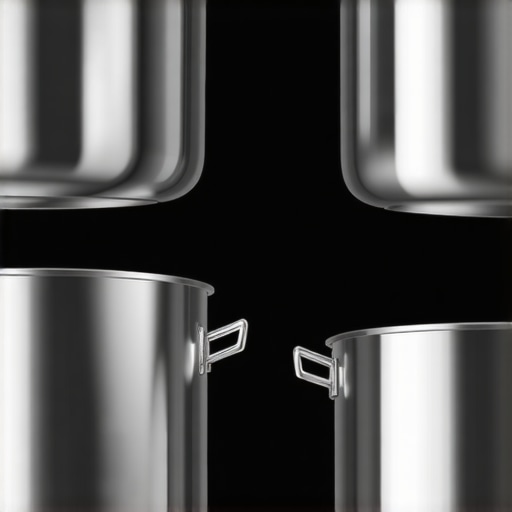
Why clad stainless steel is better than disk bottoms
Buying professional-grade cookware is an exercise in thermal management. If you are outfitting a luxury kitchen with high-output ranges, the physics of your pans becomes the bottleneck of your culinary output. Most home cooks walk into a store and see a shiny stainless steel surface, assuming the metal is uniform. It is not. After two decades in the industry, I have seen thousands of ‘impact-bonded’ disk pans fail where a fully clad vessel would have thrived. The stakes are clear: inconsistent heat leads to scorched proteins and ruined emulsions. High-end cookware represents a long-term capital investment. Choosing the wrong construction is an expensive mistake. You are not just buying a pot; you are buying a thermal heat sink designed to interface with 20,000 BTU burners or high-wattage induction zones.
The Engineering Reality of Thermal Transfer
Disk-bottom pans are essentially a standard stainless steel shell with a thick plate of aluminum or copper glued to the underside. This is a cost-cutting measure disguised as a feature. The problem is the ‘thermal gap’ at the junction where the disk meets the sidewall. In a professional setting, we call this the scorching ring. Heat travels vertically through the disk but hits a dead end at the corner. The sides of the pan remain significantly cooler than the base. When you whisk a delicate béchamel or reduce a wine sauce, the liquid at the edges remains under-heated while the center risks burning. Contrast this with multi-clad construction. A multi-clad stainless steel pan uses a sandwich of conductive metals that extends from the base all the way to the rim. The result? Uniformity. Heat flows around the corner of the pan like a liquid, turning the entire vessel into a heat-radiating chamber. This is governed by the principles of heat flux and thermal conductivity. According to standards established by ASTM International, the bonding of these layers must withstand extreme thermal cycling without delamination. Disk pans often fail here. Over time, the thermal expansion rates of the two different pieces of metal cause the disk to bow or separate entirely.
The Operational Risk of Delamination and Warping
Performance isn’t the only concern; durability is the second-order effect of poor engineering. I have watched hundreds of disk-bottom pans develop a ‘wobble’ on glass induction cooktops. This happens because the heavy disk expands at a different rate than the thin sidewalls. This stress leads to permanent deformation. If you have ever wondered why your stainless steel skillet warps when cooking on high heat, the answer is usually found in the lack of structural integrity provided by full cladding. In my experience, a 3-ply or 5-ply clad pan acts as a single, rigid unit. The layers of aluminum or copper provide the thermal muscle, while the exterior layers of 18/10 stainless steel provide the structural ‘cage.’ This rigidity prevents the base from oil-canning or bowing. There is also the sensory experience to consider. A disk pan feels bottom-heavy and unbalanced. A clad pan feels like a singular piece of industrial equipment. You can feel the weight of the high-grade steel. The clank of a clad pan on a cast iron grate is a dull, solid thud. A disk pan often rings with a hollow, tinny vibration. Even the lids behave differently; a poorly fitted lid on a warped disk pan is the primary reason your lid keeps rattling when you boil water.
Market Corrections and the Future of Induction
The luxury kitchen market is shifting toward high-output induction. This technology is unforgiving to poor cookware. Induction works by creating a magnetic field that turns the pan itself into the heating element. In a disk-bottom pan, only the bottom gets hot. The thin sides stay cold. This creates a massive thermal gradient that can cause the pan to crack or the bonding agent to fail. We are seeing a move toward 7-ply and copper-core cladding to handle the instant-on power of modern cooktops. Trade organizations like the Specialty Steel Industry of North America note that the demand for high-nickel, magnetic stainless steels is rising specifically because consumers are tired of the failures inherent in budget construction. In the next 24 months, expect to see disk-bottom pans relegated strictly to the entry-level market as consumers realize that cladding is a requirement, not an upgrade.
The Executive Verdict
If you are a serious cook or a homeowner looking for a ‘buy once’ solution, the decision is binary. Buy clad. Avoid disk bottoms for anything other than a dedicated stockpot where you only boil water. For sautéing, searing, and sauce work, the thermal consistency of cladding is unmatched. My recommendation: Invest in a high-quality 3-ply set for your everyday needs and a few 5-ply pieces for high-heat searing. The ROI is found in the longevity of the product and the quality of the food. Right now, the market is flooded with ‘faux-clad’ pans that have a line etched near the bottom to look like cladding. Inspect the rim. If you can see the distinct layers of metal at the very top edge of the pan, it is true clad. If the rim is sealed or looks like a single thin sheet, stay away.
Frequently Asked Questions
Is clad cookware harder to clean than disk-bottom pans? No. The interior surface of both is typically 304 or 18/10 stainless steel. However, clad pans are easier to maintain because food is less likely to burn in the corners where the disk would typically end.
Does 5-ply cook faster than 3-ply? Not necessarily faster, but more evenly. 5-ply adds more thermal mass, which means the pan holds heat better when you drop a cold steak onto it. It prevents the temperature ‘crash’ that ruins a good sear.
Can I use clad pans on a gas stove? Absolutely. Clad cookware is actually superior on gas because the flames often lick up the sides of the pan. A clad pan will capture that lateral heat and move it into the food, whereas a disk pan wastes that energy.
Why is clad cookware so much more expensive? The manufacturing process is significantly more complex. Bonding multiple sheets of metal together across the entire surface area of a vessel requires massive hydraulic pressure and specialized heat treatments that disk-bottom bonding simply doesn’t require.