
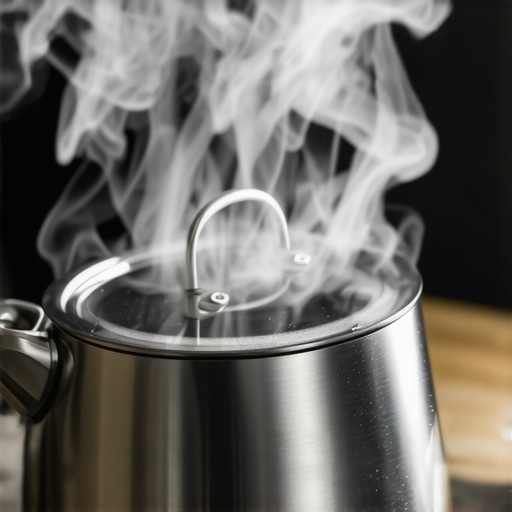
The reason your lid keeps rattling when you boil water
That rhythmic, metallic clatter on your stove isn’t a sign of life; it is a sign of thermal mismanagement. After twenty years of installing luxury kitchen systems and sourcing premium cookware for discerning clients, I have seen this issue more than any other. It is not just an annoyance. It is a symptom of energy loss and structural imbalance. Most people ignore it. They shouldn’t. The clatter of a lid against a rim signals that the internal vapor pressure has exceeded the weight of the steel. The result? Avoidable failure in heat retention.
The mechanics are simple yet often ignored by mass-market manufacturers. When water reaches its boiling point, phase change occurs. Liquid becomes gas. This steam needs space. If your lid does not have a precise vent or sufficient weight, the steam builds up until it physically lifts the metal. This is a basic struggle between gravity and thermodynamics. In a high-end setup, the lid should act as a seal, not a percussion instrument. Many entry-level sets fail here because they lack the necessary density. Precision engineering is the backbone of high-end tools, much like why 5-ply copper core pans outperform traditional aluminum in heat distribution. If your lid vibrates, the pan base might also be at risk; learn why your stainless steel skillet warps when cooking on high heat.
Vapor Pressure and Thermal Mass
In my experience, the problem often stems from the interaction between high-output burners and light-gauge lids. Modern induction ranges and professional gas ranges pump out staggering BTUs. When you apply that much energy to a pot, the steam production is violent. If the lid is thin, it can’t handle the pressure. It bounces. This constant movement allows heat to escape, lengthening cook times and ruining the consistency of delicate sauces. According to standards established by organizations like ASTM International, the tolerances for lid seating are tight. A gap of even a millimeter can lead to a significant drop in internal temperature. If you are using air fryers or espresso machines, you know that temperature stability is everything. Cookware is no different.
[IMAGE_PLACEHOLDER]
The Induction Factor
Induction hobs present a unique challenge. Because they heat the metal directly via magnetic friction, the water can come to a boil much faster than on traditional electric coils. This rapid onset of steam creates a sudden pressure spike. Modern magnetic transfer is finicky, which is why your induction hob struggles with small diameter pans and why it can make lid rattling worse. Excessive heat isn’t just a lid issue; it is the reason your non-stick pan smokes at low heat if the thermal mass is insufficient to absorb the energy. I’ve seen cheap lids dance across the stovetop because the cooktop was too efficient for the pot’s design.
The Messy Reality of Damaged Rims
Sometimes, the rattle isn’t about pressure. It’s about warpage. I remember a client in a high-rise penthouse who complained about her stand mixers being loud, but the real culprit was her rattling stockpot. Upon inspection, the rim was out of round by nearly three millimeters. Someone had dropped it, or perhaps it had been subjected to thermal shock. When the rim is no longer a perfect circle, the lid sits on high points. It becomes a seesaw. Every bubble that rises through the liquid sends a vibration that the lid amplifies. It’s a sensory nightmare: the smell of escaping steam, the harsh clink of metal on metal, and the sight of water dripping down the side of a $10,000 range. You should always reference technical data from sources like the National Institute of Standards and Technology (NIST) regarding thermal expansion coefficients to understand how metal behaves under stress.
Market Corrections and Future Trends
Over the next 12 to 24 months, I expect to see a shift toward ‘smart’ lids with integrated pressure valves. As residential kitchens move closer to commercial standards, the tolerance for inefficient cookware will vanish. Regulatory changes focusing on energy efficiency will likely target heat loss during the cooking process. High-mass, precision-milled lids will become the standard, not the exception. We are moving away from the era of thin, stamped steel. The future is heavy, silent, and sealed.
The Executive Verdict
If your lid is rattling, check three things. First, verify the heat level. You are likely pumping in more energy than the vessel can dissipate. Second, check for warpage on a flat granite surface. Third, weigh the lid. If it feels light, it is light. My recommendation? Buy cookware with cast stainless steel lids or weighted glass with silicone gaskets. If you are serious about your kitchen, don’t tolerate the rattle. It is a sign of a system out of balance.
Frequently Asked Questions
Can I stop the rattling without buying new pots?
Yes. Try reducing the heat once the boil is reached. A gentle simmer requires far less energy and produces less steam pressure. You can also use a ‘lid offset’ method, but this sacrifices heat retention.
Is a rattling lid dangerous?
Rarely dangerous, but always inefficient. It can lead to boil-overs, which might extinguish a gas flame or damage the electronics on an induction cooktop.
Do glass lids rattle more than metal ones?
Often, yes. Glass is usually lighter than the heavy cast-steel lids found on professional-grade copper or 5-ply sets. However, many glass lids include a steam vent hole specifically to prevent this issue.
Does the shape of the pot matter?
High-walled stockpots are more prone to rattling because they create a ‘chimney effect’ for the steam, concentrating the pressure directly against the center of the lid.