
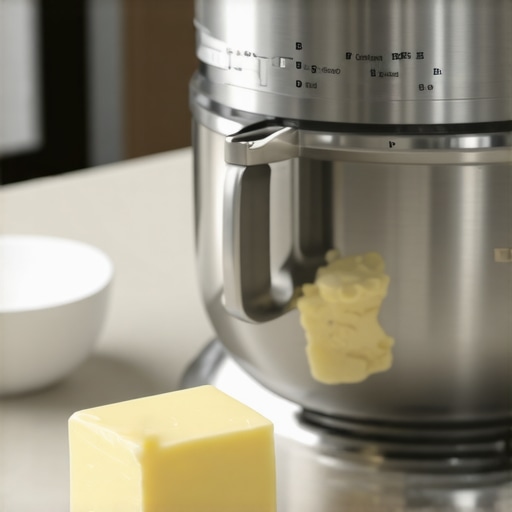
Physics doesn’t care about your recipe. When you drop a 40-degree Fahrenheit block of fat into a mixing bowl and engage a planetary gear system, you are essentially asking a set of precision-cut teeth to act as a hydraulic press without the necessary displacement capacity. After 15 years of tearing down high-end kitchen machinery and seeing the same scorched motor windings, I can tell you: the ‘clank’ of the head pin is the sound of money leaving your pocket. Cold butter is not an ingredient in this state; it is a structural impediment. Forcing a motor to overcome this resistance triggers a massive spike in amperage. The result? Avoidable failure. This isn’t just about baking; it’s about the mechanical limits of residential luxury appliances.
Why Your Stand Mixer Motor Struggles with Cold Butter
The primary issue is torque versus resistance. Most high-end stand mixers utilize either an AC universal motor or a more sophisticated DC brushless motor. While DC motors handle low-end torque better, neither is designed to pulverize a solid crystalline structure like chilled dairy fat. When the paddle hits a cold chunk, the motor’s RPM drops, causing the controller to dump more current into the windings to maintain speed. This creates heat. Rapidly. If you notice the machine screaming, you should understand why your stand mixer whines during heavy loads before the gears strip. The internal friction of the planetary assembly increases exponentially as it fights the butter. We are talking about metal-on-metal stress that exceeds the tolerances set by the American Society of Mechanical Engineers (ASME) for residential motor ratings.
[IMAGE_PLACEHOLDER]
The Mechanical Reality of Gear Stripping
Inside most mixers, there is a sacrificial gear. Usually made of high-strength nylon or a specific brass alloy, this part is designed to fail so the motor doesn’t explode. But ‘designed to fail’ still means a $150 repair bill and a week of downtime. Cold butter increases the shear force on these gear teeth. I have seen countless units where the worm gear has literally shaved the teeth off the main drive gear because the user was too impatient to wait for room-temperature softening. Misalignment leads to more than just noise; knowing how to realign the tension on your professional stand mixer is a skill every luxury owner needs, but it won’t save a gear that has been ground to dust. The smell of ozone—that sharp, electric tang—is your first warning. It means the carbon brushes are arcing because the motor is struggling to turn. It is the literal scent of mechanical distress.
The Thermal Stress Factor
Heat is the silent killer of kitchen electronics. When a motor works too hard, the lacquer coating on the copper windings begins to degrade. Once that insulation fails, the motor shorts out. This is not a slow process; it can happen in a single session of ‘creaming’ cold butter. Excessive heat can even liquify the food-grade grease inside the gear housing, leading to a mess; that is why your stand mixer is leaking oil into the bowl. It’s a chain reaction. The butter stays hard, the motor gets hot, the grease thins, and the mechanical integrity of the entire unit is compromised. I’ve seen $1,000 machines turned into doorstops because of a five-minute rush to get cookies in the oven. It is a poor trade-off by any economic metric.
Industry Shift Toward High-Torque DC Motors
Looking ahead, we are seeing a shift in the luxury market toward DC motors with sophisticated logic boards. These boards can detect resistance and shut the motor down before it burns out. However, this ‘safety’ feature often results in a machine that simply refuses to work with cold ingredients, frustrating the user. Within the next 24 months, expect to see more integration of thermal sensors and ‘soft-start’ tech that limits initial current. The National Kitchen & Bath Association (NKBA) has noted a trend toward professional-grade performance in home settings, but the physics of fat remains a constant. The industry is moving toward protection, but the best protection is still operator intelligence.
The Executive Verdict
If you are serious about the longevity of your kitchen arsenal, treat your stand mixer with respect. Never use butter straight from the fridge. If you are in a time crunch, grate the cold butter into small shards or use a rolling pin to flatten it between parchment paper before adding it to the bowl. This reduces the mechanical load and allows the paddle to incorporate the fat without over-torquing the drive shaft. My recommendation: Room temperature is 65-68 degrees Fahrenheit for baking. Anything lower is a risk to your equipment. Don’t let a $5 block of butter ruin a $600 motor.
FAQ
Q: Can I use the ‘Stir’ setting to safely mix cold butter?
A: No. While the speed is lower, the resistance is still high. The motor will still pull high amperage to maintain that low speed, leading to heat buildup.
Q: Why does my mixer smell like it is burning?
A: That is the smell of the carbon brushes or the motor winding insulation getting too hot. Turn it off immediately and let it cool for 30 minutes.
Q: Is a DC motor mixer better for cold ingredients?
A: It handles the torque better, but the physical stress on the gears remains the same. It is less likely to burn the motor but just as likely to strip a gear.
Q: How can I tell if I’ve already damaged my gears?
A: Listen for a rhythmic clicking or grinding. If the head of the mixer is jumping excessively, you likely have a partially stripped gear or a loose hinge pin. See how to stop your stand mixer from overheating during bread making for more preventative tips.