
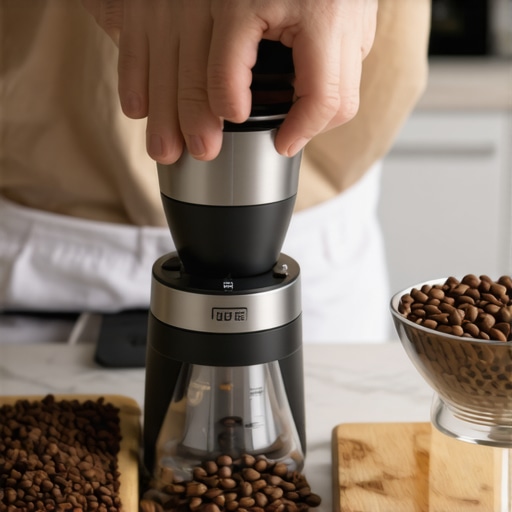
How to Calibrate Your Coffee Grinder After Changing Roasts
Static is a liar. It masks the reality of your particle distribution and ruins your shot before you even engage the pump. Changing coffee roasts in a luxury kitchen setup is not a simple matter of twisting a dial; it is a recalibration of physics. After running this company for 15 years, I have seen seasoned home baristas waste pounds of expensive beans because they failed to account for the structural integrity of the bean itself. Light roasts are dense, rubbery, and resist grinding. Dark roasts are brittle, porous, and shatter into dust. If you treat them the same, your espresso machines will scream under the pressure of a choked puck or gush like a broken pipe.
The Engineering Reality
Calibration is about managing the gap between steel burrs. When you move from a medium roast to a light roast, you are moving to a bean that has retained more moisture and cellular structure. The motor on your grinder will work harder. You will hear the high-pitched whine of the burrs straining. Because light roasts do not shatter easily, you must grind finer to achieve the same surface area. Conversely, dark roasts have undergone more pyrolysis. They are fragile. They break into fines—tiny microscopic particles—far more easily. If you keep your grinder at a light-roast setting for a dark-roast bean, you will end up with a muddy, bitter mess that clogs your basket. To get it right, you need to understand how to calibrate the burrs on a new coffee grinder before you even think about switching bean profiles.
The ROI of Precision
Think of your espresso setup as a high-performance engine. You would not put low-octane fuel in a Ferrari and expect it to purr. The economic reality is that a failed calibration costs you roughly $2.00 per wasted shot in beans and wear-and-tear on your motor. Over a year, that is a $700 mistake. The solution is a systemic purge. Whenever you switch roasts, you must clear the retention. Stale grounds from the previous roast will act as a buffer, giving you false readings on your extraction time. I recommend using bellows or a dedicated vacuum to ensure the chamber is empty. This prevents the frustration of how to stop your espresso grinder from retaining stale beans from ruining your morning ritual.
Why Standard Methods Fail
Most people follow the ‘one notch’ rule. It is a myth. The delta between roasts is rarely linear. I have seen beans from the same farm, roasted just two minutes longer, require a thirty-degree shift on a flat burr grinder. The smell of scorched cellulose is the first sign of a friction-related failure. If your burrs get too hot during the adjustment phase, they expand. This thermal expansion changes the zero-point of your grinder. Suddenly, the setting that worked five minutes ago is now too tight. You are chasing a moving target. To avoid this, only adjust the grind size while the motor is running. This prevents beans from getting trapped between the burrs and stripping the adjustment threads—a repair that usually costs more than the grinder is worth. Proper maintenance is vital, which is why I often emphasize the proper way to clean a burr grinder without ruining the calibration as a prerequisite for any roast change.
Market Corrections Ahead
We are seeing a shift in the luxury kitchen space toward high-torque, low-RPM grinders. The industry is moving away from the ‘bigger is better’ mentality of the early 2000s. The focus now is on thermal stability and minimal retention. In the next 18 months, expect to see more grinders with built-in laser diffraction sensors to measure particle size in real-time. This will take the guesswork out of how to dial in a light roast espresso without the sour aftertaste. For now, we rely on the weight of the industrial grade steel and our own sensory feedback. According to reports from the Specialty Coffee Association, precision in grinding is the single most significant factor in extraction quality, yet it remains the most neglected by consumers.
The Executive Verdict
If you are switching from a dark roast to a light roast, grind finer by 2-3 major marks while the motor is spinning. If you are going from light to dark, move coarser immediately to avoid clogging. My recommendation is a ‘Buy’ on high-quality bellows and a ‘Hold’ on any grinder that does not allow for stepless adjustment. The result of ignoring these physics? Bitter, inconsistent coffee that devalues your premium cookware and espresso machines. If you find yourself frustrated, stop. Purge. Re-zero. Start from a known coarse point and walk it in. It is the only way to ensure the integrity of the cup. [image_placeholder_1]
Expert FAQ
Q: Do I really need to run the motor while adjusting?
A: Yes. Adjusting finer while the motor is stationary can wedge bean fragments between the burrs, causing the motor to stall or the adjustment mechanism to seize. It is a fundamental mechanical safety step.
Q: How many grams should I purge?
A: For most prosumer grinders, 5 to 10 grams is sufficient to clear the ‘dead space’ between the burrs and the exit chute. Without this, your first shot will be a hybrid of two different roasts.
Q: Why does my light roast taste sour even after grinding finer?
A: Light roasts are less soluble. You may need to increase your water temperature. The National Institute of Standards and Technology notes that temperature precision is as vital as physical measurement in chemical extractions like brewing.
Q: Can I use the same setting for pour-over and espresso?
A: Never. The particle size requirement for espresso is micron-level precision. Using an espresso grinder for pour-over frequently without a full recalibration usually leads to poor results in both methods.