
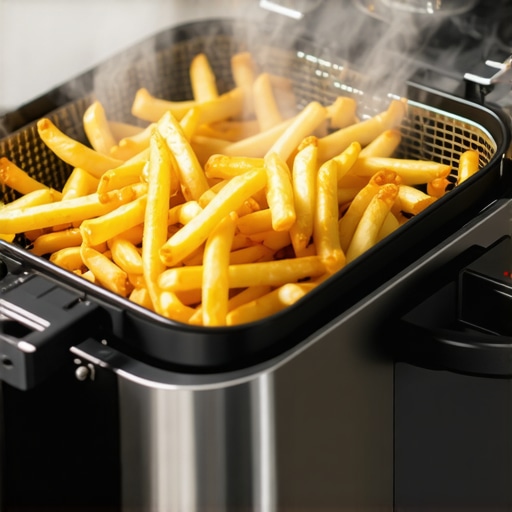
Why Your Air Fryer Food Is Always Unevenly Cooked
Marketing departments have sold the public a fantasy. They suggest that these compact convection machines are ‘set and forget’ miracles of the modern luxury kitchen. After 15 years of diagnosing kitchen appliance failures and analyzing the internal mechanics of high-end espresso machines and air fryers, I have seen the same operational error repeated in thousands of homes. The truth? Your food is unevenly cooked because you are fighting against basic fluid dynamics. An air fryer is not a deep fryer; it is a high-velocity thermal wind tunnel. When you ignore the physics of airflow, you guarantee a soggy, disappointing result.
The Engineering Reality of Boundary Layers
The core of the issue lies in the ‘boundary layer’ of air. In any cooking environment, a thin layer of stagnant air clings to the surface of the food. To achieve the crispness found in professional kitchens, this layer must be stripped away by turbulent, high-velocity air. If the fan cannot circulate air at its intended Cubic Feet per Minute (CFM) because you have packed the basket to the brim, the air stagnates. You are no longer air-frying; you are steaming your food in its own moisture. This is the primary reason why many users experience temperature fluctuations in your air fryer that lead to raw centers and burnt edges.
Technical truth: Radiant heat from the top element is only half the battle. The bottom-up convection, redirected by the star-shaped or vented floor of the basket, is what determines the ‘crisp factor.’ If that air cannot return to the intake, the thermal loop breaks. Most domestic models lack the static pressure required to push air through dense layers of protein. The result? Avoidable failure. To understand how this differs from traditional methods, one should study the difference between forced air and conventional heating.
The Economics of Heat Shadowing
Heat shadows occur when one piece of food blocks the direct line of high-velocity air from reaching another. Think of it like trying to get a tan while standing in the shade of a building. In a luxury kitchen environment where precision is expected, heat shadowing is the ultimate sin. From a strategic perspective, overcrowding your air fryer is an ROI-negative move. You spend more on energy and time re-cooking or tossing out inedible portions than you would by simply cooking in two smaller, high-efficiency batches.
When we look at the UL Solutions standards for thermal performance, we see that appliance efficiency is measured under specific load conditions. Home users often exceed these loads by 40%. This stresses the heating element and the fan motor. I’ve seen industrial-grade heating coils snap because of the back-pressure created by an overstuffed basket. It is a costly mistake that shortens the lifespan of premium cookware and appliances alike.
Thermal Bridging and Moisture Traps
Sensory anchors are vital here. Recall the smell of acrid smoke or the sound of a struggling fan. That high-pitched whine? That is the motor fighting a vacuum. When food items touch, they create a thermal bridge. Heat transfers via conduction at the contact point, but since food is a poor conductor compared to air, the contact point stays cold while the exposed tops carbonize. Furthermore, the oil you use matters. Selecting the best oil to use for high heat air frying is not just about flavor; it is about viscosity and how it interacts with the airflow. Heavy oils can gum up the mesh, leading to further airflow restrictions.
The messy reality is that these machines require maintenance that isn’t in the manual. Over time, aerosolized grease coats the fan blades. This adds mass to the blades, slowing the RPMs and reducing the wind speed necessary to break the boundary layer. If you haven’t learned how to clean the fan blades inside your air fryer, your unit is likely underperforming by 20% compared to its factory state. It is the ‘operational scar’ of the modern air fryer enthusiast.
Market Corrections and Future Tech
The industry is moving toward PID (Proportional-Integral-Derivative) controllers, much like those found in a high-end luxury espresso machine. Within the next 12 to 24 months, we will see air fryers that adjust fan speed based on humidity sensors. This will mitigate some of the user errors associated with overcrowding. Regulatory changes from the Association of Home Appliance Manufacturers are also pushing for more transparent ‘usable volume’ ratings versus total volume, which will help consumers understand exactly how much they can cook at once without ruining the output.
The Executive Verdict
If you are looking for restaurant-grade results in a luxury home setting, you must treat your air fryer with the same technical respect you give a sous-vide circulator or a manual espresso press. Buy a model with a higher wattage-to-volume ratio. Sell the idea that you can cook a whole chicken in a 4-quart basket. Hold your standards high by ensuring a minimum of 15% open space on the basket floor at all times. The actionable strategy is simple: Single layers, dry surfaces, and clean fans.
Frequently Asked Questions
Q: Why does the left side of my basket cook faster?
A: This is usually due to the rotation direction of the fan and the placement of the internal thermocouple. Air is often pushed more aggressively to one side before circulating back. Rotating the basket 180 degrees halfway through is the only manual fix.
Q: Can I use parchment paper?
A: You can, but it is a major cause of uneven cooking. Parchment paper acts as a solid barrier to vertical airflow. If you must use it, use perforated sheets designed for air fryers to maintain the thermal loop.
Q: Does the size of the food matter?
A: Absolutely. Uniformity in surface-area-to-volume ratio is key. If you have large chunks and small crumbs together, the small pieces will reach terminal crispness and burn before the large pieces’ internal temperatures reach safety levels.