
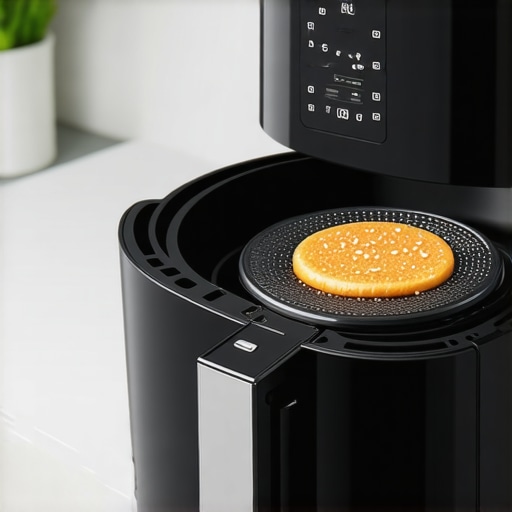
Why You Need a Splatter Guard for Your Air Fryer Heating Element
Neglecting the protective barrier between your food and the heating element in a high-end air fryer is a fast track to hardware failure. After 15 years of diagnosing appliance failures in luxury kitchens, I can tell you that grease is the primary silent killer of these machines. The heating element is not a indestructible heat source; it is a precision resistance coil usually sheathed in stainless steel or incoloy. When aerosolized fats hit that surface at 400 degrees, they do not just disappear. They carbonize. This layer of burnt organic material acts as an insulator, forcing the element to work harder to reach the same ambient temperature. The result? Premature burnout and a machine that belongs in the scrap heap. If you value the longevity of your premium appliances, a splatter guard is not an optional accessory. It is a fundamental maintenance tool.
The Engineering Reality of Convection Heat
Air fryers function on the principle of high-velocity convection. The internal fan, often spinning at several thousand RPM, creates a cyclonic effect designed to strip moisture from the surface of food. This same force turns liquid fat into a fine mist. Without a guard, this mist is sucked directly into the fan housing and onto the heating coil. Think about why your air fryer smells like burnt toast every time you use it; that is the smell of accumulated grease undergoing a secondary combustion process. This buildup reduces the thermal efficiency of the unit. The Association of Home Appliance Manufacturers (AHAM) notes that equipment efficiency is tied directly to the cleanliness of the heat transfer surfaces. When grease coats the coil, the heat cannot dissipate effectively into the air stream. This heat backs up into the internal electronics, eventually melting the thermal fuse or degrading the wiring insulation.
Grease Carbonization and the Burn-Off Cycle
The technical truth about grease is its ability to polymerize. Under repeated high-heat cycles, oil transforms from a liquid to a sticky resin, and finally to a hard, carbonized shell. This shell is notoriously difficult to remove without damaging the element. Scrubbing a heating coil with abrasives often leads to microscopic scratches that become hot spots, leading to a cracked sheath. Preventing the grease from reaching the coil in the first place is the only logical strategy. By installing a fine-mesh stainless steel guard, you intercept 95% of the liquid particulate. The air passes through, but the heavy fat molecules are trapped. This simple barrier is the difference between a five-year lifespan and a fourteen-month lifespan for your unit. Many users ignore this, only to find that your air fryer takes twice as long to cook because the element is fighting through a layer of insulation.
The Smoke Alarm Trigger and Fire Risk
Beyond the mechanical degradation, there is a serious safety implication. Accumulated grease on a heating element is a fire hazard. According to the National Fire Protection Association, cooking remains the leading cause of home structure fires. When fat drips onto a 400-degree coil, it can flash-ignite. Even if it does not start a full-blown fire, the resulting smoke is enough to ruin the flavor of your meal and trigger every sensor in your home. Understanding how to stop your air fryer from setting off the smoke alarm involves more than just opening a window; it requires keeping the heat source clean. A splatter guard acts as a physical shield against these flare-ups. I have seen countless units with scorched fan blades and melted plastic housings, all because the user was air-frying high-fat items like bacon or chicken wings without any protection for the upper assembly.
Market Corrections and the Right to Repair
The appliance industry is shifting. We are seeing a move away from the ‘disposable’ culture of the early 2010s toward more durable, repairable luxury goods. However, air fryer manufacturers still design the heating element to be the most vulnerable component. Replacing a coil often costs nearly as much as a new unit when you factor in professional labor. The strategic move for the homeowner is to invest in prevention. In the next 12 to 24 months, I expect to see more regulatory pressure regarding the cleanability of these devices, but until self-cleaning elements become the industry standard, the aftermarket guard is your best defense. It is a small capital outlay with a massive ROI in terms of appliance longevity.
The Executive Verdict
If you own a premium air fryer, buy a stainless steel splatter guard today. Do not wait for the smell of burnt plastic to alert you to a problem. Use the guard every time you cook protein or anything with a high fat content. Clean the guard in the dishwasher after every use to ensure airflow remains unobstructed. If your unit already has buildup, do not attempt to scrape the element; use a soft brush and a specialized degreaser, then install a guard to prevent future damage. This is the only way to protect your investment and maintain the culinary performance you paid for.
Common Questions
Does a splatter guard slow down cooking? No. A high-quality mesh guard is designed to allow air to pass through with minimal resistance while catching larger liquid particles. You will not notice a change in cook time, but you will notice a cleaner machine.
Can I use aluminum foil instead? Never. Foil blocks the airflow entirely and can cause the motor to overheat or the element to melt. Only use a mesh guard designed for convection airflow.
How do I know if my element is already damaged? If you see white smoke, smell a sharp acrid odor, or notice that the heating coil has dark, crusty patches that do not come off, you have significant carbonization. It is time to clean it thoroughly and start using a guard immediately.