
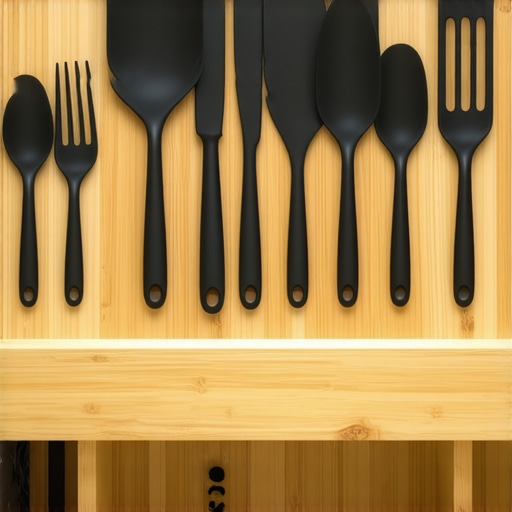
The drawer organizer that actually holds oversized utensils
Standard kitchen storage is a failure of geometry. After fifteen years of designing high-end culinary spaces, I have observed a recurring frustration: the ‘Drawer Jam.’ It happens when a professional-grade balloon whisk or a silicone-handled offset spatula catches the lip of the cabinet frame. The wood splinters. The drawer refuses to open. You are left struggling with a stuck utensil while your reduction sauce burns. This is the tax paid for using mass-market organizers in a luxury kitchen environment. Most inserts are built for flatware—thin, uniform, predictable. But your premium cookware and the specialized tools required for high-torque stand mixers or commercial-grade espresso machines do not follow those rules.
The Engineering Reality of Culinary Storage
The core problem is vertical clearance and volumetric displacement. A standard 15-inch drawer insert provides shallow troughs. These are fine for teaspoons but useless for a heavy-duty rolling pin or a long-handled microplane. To solve this, we must look at deep-well modularity. Custom millwork often utilizes 5/8-inch solid maple dividers that are notched into the drawer box itself, rather than a loose plastic tray that slides around every time the drawer closes. When you invest in a luxury kitchen, the internal hardware should match the external aesthetics. The height of the divider must sit exactly 1/4 inch below the cabinet rail to prevent mechanical interference. This precision ensures that even the bulkiest air fryers accessories or espresso machine portafilters stay in place without migrating under the frame. If your current setup feels cramped, you might be suffering from the countertop depth mistake that makes your kitchen feel tight, which often forces users to overstuff drawers because they lack functional prep space.
The ROI of Quality Millwork
Why do standard methods fail? Because they ignore the kinetic energy of a heavy drawer. A drawer filled with stainless steel ladles and cast iron presses carries significant momentum. Low-grade plastic inserts crack under this weight. We utilize adjustable tension-lock dividers or custom-routed blocks. The cost-benefit analysis is clear: pay for the organization once, or pay a contractor to repair the drawer tracks and face-frames every three years. Modern disruptors in the industry are now using magnetic docking stations inside drawers to keep metal utensils from rattling. This silence is a hallmark of a truly high-end build. While you are optimizing your small tools, do not forget the larger ones; knowing the best way to organize heavy dutch ovens in a low cabinet is equally vital for maintaining the structural integrity of your shelving.
Market Corrections and Future Proofing
The industry is shifting toward deeper base cabinets. Historically, 24 inches was the standard. Now, we are seeing a move toward 27-inch and 30-inch depths to accommodate oversized appliances and the sheer volume of gear enthusiasts collect. If you are planning a renovation, specify ‘Full-Extension’ slides with an over-travel feature. This allows the drawer to come out past the edge of the counter, giving you total access to the back where the oversized items often hide. Avoiding the ‘lost item’ syndrome is easy if you know how to organize a corner cabinet without losing items in the back. Over the next 24 months, expect to see more integrated LED lighting within these deep drawers. The National Kitchen & Bath Association (NKBA) has already noted a 40% increase in requests for specialized internal cabinet lighting. This isn’t just vanity; it’s visibility for high-precision tools.
Market Corrections Ahead
Regulatory changes regarding material emissions (VOCs) are also impacting what we can put inside our drawers. Those cheap, rubberized ‘non-slip’ mats? Many are being phased out because they off-gas in the enclosed, warm environment of a kitchen. I recommend cork liners or felt-lined walnut trays. They are inert, durable, and dampen the clatter of metal on wood. If you find your kitchen lacks the necessary organization for smaller but essential items, consider why every modern kitchen needs a pull-out spice rack to free up drawer space for your larger utensils.
The Executive Verdict
If your kitchen drawers are a chaotic mess of overlapping steel, stop buying disposable inserts. Sell the idea of ‘one size fits all’ and Buy into a modular, high-walled system made of solid hardwoods or powder-coated steel. If you are in a situation where custom millwork is not an option, seek out expandable organizers with a minimum depth of 3 inches and heavy-weight ratings. The result? A kitchen that works for you, not against you. According to recent reports by the Kitchen Cabinet Manufacturers Association (KCMA), the durability of internal hardware is the number one predictor of long-term owner satisfaction.
Frequently Asked Questions
Will these deep organizers work in older cabinets? No, you must measure your internal clearance. Most older cabinets have a very narrow ‘throat’ that limits the height of the organizer and the utensils within.
What material is best for heavy utensils? Solid maple or walnut with dovetail joinery. Plastic and thin bamboo will bow and eventually snap under the weight of professional-grade tools.
How do I prevent my organizer from sliding? Use silicone pressure-fit bumpers or a small amount of museum gel on the corners. This keeps the unit stationary without damaging the drawer finish.
Do I need custom dividers for my espresso tools? Yes, portafilters are exceptionally heavy and odd-shaped. A dedicated, felt-lined niche is the only way to prevent them from scratching other tools.