
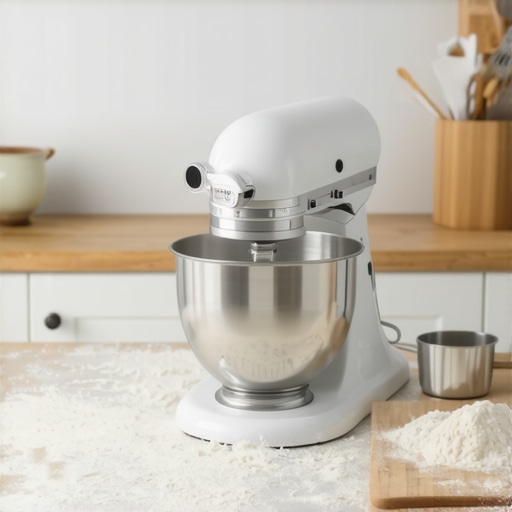
How to Stop Your Stand Mixer from Splattering Flour Everywhere
Flour splatter is not just a cleaning nuisance; it is a symptom of poor ingredient sequencing and ignored physics in the high-end kitchen. After fifteen years of diagnosing motor failures and gear stripping in premium kitchen environments, I can tell you that the white dust coating your backsplash is a sign of wasted torque. High-velocity aeration requires precision, yet most users treat their machines like industrial cement mixers. The stakes? Beyond the mess, fine particulate matter entering the motor housing leads to overheating and premature carbon brush wear. If you are using a professional-grade machine, you are likely overpowering the bowl’s containment capacity before the flour has even hydrated. The technical reality is simple: dry particles lack the mass to resist the centrifugal force generated by planetary mixing actions until they are bound by liquid.
The Engineering Reality of Ingredient Hydration
To control the mess, you must master the dry-wet interface. Most people dump three cups of flour into a bowl and hit ‘start’ on speed four. This is an operational error. The beater hits the dry mass, creating a localized pressure wave that ejects the smallest particles upward. Instead, utilize the pulse method. Brief, one-second bursts allow the flour to settle into the liquid base without reaching the ‘escape velocity’ required to exit the bowl. This is where properly cleaning the gasket on your stand mixer’s splash guard becomes vital; a fouled gasket prevents a vacuum seal, allowing dust to escape through micro-gaps. You are looking for a cohesive mass, not a vortex of dust. If your machine is older, you might notice the stand mixer whines during heavy loads, which often indicates that the motor is struggling with the initial resistance of un-hydrated dry goods. High-quality ASTM International standards for household appliances suggest that motor efficiency is highest when loads are introduced gradually, reducing the peak current draw during the start-up phase.
Why Standard Methods Fail Under Pressure
The ‘towel over the bowl’ trick is a common amateur fix that I despise. It introduces fibers into your dough and creates a safety hazard if the fabric catches the planetary head. The real failure point is often the bowl-to-beater clearance. If the gap is too large, dry ingredients sit at the bottom, untouched, until the friction finally kicks them up in a cloud. You can often fix a wobbly stand mixer in ten seconds by adjusting the neck screw, which also resets the depth of the beater. I’ve seen kitchens where the ‘flour volcano’ was so severe it actually clogged the intake vents of the machine. The smell of burning flour inside a $600 appliance is a scent you don’t forget. It’s gritty, scorched, and expensive. If you see signs of internal contamination, be aware that your stand mixer might leak oil into the bowl as the internal food-grade grease breaks down from the heat of the trapped dust.
Strategic Market Corrections and Future Tech
Looking at the next 24 months, the industry is moving toward brushless DC (BLDC) motors. These allow for ‘soft-start’ profiles that are far more sophisticated than current residential models. According to reports from the National Restaurant Association, the demand for precision control in home baking is forcing manufacturers to adopt sensors that detect bowl load and adjust RPM automatically to prevent splatter. We are seeing a shift away from raw power toward intelligent torque distribution. For now, the best strategy is manual intervention: add flour in 1/2 cup increments with the machine off. It takes thirty seconds longer, but it saves twenty minutes of detailing your luxury countertops. This is about operational efficiency, not just baking.
The Executive Verdict
If your mixer splatters, your technique is too aggressive for your hardware. My recommendation? Implement a strict ‘Speed 1 Only’ rule for the first 60 seconds of any bake. If the splatter persists, your bowl-to-beater height is out of spec. Stop the machine, adjust the clearance, and use a dedicated pouring shield. Avoid the towels. Avoid the high-speed starts. Your motor and your backsplash will thank you.
Frequently Asked Questions
Why does my mixer still spray flour even on the lowest speed?
This usually happens when the bowl is too full or the beater is hitting the dry pile at an angle that creates an updraft. Try adding a tablespoon of oil or liquid to the flour before starting to ‘weight’ the particles.
Can flour dust actually damage the internal gears?
Yes. Fine flour acts as an abrasive. If it gets into the gearbox, it mixes with the grease, creating a paste that wears down the teeth of the gears over time.
Are plastic splash guards worth using?
They are effective but only if the seal is tight. If your guard is warped, it can actually funnel the flour out through the gaps, making the mess more concentrated in one area.