
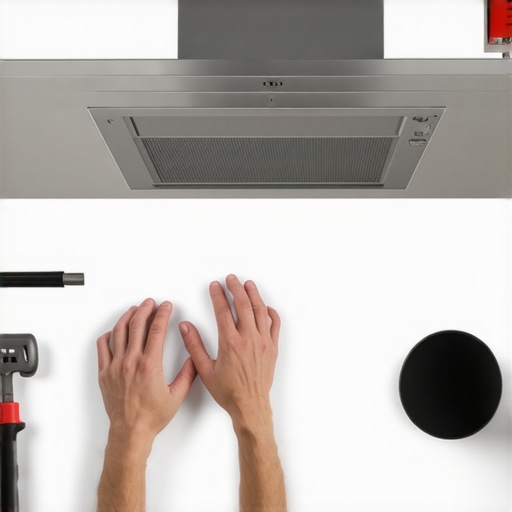
How to Fix a Rattling Kitchen Exhaust Fan
A rattling exhaust fan is the death rattle of your kitchen’s air quality. Ignore it, and you are not just enduring a nuisance; you are permitting the slow destruction of the motor assembly. After running this company for 15 years, I have seen five-figure luxury range hoods reduced to scrap because a homeowner ignored a minor harmonic vibration. The stakes involve more than sound. A vibrating fan creates microscopic fractures in the ductwork seals, leading to grease leakage in wall cavities. This is a technical failure that demands a technical response.
The physics of the centrifugal fan dictates that balance is everything. When your fan spins at high RPMs, even a milligram of uneven grease accumulation on the squirrel cage—the cylindrical blower wheel—transforms into a destructive centrifugal force. This is the ‘Technical Truth’ most handymen miss: cleaning the filters does nothing if the impeller itself is out of balance. The noise you hear is likely the motor shaft fighting against an offset center of gravity. If the rattling persists, you are wearing down the brass bushings or ball bearings, leading to a seized motor that requires a full, expensive replacement. You should understand why your kitchen hood doesn’t actually clear smoke before assuming the motor is the only culprit.
Consider the mechanics of the damper flap. In many high-end installations, the backdraft damper—the thin metal or plastic flap that prevents outside air from entering—becomes loose or warped. At high speeds, the static pressure inside the ducting causes this flap to oscillate violently against the housing. The sound? A rhythmic, metallic tapping that echoes through the vent. To diagnose this, you must bypass the standard filters and inspect the primary discharge point. If the flap is loose, high-temperature silicone adhesive or a simple tension spring adjustment often resolves the issue. For those maintaining a luxury kitchen, ensuring the integrity of these hidden components is vital for long-term ROI.
The reality of field repairs is rarely clean. I remember a project in a waterfront estate where the rattling was so severe it cracked the backsplash grout. The culprit was not the fan, but the mounting bracket. The installers had used standard wood screws into thin cabinetry instead of securing the unit to the structural studs. Over time, the vibration backed the screws out, leaving the entire 60-pound unit hanging by a prayer and two metal tabs. The smell of scorched electrical insulation was the first sign that the motor was overheating due to the physical strain of the misalignment. We had to strip the unit down to the chassis, reinforce the sub-frame, and re-index the blower wheel. It was a 6-hour job that could have been avoided with a 10-minute inspection a year prior. Implementing the grease trap trick during your regular maintenance can help identify these issues early by forcing you to look at the internal housing.
Looking toward the next 24 months, the industry is shifting toward high-static pressure systems and stricter ASHRAE 62.2 standards for residential ventilation. Modern homes are becoming more airtight, meaning your exhaust fan has to work harder against negative pressure. This increased load accelerates the wear on imbalanced fans. We are also seeing a move toward brushless DC motors (BLDC) which are quieter but far more sensitive to physical obstructions. If your current fan is rattling now, it will likely fail entirely under the demands of a modernized, high-performance kitchen environment. Standards set by the Home Ventilating Institute emphasize that any increase in decibel levels is a direct indicator of mechanical inefficiency.
My executive verdict: Fix it immediately or face a four-figure replacement bill. If the rattle is high-pitched, look at the motor bearings. If it is a low-frequency thud, check the mounting and the impeller balance. If you are in a situation where the fan housing itself is vibrating, use heavy-duty vibration dampening tape on the interior of the cabinet. This is not about ‘maintenance’; it is about protecting the structural integrity of your cooking environment. The result? A quiet, efficient kitchen that maintains its value. Don’t let a $20 balance issue destroy a $2,000 appliance.
Why does my fan rattle only on the high setting?
Higher speeds increase the centrifugal force acting on any imbalance in the blower wheel. Minor weight discrepancies that are unnoticeable at low RPMs become violent oscillations when the motor reaches full power. This usually indicates grease buildup or a slightly bent impeller blade.
Can I spray lubricant on the fan motor?
No. Most modern exhaust motors are sealed units. Spraying topical lubricants like WD-40 will actually attract more dust and grease, creating a sticky paste that will eventually seize the motor bearings. Only use manufacturer-approved high-temperature machine oil if the motor has specific oiling ports.
Is a rattling fan a fire hazard?
Potentially. If the rattle is caused by the motor shaft grinding against the housing, it generates significant friction heat. In a grease-laden environment, this heat can ignite the residue inside the ductwork. If you smell ‘electrical’ or ‘burnt’ odors, shut the power off at the breaker immediately.
How do I know if the blower wheel is balanced?
Remove the wheel and place it on a level surface. Spin it slowly; if it always stops with the same side facing down, that side is heavy. You can often clean the heavy side or use small metal balancing clips, though replacing the wheel is usually more cost-effective for long-term reliability.