
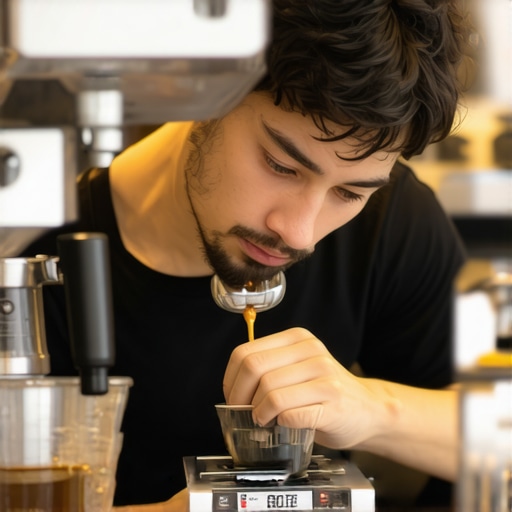
Why Your Coffee Scale Latency is Ruining Your Shots
Stop blaming the bean. The fault often lies in the sensor. In fifteen years of optimizing luxury kitchen workflows, I have seen five-thousand-dollar machines neutered by a twenty-dollar scale with the processing speed of a calculator from 1994. Precision in espresso is not about a static number; it is about the velocity of change. If your scale display lags behind the actual weight falling into the cup, you are not brewing; you are guessing. The stake is simple: every millisecond of latency translates into tenths of a gram. In a 1:2 ratio pull, a two-gram overshoot is the difference between a syrupy masterpiece and a bitter, over-extracted mess.
The Physics of the Pour
Espresso extraction is a high-speed chemical event. Once the pump engages and the first drops hit the ceramic, the clock starts. Most entry-level digital scales have a refresh rate—or polling rate—of about 2Hz to 5Hz. That means the screen updates only two to five times per second. While that sounds fast, a high-performing espresso machine can deliver 2 grams of liquid per second. If your scale lags by 500 milliseconds, you are seeing a weight that existed half a second ago. By the time you kill the pump, you have already flooded the puck. This delay explains why your espresso puck is always soupy and wet despite your best efforts to dial in the grind.
We deal in gravimetric measurement, yet we often ignore the microprocessor’s clock speed. A professional-grade scale, such as those used in industrial labs or high-end cafes, operates at 20Hz or higher. This reduces the ‘perceived weight’ gap. When the stream of coffee hits the cup, there is also the force of the falling liquid—kinetic energy—that the scale must tare out instantly. Cheap sensors get confused by this downward force, leading to a ‘drift’ in the final reading. You think you hit 36 grams. You actually hit 39. The result? Avoidable failure.
The Cost of Computational Delay
Let’s talk economics. If you spend forty dollars a bag on single-origin Ethiopian beans, every botched shot is a literal waste of capital. A scale with high latency is a hidden tax on your hobby. I call this the ‘Response Gap.’ When you are hunting for that perfect 28-second extraction, a 0.5-second lag represents a 1.7% error margin in time alone, but a much higher error in flavor profile. This is often why your espresso shots taste sour even with good beans; the inconsistency prevents you from ever finding the sweet spot of the roast.
The Reality of Thermal Drift
There is a sensory reality to this that most reviewers miss: the smell of hot electronics. Cheap scales lack adequate thermal shielding. As that 190-degree liquid sits on the platform, heat transfers through the plastic housing and into the load cell. Metal expands. Resistance changes. The scale starts counting up even when no liquid is being added. This is thermal drift. It is the silent killer of consistency. I have watched clients struggle with ‘wandering zeros’ for months, never realizing that the heat from their cup was warping their data in real-time. High-end scales use insulated glass or thick aluminum to decouple the sensor from the heat source. They feel heavy. They feel cold. That weight is the engineering required to keep your data honest.
Mechanical Failure in the Field
I remember a project for a local boutique hotel. They had the best grinders, the best boilers, but the staff kept complaining about ‘inconsistent’ flavor. I walked in and heard it immediately—the clack of the solenoid valve closing too late. They were using beautiful-looking scales that had a three-second ‘wake-up’ time and a massive display lag. The baristas were flying blind. We swapped them for high-speed sensors with 20ms response times. The consistency issues vanished overnight. The lesson? The interface between the machine and the human is only as good as the data provided. You can have the simple hack for leveling your espresso puck every time, but if you don’t know when to stop the flow, the levelness of the bed won’t save the cup.
Industry Trajectory for 2025
The next twenty-four months will see a shift toward integrated machine-scale communication. We are moving away from the ‘human-as-the-loop’ model. Predictive stopping is the new standard. Future scales will likely use AI to calculate the flow rate acceleration and signal the machine to cut the pump two grams early to account for the ‘drip-out’ weight. This isn’t just gadgetry; it is a response to the increasing volatility of modern light roasts which require tighter extraction windows than traditional Italian blends. Regulatory standards for consumer scales are also tightening, with more emphasis on ‘certified’ accuracy under varying temperatures.
The Executive Verdict
If you are serious about the chemistry of your morning, the scale is not an accessory; it is the primary instrument of control. My recommendation is a ‘Buy’ on any scale that explicitly lists a refresh rate of 20Hz or higher and includes a physical heat shield. If your current scale feels ‘floaty’ or takes a moment to catch up when you tap the platform, it is lying to you. Replace it. Your palate—and your bank account—will thank you. Look for equipment that meets the standards of the Specialty Coffee Association (SCA) for laboratory-grade measurement. Precision is the only path to repeatable luxury.
Frequently Asked Questions
Q: Is 0.1g resolution enough?
A: Resolution is not accuracy. A scale can show 0.1g increments but have a 0.5g error margin. You need 0.1g resolution paired with a high polling rate to actually achieve precision.
Q: Does the weight of the cup affect latency?
A: Yes. Heavier cups increase the inertia the load cell must overcome. This is why many pros prefer lightweight borosilicate glass over heavy ceramic for the most sensitive readings.
Q: Can I fix latency with a firmware update?
A: Rarely. Latency is usually a hardware limitation of the Analog-to-Digital Converter (ADC) chip. If the hardware is slow, software cannot make it faster.
Q: Why do some scales ‘jump’ numbers?
A: This is usually due to vibration or electromagnetic interference. High-end scales have better shielding to prevent your espresso machine’s pump motor from interfering with the weight reading.