
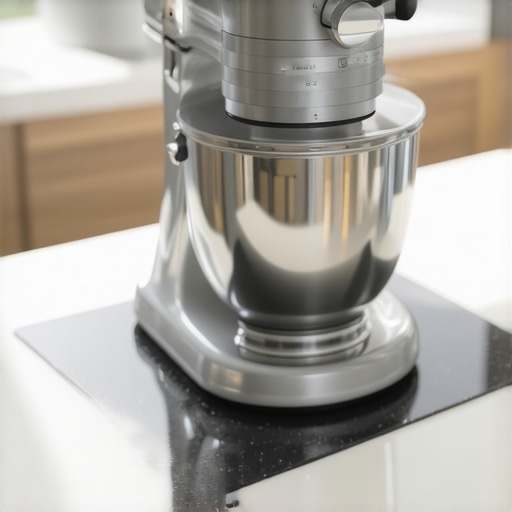
How to Balance Your Stand Mixer on a Slick Countertop
A $1,000 professional mixer becomes a lethal projectile when its high-torque planetary gear system meets a polished Carrara marble slab. After fifteen years of diagnosing mechanical failures in premium culinary environments, I have observed that the most expensive kitchen installations often possess the lowest coefficients of friction. This creates a physics-based conflict. You are not just mixing dough; you are managing kinetic energy that wants to find an exit. Most homeowners assume the weight of the machine provides security. It does not. The oscillation produced by heavy bread dough creates a harmonic frequency that effectively breaks the static friction of standard rubber feet. The result? Avoidable failure.
The Mechanics of Lateral Drift
To understand why your machine migrates, we must examine the motor architecture. Luxury mixers utilize either AC or DC motors, each with distinct vibrational signatures. A high-wattage motor creates immense rotational force. When this torque is applied to a dense, 65% hydration dough, the resistance is pushed back through the chassis. On a porous surface like old butcher block, the feet ‘bite.’ On modern quartz or polished granite, the air trapped under the rubber feet acts as a lubricant. This is basic Newtonian mechanics. Action and reaction. If the surface cannot absorb the lateral energy, the machine moves. This is particularly violent during bread-prep dynamics where the dough hook catches and releases the gluten structure. The oscillation often matches the natural frequency of the kitchen island, amplifying the travel. According to standards set by the ASTM International for surface friction, highly polished surfaces require specific interventions to maintain equipment safety.
We solve this by manipulating the Shore hardness of the contact points. Manufacturers often use cheap, high-plasticity rubber for feet because it is cost-effective. For a technical fix, you need low-Shore, high-tack silicone. This material creates a temporary molecular bond with the countertop without leaving adhesive residue. Another method is the dampening mat. Do not use a dish towel. A towel reduces friction to near zero. Use a dedicated micro-suction silicone mat. This creates a vacuum between the mat and the slick surface, effectively bolting the mixer to the stone without drilling holes.
The Stress Test of Real-World Application
The operational risk is real. I recall a client in a high-rise loft who lost a limited-edition copper mixer—and a section of their backsplash—because the machine ‘walked’ six inches in three minutes. The smell of scorched rubber feet is a warning sign. When the machine vibrates against stone, the heat generated can actually mar the finish of a delicate marble. This is not just about the mixer; it is about protecting the countertop material itself. If you hear a high-pitched ‘chirp’ during high-speed whisking, that is the sound of rubber skipping across stone. It is a precursor to a total loss of stability.
Strategic Market Foresight
The industry is shifting toward ultra-dense sintered stones and porcelain slabs. These materials are even slicker than traditional granite. Within the next 24 months, I expect to see appliance manufacturers integrate active suction bases or magnetic lockdowns into high-end models. Regulatory bodies like ISO are already tightening safety requirements for benchtop machinery to prevent impact injuries. If you are designing a kitchen now, consider a dedicated ‘appliance garage’ with a recessed, high-friction surface specifically for heavy-duty mixing. The days of letting a 30-pound machine roam free on a $5,000 island are ending.
The Executive Verdict
If you are operating a professional-grade mixer on quartz or marble, do not trust the factory feet. Invest in a micro-suction stabilization mat immediately. If your machine is already showing signs of travel, inspect the feet for glaze or cracking. Replacing them with high-tack silicone alternatives is the only way to ensure preventing appliance travel is permanent. Stop the migration before the machine hits the floor. It is a simple engineering fix for a high-stakes problem.
Frequently Asked Questions
Q: Can I use a damp paper towel under the mixer?
A: No. Water creates a hydroplaning effect on slick surfaces. Once the motor heats up, the water evaporates or thins, causing sudden, erratic movement.
Q: Does the age of the mixer affect its stability?
A: Yes. Older grease in the gear housing can settle or harden, causing uneven internal weight distribution which increases vibration during operation.
Q: Are certain countertop colors slicker than others?
A: Color is irrelevant, but the level of polish is. A ‘honed’ finish offers significantly more natural grip than a ‘mirror’ or ‘high-gloss’ finish.
Q: Will a heavy mixer move less than a light one?
A: Counter-intuitively, no. A heavier machine carries more momentum. Once it starts moving, its mass makes it harder for the friction of the feet to stop it.