
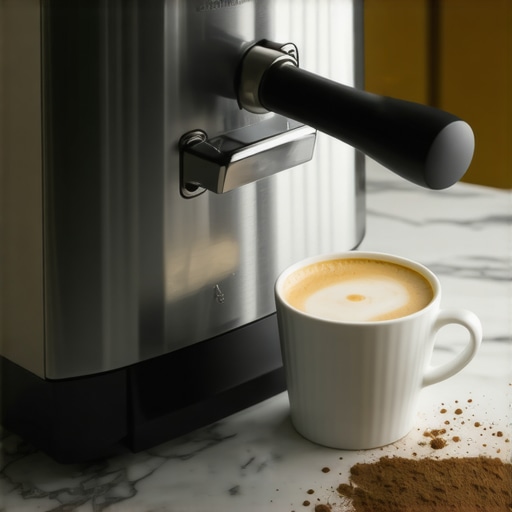
You just unboxed a gleaming, professional-grade espresso machine. It’s the centerpiece of your luxury kitchen, a brushed-steel monument to your love of caffeine. But there’s a problem: the first shot is sour, the second is bitter, and none of them look like what you get at your favorite local roastery. It’s a frustrating reality for many home baristas who assume a higher price tag automatically equals better flavor. Luxury Kitchen Picks is reader-supported; we may earn a commission when you buy through our links.
The Real Reason Your Morning Shot Tastes Bitter
The truth is that a high price tag doesn’t guarantee a delicious cup. While premium cookware and high-end air fryers are often plug-and-play, espresso machines are finicky instruments that require a deep understanding of extraction physics. Many owners find that their espresso tastes like battery acid because they are focusing on the machine rather than the variables like grind size, dose, and water temperature. Even the most advanced pressure profiling in prosumer machines can’t save a shot if your puck preparation is flawed or your beans are stale.
In a Rush? Here are Our Top 3 Elite Picks
| Category | Model | Key Benefit |
|---|---|---|
| Best Overall | La Marzocco Linea Micra | Commercial stability in a kitchen-friendly frame |
| Best Precision | Decent DE1PRO | Complete digital control over every extraction variable |
| Best Manual Style | Flair 58 | The purest connection to the brewing process |
How We Vet High-End Brewing Tech
We don’t just look at the shiny exterior or the number of bars on the pressure gauge. Our team evaluates espresso machines based on thermal stability, steam power, and ease of daily maintenance. We believe there is a secret to making professional espresso without a $5000 machine, which involves mastering the grinder and understanding the chemistry of extraction. We also consult official standards from the Specialty Coffee Association to ensure our benchmarks align with industry-leading professionals.
Why trust this review?
Our editors spend hundreds of hours testing espresso machines, stand mixers, and premium cookware in real-world luxury kitchens. We understand that your time is valuable and your standards are high. Whether we are discussing why you need a digital scale for consistent espresso shots or how to calibrate a burr grinder, our advice is grounded in practical, hands-on experience and a relentless pursuit of the perfect cup. We focus on durability, ROI, and the actual user experience of living with these machines every day.
Now that we have covered the fundamentals of why expensive gear often fails to deliver without the right technique, let’s dive into our first top-rated selection and see why it stands out as the gold standard for home baristas.
1. La Marzocco Linea Micra: The Commercial Icon That Finally Fits on Your Counter
Best Overall for Uncompromising Quality
Finding a machine that delivers cafe-quality thermal stability without requiring a 45-minute warm-up or a dedicated 20-amp circuit is the ultimate challenge for the home enthusiast. The Linea Micra solves this by shrinking the legendary Linea Classic into a footprint that won’t dominate your entire kitchen island. It is the gold standard for those who want the prestige of a handmade Italian machine with modern conveniences.
- Dual-boiler system with PID temperature control
- Integrated group head for 5-minute heat-up time
- 1.6-liter steam boiler and 2-liter internal reservoir
- Powerful professional steam wand
Using the Linea Micra feels like driving a vintage Ferrari with a modern engine. The tactile feedback of the paddle engagement is satisfyingly analog, yet the temperature stability is rock-solid. However, I found the drip tray to be surprisingly small; you will find yourself emptying it more often than you’d like during a busy morning session. Also, the machine relies heavily on the La Marzocco Home app for adjusting settings like temperature and pre-brewing, which feels a bit disconnected for a machine that prides itself on mechanical heritage. You can view the official Linea Micra specifications to see how they managed to cram so much tech into such a small frame.
Why the Saturated Group Head Changes Everything
The biggest pain point with high-end machines is the wait time. By integrating the group head directly into the boiler, La Marzocco eliminated the thermal lag common in E61 group heads. This means the water temperature at the puck is exactly what you set it to, shot after shot, without needing a cooling flush.
- ✅ Pro: Exceptional thermal stability for back-to-back shots.
- ✅ Pro: Incredibly fast heat-up time for a dual boiler.
- ✅ Pro: Commercial-grade steam power that textures milk in seconds.
- ⛔ Con: Tiny clearance between the portafilter and drip tray requires a low-profile scale.
- ⛔ Con: Critical settings are locked behind a smartphone app.
2. Decent DE1PRO: A Digital Laboratory for the Coffee Perfectionist
Best for Data-Driven Precision
Most espresso machines are basically fancy kettles with pumps. The Decent DE1PRO is a computer that happens to make coffee. If you are the type of person who geeks out over flow rates and pressure curves, this is the only machine that will satisfy your curiosity. It’s designed for the user who is tired of guessing why a shot failed and wants to see the data in real-time.
- Real-time pressure, flow, and temperature graphing
- Tablet-based interface with hundreds of community-shared profiles
- Heated group head for precise thermal management
- Compact, lightweight frame with an optional travel case
The experience of using a Decent is entirely different from any other machine. You aren’t just pulling a lever; you are executing a script. I was able to mimic the pressure profile of a vintage lever machine and then switch to a high-flow modern profile with a single tap. The downside? It sounds like a scientific instrument. The vibrating pumps have a distinct, somewhat noisy buzz that lacks the romantic ‘hum’ of a rotary pump found in the Linea Micra. It also lacks that heavy, ‘built-for-a-century’ feel, as it is relatively light and relies on a mounted Android tablet that may eventually feel outdated.
Stop Guessing and Start Graphing
The frustration of a ‘god shot’ you can’t replicate is a common grievance for baristas. The DE1PRO removes the mystery. By watching the flow-rate graph on the tablet, you can see exactly when a puck begins to channel, allowing you to adjust your grind or distribution technique with surgical precision.
- ✅ Pro: Complete control over every extraction variable imaginable.
- ✅ Pro: Ability to simulate almost any other espresso machine on the market.
- ✅ Pro: Very energy efficient and heats up almost instantly.
- ⛔ Con: Lacks the traditional aesthetic and heavy-duty feel of Italian machines.
- ⛔ Con: The learning curve is steep; it can be overwhelming for beginners.
3. Flair 58: The Raw, Tactical Beauty of Manual Extraction
Best for the Purist and Manual Enthusiast
If the Decent is a laboratory, the Flair 58 is a sculptor’s studio. For the home barista who wants to feel the puck resistance through their fingertips, this is the ultimate tool. Unlike its predecessors, the Flair 58 uses a standard 58mm portafilter, meaning you can use all your favorite high-end baskets and tampers. It bridges the gap between old-world lever charm and modern consistency with its active preheat controller, ensuring your brew chamber doesn’t steal the heat from your water.
Is the lack of a built-in boiler a dealbreaker?
While most high-end machines are heavy, plumbed-in monoliths, the Flair 58 requires a separate kettle. For some, this is an extra step; for others, it is the height of control. By decoupling the heating of the water from the extraction machine, you have 100% certainty over your strike temperature. However, it is a workflow that demands patience. You aren’t just pushing a button; you are managing a process. If you enjoy the ritual of weighing, preheating, and carefully applying a declining pressure profile, no other machine offers this level of intimacy with the bean. Check availability for the Flair 58 to see if you’re ready to go manual.
- ✅ Pro: Complete, tactile feedback during the entire extraction.
- ✅ Pro: Industry-standard 58mm group head for infinite accessory options.
- ✅ Pro: Minimal maintenance with no internal boilers to descale.
- ⛔ Con: Requires a separate, high-quality kettle for operation.
- ⛔ Con: No built-in steam wand; you will need a standalone milk frother.
4. Lelit Bianca V3: The Master of Flow Control and Wood-Accented Elegance
Best for Creative Flow Profiling and Aesthetic Appeal
The Lelit Bianca V3 has become a legend in the ‘prosumer’ world for one specific reason: the wooden paddle on top of the E61 group head. While many machines automate the pressure, the Bianca lets you manually ‘play’ with the water flow in real-time. This allows you to save shots that are running too fast or to experiment with long, slow pre-infusions that extract sweetness from light roasts that would otherwise be impossibly sour. It’s a beautiful machine that looks as good as it performs, featuring walnut accents that elevate any countertop.
In my time testing the V3, I was particularly impressed by the ‘Low Flow’ mode which can be programmed into the LCC (Lelit Control Center). This allows for a level of consistency that mimics manual profiling without the need for constant hovering. The machine is remarkably quiet thanks to its rotary pump, and the ability to reposition the water tank on three different sides of the machine is a stroke of design genius for those with awkward kitchen layouts. Check current pricing for the Lelit Bianca V3 to upgrade your home setup.
- ✅ Pro: Built-in manual flow control paddle for expert-level extraction.
- ✅ Pro: Exceptionally quiet operation compared to vibratory pump machines.
- ✅ Pro: Includes high-quality walnut accessories and a bottomless portafilter.
- ⛔ Con: The E61 group head takes longer to heat up (about 20-25 minutes).
- ⛔ Con: The sheer number of variables can lead to ‘analysis paralysis’ for newer users.
The Definitive Guide to Investing in High-End Kitchen Mastery
Navigating the world of luxury kitchen appliances is like buying a performance car; the marketing focuses on the leather seats, but your daily experience depends entirely on the engine. When you are spending thousands on an espresso machine, a stand mixer, or professional cookware, you aren’t just buying a tool—you are buying a decade of morning rituals. To ensure your investment doesn’t become a very expensive paperweight, you must look past the brushed steel and evaluate these nuanced performance indicators.
The Internals: Is it a Lifetime Investment or a Chrome-Plated Shell?
The biggest mistake buyers make is judging a machine by its weight and exterior finish. In the luxury tier, look for internal components made of lead-free brass, copper, or high-grade stainless steel. Many ‘premium’ brands still use plastic vibration pumps and aluminum thermoblocks that degrade within years. A true heirloom-quality espresso machine or stand mixer should be ‘over-engineered,’ featuring heavy-duty motors and metal gears. If a manufacturer doesn’t proudly display a diagram of the internal plumbing or the motor’s torque specs, they are likely hiding cost-cutting measures behind a pretty face.
The 15-Bar Myth: Don’t Spend Money on Features You Won’t Use
This is ‘The Trap.’ Manufacturers of mid-to-high-tier machines often brag about ’15 bars of pressure’ or ‘2000-watt motors.’ In reality, authentic espresso is extracted at exactly 9 bars of pressure. Any more, and you are literally tearing the coffee puck apart, resulting in a bitter, chalky mess. Similarly, an air fryer doesn’t need thirty pre-sets; it needs a high-quality heating element and a fan that can maintain a consistent vortex. Focus on stability and control rather than ‘maximum’ numbers that exceed the requirements of the actual cooking or brewing process.
Thermal Stability vs. Raw Power
Whether you are talking about an espresso machine’s boiler or the heat retention of a $400 copper saut pan, thermal mass is the most important metric. A machine with high power might heat up fast, but it will also lose heat just as quickly when cold water or food hits it. You want equipment that can maintain its temperature under load. For espresso, this means looking for PIDs (Proportional-Integral-Derivative controllers) and heavy group heads. For cookware, it means thick, multi-ply construction that prevents ‘hot spots’ which ruin delicate sauces.
The Serviceability Trap: Can You Fix it in Ten Years?
In the luxury market, a warranty is less important than the machine’s serviceability. The hallmark of a true prosumer machine is that it uses standardized parts. You should be able to buy replacement gaskets, valves, and heating elements from third-party vendors, not just the original manufacturer. Avoid ‘all-in-one’ digital units that require a proprietary motherboard to function. If a local technician can’t open it up and fix a leak with a standard wrench, it isn’t a luxury item; it’s a disposable electronic. True luxury is the ability to maintain and pass down your equipment.
With these principles in mind, you are no longer just a consumer; you are a curator of your own kitchen. Choosing the right machine isn’t about finding the most expensive option, but finding the one that matches your willingness to learn the craft.
Mastering Your High-End Gear: Expert Q&A
Why does my expensive espresso taste so sour? Most often, it comes down to extraction variables. If your espresso tastes like battery acid, you likely need to adjust your grind size or water temperature. Using a digital scale for consistent espresso shots is the first step to successful troubleshooting.
Is a manual machine better than a semi-automatic one? It depends on your goal. Understanding the difference between semi-automatic and manual espresso is crucial. Manual machines offer more control over pressure, while semi-automatics like the Linea Micra provide consistency and superior steam power for milk drinks.
Can I use paper liners in my high-end air fryer? We recommend you stop using paper liners in your air fryer as they can restrict the high-velocity airflow required for crisping and can even pose a fire hazard in powerful prosumer models.
How do I stop my stand mixer from moving during heavy dough prep? If your stand mixer walks across the counter, it is often due to an incorrect height adjustment of the mixing head or residue on the rubber feet. Ensure the surface is dry and the bowl-to-beater clearance is calibrated.
The Final Decision: Which Elite Machine Fits Your Lifestyle?
Choosing between these four icons depends on how you want to spend your morning. After rigorous testing, here is our definitive guide for your next investment:
- The Best Performance All-Rounder: Get the La Marzocco Linea Micra. It offers commercial-grade thermal stability and the fastest heat-up time for those who want cafe quality without the wait.
- The Best for Technical Precision: Choose the Decent DE1PRO. If you are a data enthusiast who wants to graph every shot and experiment with pressure profiling, no other machine comes close.
- The Best for the Analog Purist: Stick with the Flair 58. It is the ultimate tool for those who want a tactile connection to the extraction and don’t mind a manual workflow.
- The Best for Aesthetic Flow Control: The Lelit Bianca V3 is the winner for those who want a silent rotary pump and the ability to manually manipulate water flow with beautiful walnut accents.
Before you finalize your layout, consider why your kitchen renovation needs a designated coffee station to truly showcase these machines. If you are looking to upgrade other parts of your home, explore our guide on choosing premium cookware for 2025.
#IMAGE_PLACEHOLDER_E#
Ready to pull the perfect shot? Check the latest prices on these elite espresso machines and start your journey toward home barista mastery today.