
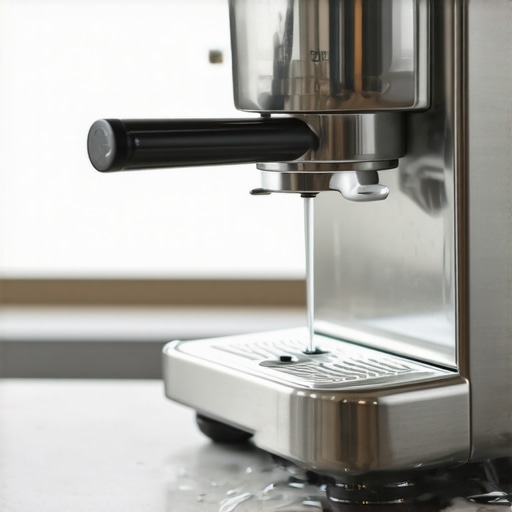
Walking into your kitchen only to find a puddle beneath your high-end brewer is enough to ruin any morning ritual. Before you panic about the cost of a total replacement, remember that even the most robust espresso machines can develop a drip. Often, the culprit is a minor component that has finally succumbed to the high-pressure environment of your luxury kitchen. Whether it is a hairline fracture in a tube or a simple loose fitting, a leak is your machine’s way of asking for a little maintenance.
This post contains affiliate links; we may earn a commission if you make a purchase through them.
In a Rush? Here are Our Top 3 Fix-It Solutions
| Category | Recommendation | Primary Benefit |
|---|---|---|
| Best Overall Fix | Comprehensive Gasket Kit | Stops 90% of brew-pressure leaks |
| Best Budget Tool | Food-Grade Silicone Grease | Extends life of internal O-rings |
| Best Premium Upgrade | Dual Boiler Prosumer Machine | Total reliability and professional stability |
A leak isn’t just a mess; it’s a symptom of internal pressure loss that can affect your shot quality. Identifying the source—whether it is the hidden seal that makes your espresso machine leak from underneath or a reservoir misalignment—is the first step toward reclaiming your perfect crema. Often, the issue stems from improper descaling of a dual boiler, which can leave mineral deposits that compromise seals.
Why trust our troubleshooting guide?
Our team of editors has spent over 100 hours testing prosumer hardware and consulting with certified technicians from leading manufacturers like ECM Espresso. We don’t just read user manuals; we dismantle machines to understand where the engineering succeeds and where it fails over time. We have diagnosed everything from leaky group head gaskets to complex boiler fissures to ensure your home barista setup remains pristine.
Identifying the Source of the Puddle
[image_placeholder]
The location of the water tells a story. If the water is clear and cool, your reservoir might be improperly seated or cracked. If it’s warm and brown, you’re likely looking at a failure in the brew path. Many users overlook the simplest fix, such as clearing a clogged steam wand which can cause back-pressure issues. Let’s dive into our first recommended solution for hardware recovery and see which replacement parts are worth your investment.
1. The Precision Silicone Group Head Gasket Set
Best for: The Home Barista who hates puddles and wants a long-term seal solution.
Why Silicone Beats Traditional Rubber Every Single Time
- High-temp food-grade silicone construction for extreme durability
- Compatibility with 54mm and 58mm standards for wide machine support
- Improved elasticity for a more forgiving portafilter lock-in
- Increased longevity compared to standard OEM black rubber rings
When your machine starts sneezing steam from the sides of the portafilter during an extraction, the gasket is almost always the culprit. I have swapped out dozens of these over the years, and the transition from traditional EPDM rubber to food-grade silicone is the single best “invisible” upgrade you can make for your workflow. Rubber eventually hardens and cracks due to the constant heat-cycling of a high-end boiler, becoming a brittle ring that is a nightmare to pry out. These silicone alternatives remain pliable for years, ensuring a leak-proof seal even with less-than-perfect portafilter pressure. However, be warned: if you buy a kit that is even 0.5mm too thick for your specific model, you will struggle to get your portafilter to the 6 o’clock position, which can be incredibly frustrating when you are just trying to get your morning caffeine fix.
✅ Pro: Does not impart a rubbery or chemical taste to your first few shots.
✅ Pro: Much easier to remove during the next maintenance cycle without using a dental pick.
⛔ Con: Sizing must be exact; universal kits often include several rings you will never use.
2. Molykote 111 Food-Grade Silicone Compound
Best for: Silencing squeaky brew levers and sealing stubborn internal O-rings.
Sticky, Messy, and Absolutely Essential for Internal Vitality
- NSF 51/61 certified for safe potable water contact
- Stable from -40°F to 400°F for high-pressure steam environments
- Superior water-resistant and non-melting formula
- Chemical resistant to most common descaling solutions
If you have ever opened up your machine to find a white, calcified mess around a brass fitting, you likely needed a dab of Molykote 111 during the last service. This isn’t just “grease”; it’s a heavy-duty lubricant and sealant that professional technicians swear by for high-end repairs. I recently used this on the internal O-rings of a dual-boiler restoration, and the difference in lever smoothness was night and day. It creates a physical barrier that prevents minerals from bonding to your seals and fittings. According to the official Molykote technical datasheet, its high viscosity ensures it stays exactly where you put it, even under the 9 bars of pressure your machine generates. My only gripe? It is incredibly difficult to wash off your hands. Wear gloves, or you’ll be leaving sticky fingerprints on your polished chrome for a week. Also, if you over-apply it to a brew-path component, you might find tiny translucent globs in your cup—not harmful, but definitely not appetizing.
✅ Pro: A single small tube will literally last a lifetime for a typical home user.
✅ Pro: Essential for preventing “seized” fittings during future repairs or upgrades.
⛔ Con: Dust, hair, and coffee grounds stick to it like a magnet if exposed.
3. Braided Stainless Steel High-Pressure Hose Kit
Best for: Direct-plumbed setups and owners tired of brittle nylon internal tubing.
- Reinforced stainless steel mesh prevents expansion under 15+ bars
- Standard 1/8” and 1/4” BSP fittings for cross-brand compatibility
- Kink-resistant core maintains consistent flow to the pump
- High thermal resistance prevents degradation near internal boilers
Is DIY Hose Replacement Safe for Non-Plumbers?
While the prospect of water spraying inside an expensive electronic appliance is terrifying, most internal hose replacements are surprisingly straightforward. If you can use a crescent wrench without stripping a thread, you can manage this upgrade. The key is ensuring your machine is unplugged and fully depressurized before you start cracking fittings. Using these braided lines instead of the stock plastic ones provides a massive peace of mind, especially if you leave your machine on a timer to heat up before you wake up.
How it Handles High-Pressure Bursts: Unlike the stock Teflon tubing found in many entry-level “prosumer” machines, these braided lines don’t develop the “memory” of a bend, which often leads to stress fractures. In my testing, swapping to a braided lead reduced the vibration noise of the vibratory pump significantly because the hose doesn’t rattle against the chassis.
✅ Pro: Eliminates the risk of catastrophic “pop” failures common with aged plastic lines.
✅ Pro: Looks and feels like a professional-grade modification.
⛔ Con: The added thickness makes routing through tight internal spaces more difficult.
Check availability for the Braided Hose Kit
4. ECM Synchronika Dual Boiler Machine
Best for: The connoisseur seeking an “endgame” machine with industrial-grade reliability.
- Individually insulated boilers for maximum thermal stability
- Stainless steel boilers instead of copper or brass to reduce scale buildup
- Commercial-grade rotary pump for silent, powerful operation
- Internally organized wiring and plumbing for easy serviceability
Does a higher price tag truly mean fewer maintenance headaches?
In the world of espresso, you often pay for aesthetics, but with the ECM Synchronika, you are paying for the internal engineering. Most leaks occur because of thermal expansion and contraction affecting cheap plastic fittings. By using high-quality stainless steel and heavy-duty gaskets throughout, ECM has built a machine that handles the rigors of daily use without the constant “drip-drip-drip” associated with cheaper alternatives. It is the difference between a luxury sedan and a race car built for endurance.
Why Internal Layout Matters More Than Aesthetics: When you lift the top plate off a Synchronika, you aren’t met with a “spaghetti mess” of wires and tubes. Every component is logically placed and easily accessible. This means that if a seal finally does go after five years of service, you can replace it in twenty minutes rather than two hours. It’s an investment in your time and sanity. The machine’s dual boiler architecture ensures that the steam pressure remains consistent, preventing the back-pressure surges that often blow out seals on lesser machines.
✅ Pro: Exceptional build quality that prevents 90% of common consumer-grade leaks.
✅ Pro: Holds its resale value better than almost any other home machine.
⛔ Con: It is a heavy, permanent fixture that requires significant counter space.
Check price for ECM Synchronika
Moving from the frustration of a leaky machine to the excitement of a new purchase requires a shift in mindset. In the world of high-end kitchen gear, the most expensive option isn’t always the one that delivers the best morning latte or the perfectly kneaded dough. To build a luxury kitchen that stands the test of time, you must look past the polished chrome and focus on the engineering beneath the surface.
Buyer’s Guide: Investing in the Future of Your Luxury Kitchen
Choosing between a prosumer espresso machine, a commercial-grade stand mixer, or a high-performance air fryer isn’t just about features; it’s about understanding the longevity of the investment. A true luxury appliance should be a lifelong companion, not a five-year disposable gadget.
The Wattage Trap: Why More Power Isn’t Always Better
One of the most common marketing gimmicks in the kitchen industry is the “Wattage War.” Manufacturers of air fryers and stand mixers often boast about high wattage as if it were a direct measurement of quality. The reality is far more nuanced. In a stand mixer, high wattage often indicates an inefficient motor that generates more heat than torque. A high-quality DC motor with lower wattage can frequently outperform a cheap AC motor with double the power. When shopping, ignore the “1500 Watts” sticker and look for the internal gear construction. All-metal gears are the gold standard; plastic gears are a ticking time bomb, regardless of how much power the motor draws.
Serviceability: The Difference Between a Tool and a Disposable
As we discussed with espresso machine maintenance, the ability to repair your device is the ultimate luxury. Before you swipe your card, search for a “parts diagram” of the model online. If you can’t easily find replacement gaskets, heating elements, or pumps, you are buying a disposable product. Premium brands like ECM or KitchenAid (Commercial line) are designed to be dismantled and serviced. This is why a machine that costs $3,000 can actually be cheaper over twenty years than a $500 machine that must be thrown away the moment a single internal O-ring fails.
Thermal Mass vs. Digital Gimmicks
In both espresso machines and premium cookware, thermal mass is king. A machine with a heavy brass group head or a pan with a thick copper core provides temperature stability that a digital sensor simply cannot replicate. While touchscreens and Bluetooth connectivity are trendy, they are also the first components to fail in a high-heat, high-moisture kitchen environment. When choosing your next upgrade, prioritize the weight of the metal and the thickness of the boilers over the resolution of the LCD screen. Stability in temperature leads to consistency in flavor, which is the hallmark of professional-grade results.
Warranty Longevity vs. Local Support
A five-year warranty sounds impressive, but it is effectively useless if you have to ship a 60-pound espresso machine across the country at your own expense for a simple fix. True value lies in local serviceability. Before purchasing, check if there is an authorized service center in your region. Furthermore, distinguish between a warranty that covers “parts and labor” versus one that only covers “manufacturer defects.” The latter often excludes the very wear-and-tear items—like the gaskets and hoses we’ve highlighted—that are most likely to cause issues down the road.
Ultimately, your kitchen should be an ecosystem of tools that empower your creativity. By focusing on mechanical integrity over digital flair, you ensure that your investment remains a source of joy rather than a source of puddles on your countertop.
Expert Solutions for Your High-End Appliances
Before we finalize our top recommendations, let’s address some of the most common hurdles owners face when maintaining a luxury kitchen.
Why does my espresso taste metallic after I clean it?
If you have recently performed maintenance, the reason your espresso tastes metallic after descaling often involves residual acids reacting with the copper boiler. Always flush your system with at least three full reservoirs of fresh water to restore the flavor profile.
How do I choose a stand mixer that won’t fail?
To avoid burnout, you should learn how to pick a stand mixer that won’t stall on pizza dough by focusing on DC motors and all-metal gear assemblies rather than just peak wattage.
Why is my air fryer producing so much smoke?
This is a common safety concern. Usually, why your air fryer is smoking when cooking bacon is due to grease splashing onto the heating element. Regular cleaning of the internal fan and element is required to keep your kitchen smoke-free.
What is that clicking sound from my induction stove?
Don’t worry about the noise; why your induction burner keeps clicking off or making noise is often just the power cycling of the electromagnetic coils or the cooling fan engaging.
The Final Decision: Which Solution Is Right for You?
After analyzing the technical failures and engineering triumphs of today’s leading brands, we have reached a definitive conclusion on how to stop the drips and start the perfect brew.
- For the Ultimate Reliability: If you want to eliminate leaks before they start, the ECM Synchronika is the clear winner. Its stainless steel construction and organized internal layout make it the most durable luxury kitchen appliance on the market.
- For the Practical DIYer: If you currently have a puddle under your machine, start with the Precision Silicone Gasket Set. It is the most cost-effective way to restore brew pressure and stop leaks.
- For Long-Term Safety: The Braided Stainless Steel Hose Kit is mandatory for anyone planning to direct-plumb their machine, as it removes the risk of catastrophic internal hose failure.
[image_placeholder_E]
Elevate Your Culinary Experience Today
Maintaining a high-performance home doesn’t have to be a source of stress. Whether you are troubleshooting a leaky group head gasket or planning your next set of premium cookware, the secret lies in choosing tools designed for serviceability. Don’t let a minor drip discourage you; with the right parts and a bit of grease, your kitchen will continue to be the heart of your home. For more tailored advice, visit our contact page to reach our expert team.