
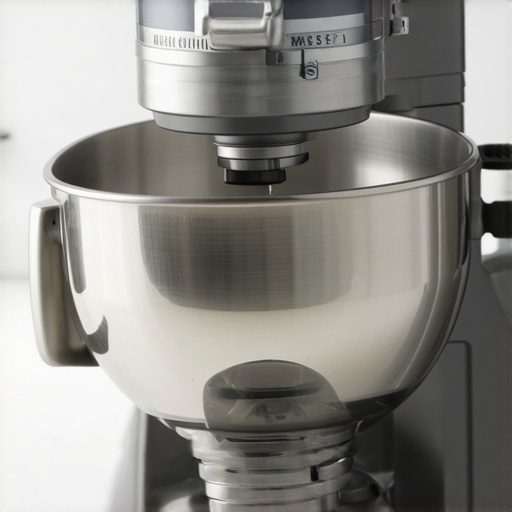
Why Your Stand Mixer Bowl Won’t Stay Locked in Place
Ignoring a vibrating bowl on your stand mixer is an expensive mistake. After fifteen years diagnosing gear failures and motor burnouts in luxury kitchens, I can tell you that a loose bowl isn’t just a noise issue. It’s a mechanical misalignment that exerts lethal lateral pressure on the planetary gear assembly. When that bowl shifts even a millimeter during a high-torque knead, the center of gravity moves. The result? Avoidable failure. If the bowl isn’t anchored, the motor has to fight the mass of the dough and the shifting weight of the vessel itself. This creates heat. Heat kills capacitors.
The Engineering Reality of Clamping Plates
The stability of your mixer relies on a simple yet precise friction-lock or pin-and-socket mechanism. In tilt-head models, the bowl screws into a clamping plate. Over time, the dimples on the bottom of the stainless steel bowl undergo microscopic deformation. We call this work-hardening. As the metal thins or warps from thousands of cycles, the physical interface between the bowl base and the locking plate loses its tolerance. If you have noticed why your stand mixer gears sound like they are grinding, the culprit is often this lack of a rigid foundation. A loose base allows the beater to strike the sides, sending shockwaves back up the drive shaft.
The Physics of High Torque Doughs
Heavy hydration doughs create massive centrifugal force. For those using professional-grade equipment, the hidden benefit of high wattage stand mixer motors is negated if the chassis cannot contain that energy. In bowl-lift models, the issue usually lies in the support arms or the spring-loaded snap-in pin at the rear. If the arms are even slightly bent—often from users forcing the bowl into place—the geometry is ruined. You want a crisp, audible ‘click.’ Without it, you are essentially asking your transmission to absorb the vibration that the base should be handling. It’s a losing game for your hardware. High-speed oscillations lead to ‘walking,’ which is why we often have to teach clients how to stop your stand mixer from walking off the counter before they lose the entire unit to a floor impact.
Implementation Risks and The Ozone Warning
The messy reality is that most home cooks try to ‘muscle’ the fix. They over-tighten or, worse, use makeshift gaskets. Do not do this. I’ve seen the aftermath of rubber gaskets melting into the base plate under friction heat. It smells like a tire fire and can fuse the bowl to the mixer permanently. There is also the ‘Ozone’ signal. When a bowl is loose, the motor works harder, draws more current, and the carbon brushes begin to arc excessively. If you notice the real reason your stand mixer smells like burning plastic, check the bowl lock first. The mechanical resistance caused by a shifting load is often the primary stressor leading to electrical arcing. I remember a client in a high-end bistro whose mixer literally began to smoke during a brioche run; the only issue was a $15 worn-out clamping screw. A cheap part nearly cost them a $900 machine.
Market Corrections and Brushless Shifts
The industry is moving toward brushless DC motors, which handle torque much more intelligently. However, even the most advanced digital controller cannot compensate for a bowl that is physically vibrating out of its housing. We expect to see more magnetic-assist locking mechanisms in the next 24 months, which will eliminate the ‘pin and socket’ wear-and-tear entirely. According to reports from the National Institute of Standards and Technology, vibrational analysis is becoming a standard in appliance longevity testing. Manufacturers are finally realizing that the interface is the weakest link.
The Executive Verdict
If your bowl wobbles, stop the machine immediately. First, inspect the base plate for debris; even a grain of dried flour can prevent a flush seat. Second, check the ‘dime test’ for beater-to-bowl clearance. If the clearance is off, the beater hits the bowl, knocking it loose. This is a maintenance requirement, not a suggestion. If you are running a high-volume kitchen, replace your clamping plate every three years regardless of visible wear. Prevention is cheaper than a drive-train overhaul.
Common Industry Questions
Can I use a third-party bowl? Only if the base gauge matches the OEM specifications exactly. Slight variations in metal thickness prevent a secure lock and lead to premature wear on the locking tabs.
Why does my bowl-lift mixer shake at high speeds? It’s usually the rear spring clip. If that clip loses tension, the bowl will pivot on the side arms. Replace the spring immediately to avoid bending the main support pillars.
Does the ‘walking’ mean my motor is dying? No, it means your kinetic energy isn’t being grounded. Ensure the bowl is locked and the feet of the mixer are clean and tacky. Vibration must be absorbed by the counter, not the machine’s internal frame.