
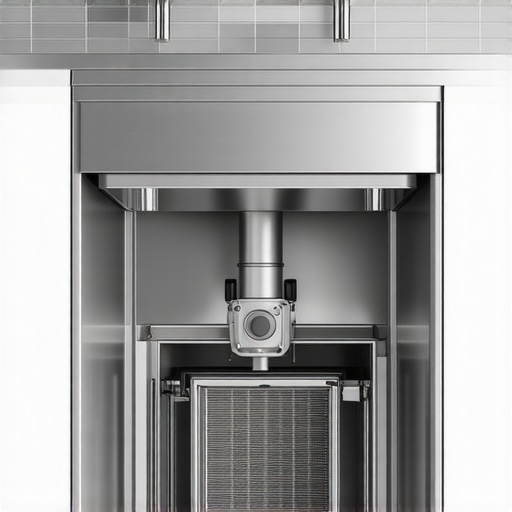
The Grease Trap Trick for Cleaner Kitchen Air
Most luxury kitchen designs treat air quality as a secondary byproduct of fan power. They are wrong. After 15 years engineering high-performance culinary environments, I have seen six-figure renovations ruined by a fundamental misunderstanding of lipid dynamics. You buy a 1200 CFM hood and assume the problem is solved. It is not. High-volume cooking, especially with high-heat premium cookware or professional-grade espresso machines, generates a specific type of aerosolized effluent that laughs at standard mesh filters. The stake here is not just a lingering smell of last night’s searing. It is the permanent degradation of your custom cabinetry and the long-term health of your family. The invisible culprit? Micronic grease droplets that bypass the fan entirely.
Technical air management requires a shift from ‘exhaust’ to ‘capture and contain.’ The physics of grease vapor dictate that once oil hits its smoke point, it undergoes a phase change into a fine mist. Standard residential hoods use aluminum mesh that acts like a sieve for these particles. The trick I implement in high-end builds involves the use of commercial-grade baffle filters coupled with a sacrificial condensation zone. Think of it as a residential grease trap for the air. By forcing the air through a series of sharp, 180-degree turns within stainless steel baffles, the heavier grease molecules lose momentum and ‘plate out’ onto the metal. This is not about suction; it is about centrifugal force. If your hood does not have a dedicated, removable grease collection trough, you are simply painting your ductwork with flammable oil. This is often why why your air fryer fan noise is getting louder over time; the internal components are coated in a sticky residue that creates drag.
The Engineering Reality of Vapor Containment
To achieve professional-grade air purity, you must account for capture velocity. This is the speed at which the air enters the hood aperture. If the velocity is too low, the thermal plume—that rising column of steam and grease—simply rolls around the edges of the hood and settles on your ceiling. We use a calculation based on the total BTU output of the range and the distance to the cooking surface. A common under-counter appliance mistake involves placing high-heat equipment without considering the make-up air requirements. For every cubic foot of air you exhaust, you must bring one in. Without a dedicated make-up air system, your high-power hood will create a vacuum, pulling air from fireplaces, water heater vents, or sewer drains. The result? Toxic back-drafting and poor air quality despite an expensive fan.
Thermal Plume Management and Surface Dynamics
Consider the material of your cooking surface. When using the most durable non-toxic coating for daily fry pans, the heat distribution is more even, which actually stabilizes the thermal plume. Cheap pans create hot spots that cause erratic ‘bursts’ of steam that a standard hood cannot catch. The ‘trick’ for cleaner air often starts at the burner. By pre-heating the hood five minutes before cooking, you establish a laminar flow that guides the effluent directly into the baffles. I have walked into countless homes where the owners complain of a ‘heavy’ feeling in the air. The smell of fresh adhesive from new cabinets often masks the real danger: PM2.5 particulate matter. This is not a theoretical risk. According to the American Society of Heating, Refrigerating and Air-Conditioning Engineers (ASHRAE), residential indoor air quality can be up to five times more polluted than outdoor air due to poor ventilation design. This is exacerbated when people use plastic liners in their premium air fryer, which can release VOCs into the kitchen environment.
Market Corrections and Future Standards
The industry is moving toward integrated air-quality sensors that talk to your HVAC system. In the next 24 months, expect local building codes to mandate higher filtration standards for any kitchen with a range exceeding 60,000 BTUs. We are seeing a move away from the ‘bigger is better’ mentality toward ‘smarter is better.’ This involves localized HEPA filtration integrated into the toe-kicks of cabinetry to catch the particles that the main hood misses. If you are designing a kitchen today, you must plan for these second-order effects. Failure to do so will result in a ‘sticky’ house within three years. My executive verdict: Invest in stainless steel baffle filters and a dedicated make-up air unit. It is a ‘buy’ for long-term property value and health. If you are currently suffering from poor air, replace your mesh filters with custom-fitted baffles immediately.
Executive Strategy FAQ
How often should I clean baffle filters?
In a high-use luxury kitchen, these should go in the dishwasher every two weeks. Grease buildup reduces the centrifugal efficiency of the air turns, leading to bypass. Do not wait for a visible layer of oil.
Does an air purifier help with cooking smells?
Only if it has a substantial activated carbon stage. Standard HEPA filters catch particles but do not neutralize the volatile organic compounds (VOCs) that carry odors. You need at least 5-10 lbs of carbon to make a dent in kitchen effluent.
Why does my kitchen still smell like fish after using the air fryer?
The heating elements often have residual oil from previous sessions. Clean the interior of the unit, not just the basket, to prevent the ‘burn-off’ of old lipids that pollutes the air. High-end units require internal wiping every five uses.