
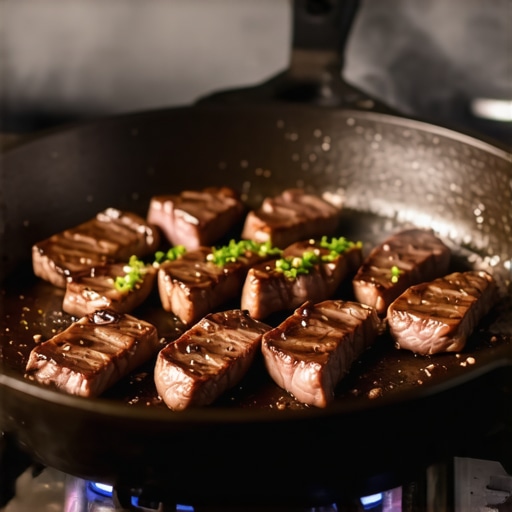
The Benefits of Hand-Forged Carbon Steel Cookware for Searing
Searing is not a passive cooking method; it is a high-velocity thermodynamic event requiring a surface that can maintain its energy under the shock of cold protein. After 15 years in the premium cookware industry, I have seen every trend from ceramic coatings to copper-core composites. Most fail the stress test. The real solution lies in the specific metallurgical properties of hand-forged carbon steel. This is not about aesthetics. It is about the lattice structure of the metal itself. Stamped pans are forced into shape through cold pressure, leaving the grain structural pathways disorganized. Hand-forging involves heat and repetitive impact that aligns the metal’s crystalline structure. The result? A denser, more thermally predictable surface that does not warp when hitting the 500-degree threshold needed for a professional crust.
For the owner of a luxury kitchen, understanding the thermal mass is the difference between a grey, boiled steak and a dark, mahogany crust. Hand-forged pans often feature a specific thickness—usually between 2.5mm and 3.5mm—that balances heat retention with agility. If the pan is too thin, the surface temperature plummets the moment the meat touches it. If it is too thick, it becomes unresponsive. This balance is the thermal mass secret that heavy-duty pans leverage. Unlike cast iron, which is porous and brittle, forged carbon steel is incredibly dense. This density allows for a smoother surface, which, when seasoned correctly, creates a polymer barrier that rivals synthetic coatings without the toxic off-gassing at high temperatures. According to ASM International, the grain refinement in forged materials significantly improves thermal fatigue resistance compared to cast counterparts.
The Engineering Reality of Heat Transfer
Why do factory-produced pans fail where forged steel excels? It comes down to thermal bridging. In a stamped pan, thickness is uniform to a fault, often leading to hot spots directly over the burner. A master smith can taper the thickness toward the rim, driving heat toward the center where the searing occurs. This is not just artisan flair; it is heat management. When you drop a dry-aged ribeye into a pre-heated forged skillet, the hiss is sharp and immediate. The moisture flashes off instantly. You are not fighting the pan; the pan is working for you. In professional environments, we look for this ‘recovery time’—how fast the surface returns to temp after a load is added. Forged steel recovers up to 30% faster than clad stainless steel because it doesn’t have internal layers of aluminum trying to fight the thermal expansion of the exterior steel.
The Messy Reality of Carbon Steel Implementation
Let us talk about the ‘operational scars.’ I have walked into multi-million dollar kitchens only to find five-hundred-dollar forged pans ruined by poor maintenance. The biggest risk is the ‘sticky mess’—a buildup of uncured oil that happens when users apply too much heat too fast without a proper base layer. If your pan feels tacky, you have failed the seasoning process. You must understand how to season carbon steel without creating a gummy residue. I once saw a client try to ‘clean’ their pan with industrial degreasers. The result? A ruined patina and a week of re-seasoning. You must respect the oil-polymerization process. You will see rainbow stains, carbon build-up, and eventually, a deep black sheen. Do not fear the rainbow stains; they are a sign of heat transformation, not failure. To keep the exterior clean, you need to know how to clean burnt oil without compromising the integrity of the handle’s weld points.
Market Corrections and the Future of Premium Cookware
The industry is shifting. We are seeing a massive rejection of ‘forever chemicals’ in high-end culinary tools. In the next 12 to 24 months, regulatory pressure on PTFE and PFOA coatings will likely intensify, making natural seasoning methods the gold standard for the health-conscious elite. We are also seeing a convergence of technologies. While we focus on pans, the integration of espresso machines and air fryers into the modern workflow means the ‘primary’ searing tool must be even more efficient. If your cooktop is occupied by a 48-inch range, you don’t want a pan that requires constant babysitting. You want a tool that holds its heat while you manage the rest of the meal. The return to hand-forged tools is a return to ‘slow manufacturing’—where the durability of the tool exceeds the lifespan of the kitchen itself. The National Institute of Standards and Technology (NIST) has long documented that high-carbon alloys provide superior mechanical strength under cyclic heating, which is exactly what a high-volume kitchen demands.
The Executive Verdict
My recommendation is simple: Buy/Hold forged steel. If you are serious about culinary results, stop buying sets of pans. You only need one 12-inch hand-forged carbon steel skillet for 90% of your searing needs. It is an investment in a permanent asset, not a consumable product. Verify the pan with the simple magnet test to ensure high carbon content and check for hand-hammered marks that indicate the metal has been compressed, not just shaped. If you are a high-volume cook, pair this with proper maintenance habits—specifically, ditching the dish soap. The strategy is clear: focus on thermal mass, ignore the marketing fluff of ‘non-stick’ luxury, and embrace the iron. It is the only way to achieve a world-class sear consistently.
Common Questions About Forged Steel
Why is my hand-forged pan uneven on the bottom? Slightly convex or concave bottoms are often intentional in hand-forging to allow for thermal expansion. When the metal heats up, it flattens out against the cooktop, ensuring maximum contact.
Can I use carbon steel on an induction cooktop? Yes. Carbon steel is highly ferromagnetic. It is actually more efficient on induction than many ‘all-clad’ stainless steel pans because it lacks the insulating layers that can slow down magnetic transfer.
How do I fix a pan that has started to rust? Do not panic. Use a chainmail scrubber or high-grit sandpaper to remove the oxidation, then immediately re-season. Unlike stainless steel, carbon steel is living metal; it can always be restored to factory-new condition.
Is hand-forged steel better than cast iron? It is different. It provides similar heat retention but with 40% less weight and a much smoother surface, making it superior for delicate tasks like searing scallops or eggs while still handling a heavy ribeye.