
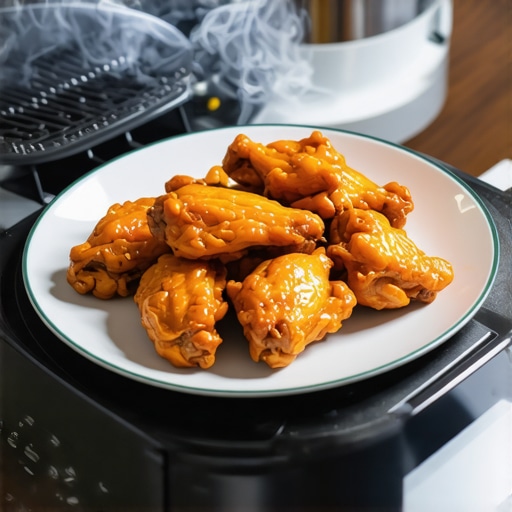
The Fan Speed Secret to Perfectly Crispy Wings Without the Oil
Soggy skin isn’t a temperature failure; it is a fluid dynamics disaster. After fifteen years designing and supplying the world’s most sophisticated luxury kitchen setups, I have seen five-thousand-dollar convection suites fail to produce a decent wing because the owner didn’t understand the boundary layer. Most home cooks believe that cranked-up heat is the lever for crispness. It is not. The real mechanism is the high-velocity displacement of moisture. If that steam lingers for even a millisecond too long on the skin, you are poaching, not frying. The stakes are high: thousands spent on high-end air fryers and premium cookware, only to produce a rubbery, grey result that ends up in the disposal.
The Engineering Reality of High-Velocity Airflow
To achieve that specific glass-like crunch, you need to navigate the physics of the Maillard reaction under high-torque conditions. Standard air fryers often suffer from ‘lazy air’—pockets where the fan speed drops due to internal resistance. In the world of commercial-grade appliances, we look at Cubic Feet per Minute (CFM) and the static pressure of the internal chamber. When air moves at a specific velocity, it strips away the insulating layer of cool, moist air surrounding the chicken. This allows the heat to hit the fat directly. This is why why air fryer chicken wings get soggy and the cornstarch fix becomes a necessary technical adjustment for those using lower-velocity consumer units. The cost-benefit is clear: higher fan speeds allow for lower temperatures, preserving the internal moisture of the meat while desiccating the exterior.
The Heat Management Matrix
Thermal mass plays a secondary but vital role. Most people throw cold wings into a cold basket. That is a tactical error. You need the basket to act as a heat sink the moment contact is made. If the fan has to work to overcome a 40-degree drop in ambient chamber temperature, you’ve already lost the crispness battle. I always recommend a ten-minute preheat at the maximum setting. We are looking for the sound of a jet engine, not a desk fan. This ensures that the moment the collagen begins to break down, the moisture is instantly vaporized and evacuated from the system. Often, the only way to get truly crispy skin in a basket air fryer is to optimize this specific preheat-to-velocity ratio.
Implementation Risks and the Messy Reality
What breaks in this pursuit of perfection? The hardware. Running a fan at 3,000+ RPM creates significant vibration and heat within the motor housing. I’ve stood in local kitchens where the smell of ozone and burning lubricants filled the air because a client pushed a mid-tier unit too hard. You can feel the vibration through the granite countertop—a rhythmic, unsettling thrum that signals imminent bearing failure. Furthermore, high-velocity air carries atomized grease into the heating elements. Without proper maintenance, this grease polymerizes, turning into a sticky, carbonized varnish that ruins efficiency. You might notice why some air fryers cook unevenly and the foil solution as a temporary fix, but the real issue is often grease-clogged intake vents reducing the very fan speed you rely on.
The Macro View of Kitchen Infrastructure
The industry is moving toward high-torque DC motors that can maintain RPMs even as the basket is crowded. However, this creates a new bottleneck: power draw. We are seeing a trend where why your air fryer needs a dedicated circuit to reach max temp is becoming a standard recommendation for luxury renovations. If you are pulling 1800 watts for the heating element and another 200 for a high-performance fan, a shared 15-amp circuit will trip, or worse, undervolt the motor, leading to the very ‘lazy air’ we are trying to avoid. Local building codes are beginning to catch up with the reality that these aren’t just ‘small appliances’—they are high-performance thermal processors.
The Executive Verdict
If you want the ultimate wing, my recommendation is a ‘Buy’ on high-wattage, high-RPM units with vertical airflow patterns. Avoid the wide, flat ‘toaster oven’ style air fryers unless they specifically cite CFM ratings. If you are currently struggling with soggy results, execute this strategy: pat the protein dry with lint-free towels, apply a thin dusting of alkaline powder (baking powder), and maximize your fan speed. Do not crowd the basket. The result? Culinary precision.
FAQ
Does using oil help or hurt the fan’s efficiency?
Excess oil becomes a coolant. Use a high-smoke point spray, but keep it minimal to allow the air velocity to do the work. Why does my air fryer smell like burning plastic at high speeds?
This is often ‘off-gassing’ from cheap internal gaskets. In premium units, this shouldn’t happen after the initial burn-in period. Can I use parchment paper?
Only if it’s perforated. Solid sheets block the very airflow we are trying to optimize, effectively turning your air fryer into a slow oven.