
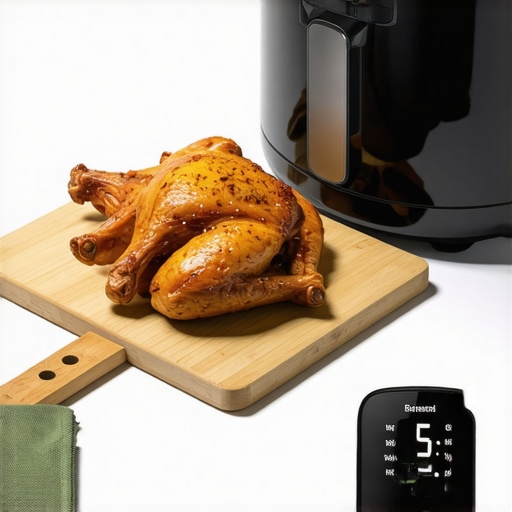
Why Most Air Fryer Recipes Overcook Chicken and How to Fix It
Most home cooks treat the air fryer like a miniature convection oven. This technical misunderstanding leads to dry, fibrous poultry that lacks the succulent texture found in professional kitchens. After fifteen years of diagnosing thermal performance in luxury kitchen appliances, I can state with certainty: the convection-to-mass ratio in these machines is too high for standard recipes. Standard instructions ignore the aggressive moisture-wicking effect of high-velocity airflow. The result? Avoidable failure.
The Physics of Rapid Dehydration
Air fryers operate on a simple principle of forced convection. A heating element positioned millimeters away from a high-speed fan creates a cyclonic heat environment. While traditional ovens rely on radiant heat with slow air movement, the air fryer uses velocity to strip the boundary layer of moisture from the surface of the chicken. This accelerates the Maillard reaction but simultaneously drives the internal temperature past the point of cellular collapse before the exterior achieves the desired crunch. The mechanical reality of these espresso machines of the cooking world is that they are too efficient. If you follow a recipe written for a standard fan-assisted oven, you are essentially sandblasting your dinner with dry heat. Managing this requires a shift in how we perceive thermal equilibrium.
To mitigate this, you must account for the hazardous aerosol build-up that often plagues these systems. Using certain oils can lead to hazardous aerosol build-up which further disrupts heat transfer by coating the sensors in a sticky residue. Cleanliness is not just about hygiene; it is about thermal accuracy. Without a clean path for the air, the machine compensates by spiking the element temperature, leading to scorched exteriors and raw centers.
Thermal Inertia and the Carryover Trap
The biggest risk to a perfect breast or thigh is thermal drift. Because the heating element is so close to the protein, the surface temperature often exceeds the target internal temperature by over 200 degrees Fahrenheit. Once the fan stops, that heat does not vanish. It migrates inward. Most recipes suggest cooking until a thermometer reads 165°F. This is a mistake. By the time the probe hits 165°F inside an air fryer, the residual energy will push the final resting temperature to 175°F or higher. This destroys the protein structure. The solution involves pulling the meat at 155°F and allowing the high surface energy to finish the job during a ten-minute rest.
Technical precision matters. If you are struggling with texture, you might need to solve soggy skin issues by focusing on surface pH and moisture rather than just cranking the heat. This balance is what separates premium cookware results from basic countertop performance. For those using professional-grade equipment, maintaining the heating element is vital to prevent erratic temperature swings. According to the Food Safety and Inspection Service (FSIS) guidelines, internal temperature is the only metric that matters, but they rarely discuss the velocity of the heat source which dictates the window of success.
The Strategy of Volumetric Loading
Airflow is the lifeblood of the luxury kitchen. If you crowd the basket, you create ‘cold spots’ where air cannot circulate. This forces the machine to run longer, overcooking the pieces near the fan while the middle pieces remain rubbery. I have seen this happen in stand mixers where the motor stalls under heavy load, and the same logic applies here: capacity is not the same as capability. You should never fill a basket more than 50% by volume. The air needs to ‘breathe’ around the meat to ensure even browning. Some technicians even recommend using foil solutions to redirect air if your specific model has a known bias toward one side of the tray. This is a common flaw in entry-level units that lack the sophisticated ducting of high-end brands.
Future Kitchen Dynamics
The industry is moving toward integrated sensors and AI-driven thermal probes. In the next 24 months, we expect to see ‘smart’ fryers that modulate fan speed based on humidity sensors. This will align the technology closer to high-end combi-ovens used in Michelin-starred restaurants. For now, the burden of intelligence falls on the operator. You must act as the thermostat. The ASHRAE (American Society of Heating, Refrigerating and Air-Conditioning Engineers) standards for air distribution highlight how turbulence affects heat transfer; applying these principles to your chicken means reducing the ‘wind chill’ effect by lightly coating the skin in a high-smoke-point fat to act as a thermal buffer.
The Executive Verdict
Stop trusting the presets. The ‘Chicken’ button is a recipe for mediocrity. If you want results that justify the counter space, invest in a fast-response thermocouple probe. Set your air fryer 25 degrees lower than the recipe suggests and pull the meat early. If you are cooking wings, focus on skin dehydration before the heat even starts. If you are cooking breasts, use a brine to increase the thermal mass. The goal is moisture retention through engineering, not luck.
Technical FAQ
Why is my chicken always dry but the skin is pale?
This is usually caused by excessive moisture on the surface. The air fryer is spending all its energy evaporating water rather than browning the skin. Pat the meat bone-dry with paper towels before seasoning.
Should I use the preheat function?
Yes. Thermal stability is reached only after the metal housing and basket have absorbed initial heat. Putting meat into a cold fryer results in a longer cook time and more moisture loss.
Can I use parchment paper to save on cleaning?
Use it sparingly. Blocking the holes in the basket restricts the very airflow the machine depends on for crisping. If you must use it, ensure there is plenty of open space around the edges.
Does the wattage of the machine matter?
High-wattage machines recovery temperature faster after the basket is opened. This prevents the ‘steaming’ effect that happens when the temperature drops too low for too long.