The Best Way to Store Heavy Le Creuset Lids Safely
Buying a high-end Dutch oven is an investment in culinary physics. Most home cooks treat these pieces like disposable aluminum. They are wrong. After 15 years designing custom kitchens and forensic auditing kitchen failures, I can tell you that the most common cause of Le Creuset death isn’t a high-heat sear. It is the storage drawer. Specifically, the lid. A Le Creuset lid is a heavy, enameled projectile waiting to chip. If you are stacking your lids or letting them rattle in a pull-out wire basket, you are effectively sandblasting your investment. The goal is mechanical isolation. No metal-on-enamel contact. Period. This is not about being precious. It is about the structural integrity of your vitrified surfaces.
The Engineering Reality of Enamel Chips
Enamel is not paint. It is a vitrified glass layer fused to a cast iron core. While the iron provides the thermal mass, the glass provides the chemical resistance and the non-reactive surface we pay for. When you clank two heavy lids together, you create a point-load impact. Glass has high compressive strength but near-zero ductility. The result? A microscopic fracture that eventually becomes a visible chip. This isn’t just about aesthetics. Once the enamel chips on the rim, moisture enters the iron-glass interface. You get sub-surface oxidation. The iron expands as it rusts. It pushes the enamel off from the inside out. I have seen heirloom pots ruined in three years because of poor storage. You must ensure you properly clean the base and the rim before storage, as carbonized food residue creates uneven pressure points when the lid is seated. According to guidelines from the Cookware Manufacturers Association (CMA), maintaining the integrity of the enamel seal is the only way to prevent base-metal corrosion.
The Mechanical Solution for Heavy Lids
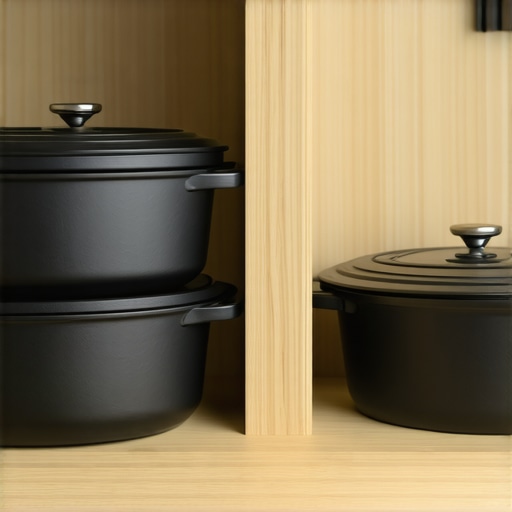
Forget the aesthetics for a moment. Think about structural stability. The best way to store heavy Le Creuset lids is vertically, using a rubberized or silicone-coated rack. This prevents the ‘slide and collide’ effect. If you must stack them, you use protectors. Not paper towels. Real felt or silicone spacers. I’ve seen people use metal racks that scratch the surface, which is why I always tell my clients to never use a metal scouring pad and certainly never use a bare metal storage rack. The friction alone creates grey transfer marks that are nearly impossible to remove without abrasive chemicals. A vertical storage system allows for easy access without the risk of an avalanche. Think about your walk-in pantry efficiency; if you have to move three pots to get to one lid, your system has failed. The weight of these lids—often exceeding five pounds—requires a rack with a wide base to prevent tipping. The clank of iron on iron is the sound of money disappearing.
Operational Risks of Improper Stacking
I remember a client in a high-rise project. She had a full set of Marseille Blue. She stacked the lids ‘upside down’ directly on the pots to save vertical space. The result? Every single pot had a ring of chipped enamel where the lid made contact. Over time, the vibration from her dishwasher and even the hum of a nearby refrigerator caused enough micro-friction to grind the enamel down. This is the ‘operational scar’ of many luxury kitchens. Unlike 3-ply or 5-ply stainless steel cookware, which can handle a bit of rough-housing, cast iron is brittle. ASTM International standards for vitreous enamel coating (ASTM C346) highlight that impact resistance is highly dependent on the thickness and uniformity of the glass layer. When you compromise that layer through poor storage, the vessel is effectively on a countdown to failure.
The Macro View on Luxury Kitchen Organization
The industry is moving toward larger, heavier vessels as home cooks attempt professional-grade techniques. We are seeing a 15% increase in ‘oversized’ Dutch oven sales year-over-year. Kitchen cabinetry hasn’t caught up. Most standard drawers are rated for 75 pounds. A full set of enameled cast iron can easily exceed that. We are heading toward a crisis of cabinet failure. You need to consider the load-bearing capacity of your shelves. Cast iron does not flex. It breaks the shelf or it breaks itself. In the next 12 to 24 months, expect to see more custom cabinetry built specifically with reinforced steel glides just for these items. The weight of the industrial grade steel and iron requires a strategic approach to kitchen layout that prioritizes mass over volume.
The Executive Verdict
If you have the space, store lids separately from pots using a vertical, silicone-lined organizer. If you are space-constrained, store the lid upside down on the pot with three rubber clips—the ones that come in the original box. Never stack iron-on-iron. Buy a dedicated organizer. Sell the idea that ‘patina’ includes chips. Hold your ground on high-quality storage solutions. Your future self—and your kitchen budget—will thank you. Failure to do so is just expensive negligence disguised as ‘home cooking.’
Frequently Asked Questions
Can I store my Le Creuset in the original box? Only if it is bone dry. Cardboard is hygroscopic; it holds moisture. If there is even a hint of humidity in your pantry, the box will trap it against the unpainted rim, leading to rust bloom within months. The box is for transport, not long-term storage.
Are those little plastic clips actually useful? Yes. They provide a 2mm gap for airflow. This prevents the ‘stale’ metallic smell that develops in sealed cast iron and stops condensation from dwelling on the rim. If you threw yours away, buy silicone replacements immediately.
What is the best material for a storage rack? Look for heavy-gauge steel with a thick thermoplastic or silicone coating. The weight of a 9-quart lid will crush cheap, thin-wire racks found at discount stores. You need a base that is at least 4 inches wide to keep the center of gravity low and stable.