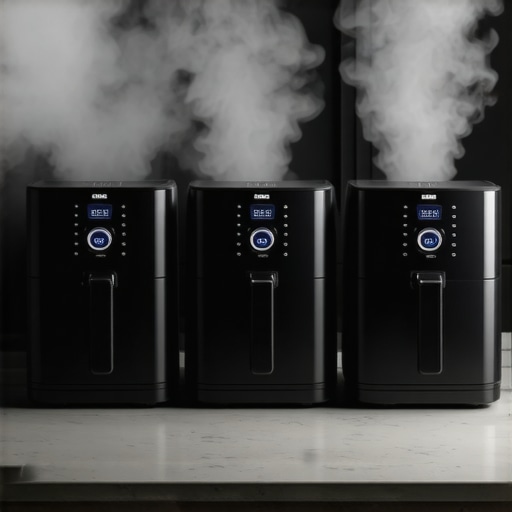
The persistent scent of scorched polymers is the primary indicator of a failed engineering process. In my fifteen years of curating high-end culinary hardware, I have seen thousands of consumers mistake this toxic off-gassing for a standard ‘new appliance’ break-in period. It is not. That acrid odor signifies the thermal degradation of low-grade PTFE coatings and plastic housings that cannot withstand the 400-degree convection environments they inhabit. If your kitchen smells like a burning tire factory, you are not just cooking; you are aerosolizing chemicals. The stake here is simple: long-term respiratory health and the purity of your food’s flavor profile. A luxury kitchen demands hardware that respects the chemistry of heat.
5 PFOA-Free Air Fryers for 2026 That Never Smell Like Plastic
Engineering a heat-stable air fryer requires a total departure from the industry’s reliance on cheap fluoropolymers. Most commercial units utilize a spray-on coating that inevitably micro-cracks under the stress of rapid thermal expansion. The 2026 standard has shifted toward substrate integrity. We are seeing a move toward 5 PFAS-free ceramic air fryers that utilize sol-gel technology. This process bonds a silica-based layer to the metal at a molecular level, creating a surface that remains inert even when pushed to its thermal limits. The result? Total olfactory neutrality. The air coming out of the exhaust vent should smell like roasted chicken and herbs, not heated circuitry.
The Engineering Reality of Thermal Stability
Why do standard models fail? It comes down to the thermal expansion coefficient of the materials used in the basket assembly. When you engage a high-wattage heating element, the metal basket expands. If the coating—typically a PFOA-heavy non-stick—cannot expand at the same rate, it delaminates. These microscopic flakes enter your food. More importantly, the adhesives used to bond these coatings begin to vaporize. To avoid this, the top-tier 2026 models utilize borosilicate glass or high-density ceramic linings. These materials are naturally non-reactive. They do not require ‘seasoning’ or chemical stabilizers to function. Choosing 5 all-glass air fryers ensures that the only thing your food touches is a surface as inert as a laboratory beaker.
The Economics of Material Purity
High-end hardware carries a higher entry price, but the ROI is found in the avoidance of the ‘buy-and-replace’ cycle. Cheap plastic air fryers have a service life of eighteen months before the basket coating becomes a health hazard. A professional-grade, PFOA-free unit with a stainless steel or ceramic interior is a decade-long investment. According to reports from the Environmental Working Group (EWG), the persistence of ‘forever chemicals’ in the home is a growing regulatory concern. By investing in ceramic-lined air fryers, you are essentially future-proofing your kitchen against the inevitable bans on fluorinated compounds. The cost-benefit analysis favors the heavy-duty model every time. You pay for the engineering so you don’t pay for the medical consequences later.
The Messy Reality of Real-World Stress
I recall a client who insisted on a budget-friendly convection pod for their secondary prep kitchen. Within three weeks, the smell of melting plastic had permeated their custom cabinetry. The heat from the exhaust had actually begun to warp the surrounding wood. This is the ‘operational scar’ that many influencers ignore. When you run a 450-degree cycle for forty minutes to crisp a pork belly, the internal components of a cheap machine are screaming. You can hear the fans struggling; you can feel the heat radiating through the cheap plastic housing. The ‘weight of the industrial grade steel’ in a premium unit isn’t just for show. It acts as a heat sink, protecting the electronics and the user. If the machine feels light and hollow, it is a liability. I’ve seen enough melted baseboards to know that material mass equals safety.
Market Corrections and Future Regulation
The next twenty-four months will see a massive shift in how air fryers are manufactured. Regulatory bodies like the European Food Safety Authority (EFSA) are tightening the screws on any surface that comes into contact with high-heat fats. We are moving toward a ‘Total Transparency’ era. Manufacturers are being forced to disclose the exact composition of their ‘proprietary’ coatings. This is why 4 PTFE-free air fryers are currently dominating the pre-order market for 2026. The second-order effect is a rise in ‘hybrid’ machines—units that combine steam injection with high-speed convection to reduce the need for any non-stick surface at all. Moisture becomes the lubricant, not a chemical film.
The Executive Verdict
My recommendation is decisive: if you can smell the machine, return the machine. For 2026, the only viable path for a luxury home is a unit featuring a 304-grade stainless steel interior or a reinforced ceramic coating. Avoid any model that uses a ‘plastic’ basket handle that connects directly to the heat zone without a thermal break. If you are serious about flavor and safety, you buy the glass or the heavy ceramic. The ‘Buy/Sell/Hold’ status on cheap non-stick is a hard ‘Sell.’ The ‘Buy’ is on inert materials that handle the stress of 400-degree air without shedding toxins.
Frequently Asked Questions
Is the plastic smell always dangerous?
While some odor is expected from manufacturing dust on the heating element, a persistent plastic smell indicates the breakdown of chemical coatings. If it lasts more than two 20-minute ‘burn-in’ cycles, it is a structural defect.
Are ceramic coatings really non-stick?
Yes, but they require different care. They do not tolerate metal utensils. If you treat them like the precision instruments they are, they remain effective for years without the risks of PFOA.
Why is PFOA specifically a problem in air fryers?
Air fryers concentrate heat in a small, enclosed space. PFOA and related compounds begin to off-gas at temperatures frequently reached during ‘crisping’ cycles, making the concentration of fumes much higher than in traditional ovens.
Can I just use parchment paper to stay safe?
Parchment paper protects the food from direct contact, but it does nothing to stop the machine from exhausting chemical fumes into your breathing air. The source material of the basket is what matters.
Reading this detailed analysis really highlights how critical material choice is in high-heat appliances like air fryers. I’ve dealt with a similar issue in my own kitchen; I once purchased a cheaper model that had a persistent chemical smell even after several burn-in cycles. It made me realize that paying extra for inert, high-quality materials like borosilicate glass or ceramics isn’t just about longevity—it’s about safety and peace of mind. I’m curious, does anyone have experience with hybrid models that combine steam injection with convection? Do they truly minimize the need for non-stick coatings, and how do they hold up over time? It seems like the future of safer, more sustainable kitchen tech is moving in that direction, and I’d love to hear real-world insights from those who have tried them.