
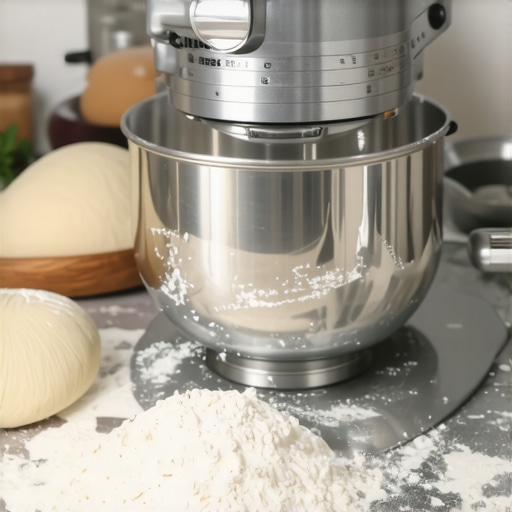
Why Your Stand Mixer Jumps Across the Counter During Kneading
I have spent fifteen years watching high-end appliances commit suicide by diving off granite countertops. You buy a premium machine expecting a workhorse, yet it dances toward the edge the moment you introduce a sourdough starter. This isn’t a quirk. It is a fundamental failure of mechanical engineering and weight distribution. If your machine is walking, it is telling you that the internal forces generated by the motor are no longer being absorbed by the chassis. Instead, they are being transferred to your kitchen island. Ignoring this leads to stripped gears, burnt-out capacitors, and a very expensive piece of scrap metal on your floor.
The Engineering Reality of Torque and Weight
Most home-grade stand mixers rely on high-speed AC motors geared down to provide the torque needed for bread. This creates a massive amount of centrifugal force. When the dough hook catches a dense mass of gluten, that force has to go somewhere. In a poorly designed unit, the center of gravity shifts too high. You can often track this back to the planetary action itself. If the head of the mixer isn’t locked down with zero tolerance, it creates an oscillatory rhythm. Think of it like an unbalanced washing machine. The heavier the dough, the more that oscillation amplifies until the rubber feet lose their grip. If you want to understand the guts of the issue, you need to look at the heavy duty stand mixer motor comparison ac vs dc to see how power delivery affects stability.
A technical truth that most big-box brands won’t admit? Weight is a double-edged sword. While a heavy cast-iron base helps, it cannot overcome a weak locking hinge. In tilt-head models, the pin that holds the motor head to the base often wears down. This creates a fraction of a millimeter of play. That tiny gap is all the physics needs to start the ‘walk.’ Professional kitchens rarely use tilt-heads for this exact reason; they opt for bowl-lift designs where the motor remains static and the bowl is braced by a steel cradle. This structural rigidity is what prevents the machine from traveling.
The Stress Test: When Sourdough Becomes a Gear Killer
I remember a client in a high-end loft who called me after her third ‘premium’ mixer died in a year. She was making 80% hydration sourdough. The smell of ozone was thick in her kitchen—a clear sign of an overworked motor. When we cracked the housing open, the internal gears looked like they had been through a rock crusher. Many modern machines use a ‘sacrificial gear’ made of plastic. The idea is that the gear breaks before the motor burns out. While it protects the electronics, it doesn’t help the fact that the machine was jumping because it couldn’t handle the sheer resistance of the dough. For those serious about heavy baking, you should look into 3 all metal gear mixers that dont strip when kneading bagel dough to avoid this specific failure point.
Sensory anchors don’t lie. Listen for a rhythmic clicking or a high-pitched whine. These are precursors to the jump. Feel the top of the motor housing. If it is hot to the touch after five minutes of kneading, your gear ratio is wrong for the task. The friction of the metal-on-metal (or metal-on-plastic) creates a heat sink effect that expands the internal components, making the ‘walking’ even more pronounced as the internal alignment shifts.
Market Corrections and the Shift to DC Power
The industry is currently at a crossroads. For decades, we relied on mass-market engineering that prioritized aesthetics over raw mechanical advantage. However, we are seeing a shift toward high-torque DC motors in the luxury segment. These motors are smaller but significantly more powerful at low speeds, allowing the weight of the machine to be concentrated lower in the base. This lower center of gravity is the best defense against counter-walking. We are also seeing the rise of stop the shake 4 pressure mapping stand mixers for 2026, which use sensors to adjust speed when they detect instability. It is a reactive solution to a physics problem, but it saves the machine from a fatal fall.
Regulatory changes in energy efficiency are also forcing manufacturers to move away from the massive, power-hungry AC motors of the past. This is a good thing for your counter stability. Smaller, more efficient motors allow for denser housing materials like zinc and magnesium alloys, which provide the weight without the bulk. Expect the next 24 months to see a total phasing out of plastic gear assemblies in any machine costing over five hundred dollars.
The Executive Verdict
If your mixer is jumping, stop the machine immediately. You are likely exceeding the ‘flour capacity’ or the ‘hydration limit’ of that specific model. My recommendation? If you bake bread more than twice a week, sell the tilt-head and move to a bowl-lift model with a DC motor. The ROI on a more expensive machine is realized the first time you don’t have to replace a $400 unit after a year of heavy use. For a quick fix, ensure your countertop and the mixer’s feet are bone dry and free of flour dust. Friction is your only friend here. If the problem persists, check the simple dime test that stops your stand mixer from chipping the bowl, as poor clearance often leads to uneven resistance and jumping.
Frequently Asked Questions
Can I use a rubber mat to stop the jumping?
No. A rubber mat often masks the vibration while allowing the internal components to continue shaking violently. You want the machine to be coupled directly to a solid surface to dissipate the energy.
Is it normal for the head of my mixer to wiggle during kneading?
A tiny amount of movement is expected in tilt-head models, but anything more than a millimeter indicates the locking bolt needs adjustment or replacement.
Why does my mixer only walk when making bread?
Bread dough is non-Newtonian in its resistance. It pulls and pushes against the hook with varying force, creating the ‘tug-of-war’ effect that causes the base to shift. Cakes and cookies don’t provide enough resistance to trigger the jump.
Should I weigh down the base of the mixer?
Never. Adding external weight can strain the motor or cause the base to crack if the internal oscillation is severe. Fix the source of the vibration instead.
Comments are closed.