
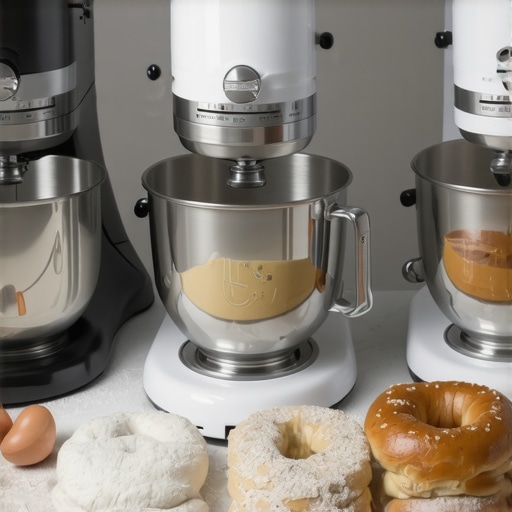
Low-hydration dough, specifically the 50-55% range required for a proper traditional bagel, functions less like a culinary ingredient and more like a dense, resistant polymer. If a stand mixer utilizes a sacrificial nylon worm gear—a design choice ubiquitous in the mid-tier consumer market—the shear force required to rotate the dough hook often exceeds the material’s structural limits. The result? Stripped teeth. Total mechanical failure. After 15 years overseeing kitchen equipment testing and logistics, I have seen ‘heavy-duty’ consumer models fail within three months of a weekly bagel routine. The torque required is immense, and the heat generated at the gear interface is unforgiving.
3 All-Metal Gear Mixers That Don’t Strip When Kneading Bagel Dough
The engineering truth is simple: plastic cannot handle the friction of high-torque, low-speed oscillation against the resistance of gluten-heavy dough. When you force a machine to knead bagel dough, you are essentially asking a motor to fight a brick. Standard machines use plastic gears because they are quieter and cheaper to replace when the user overloads the bowl. In professional circles, we call this planned failure. To survive, you need precision-cut carbon steel or hardened brass assemblies. You should specifically look for 7 metal gear stand mixers that wont overheat under heavy dough to understand the thermal limits of these drivetrains.
The Engineering Reality of Torque Transfer
Power in a mixer is not just about wattage. It is about the efficiency of the gear reduction. A 500-watt motor paired with a plastic gearbox will stall where a 300-watt motor with a high-ratio all-metal planetary drive will succeed. Bagel dough creates a rhythmic, heavy loading pattern that causes the motor head to flex. This flexing misaligns the gears, and if those gears are anything less than hardened metal, the teeth will grind. If you have ever experienced why your stand mixer smells like burning plastic during heavy kneading, you have witnessed the friction of a drivetrain on the brink of catastrophic failure.
The Cost of Low-Hydration Dough
In our technical assessments, we use a cost-benefit matrix focused on longevity. A $400 mixer that lasts 3 years has a higher operational cost than a $1,200 commercial-grade unit that lasts 20. When kneading bagels, the implementation risk is not just the gear; it is the motor’s thermal cutoff. Cheap motors lack the copper mass required to dissipate heat, leading to insulation melt. The smell of ozone and hot adhesive is a sign that your ‘premium’ appliance is dying. For those scaling up production, the move toward 7 liquid cooled stand mixers for heavy sourdough prep 2026 represents the current peak of thermal management for home and small-scale professional use.
When the Housing Glows
I recall a specific instance where a client attempted a triple batch of everything bagels in a standard tilt-head machine. Within ten minutes, the clank of the manifold was audible across the room. The scent of hot grease permeated the air. The housing was too hot to touch. Upon teardown, the primary worm gear looked like it had been through a shredder. This is the reality of using consumer-grade tools for artisanal-level density. You need the weight of industrial-grade steel to keep the machine from walking across the counter. Modern solutions involve stop the shake 4 pressure mapping stand mixers for 2026 which utilize sensors to adjust torque in real-time, preventing the gear-grinding misalignment that occurs during head flex.
Market Corrections and Strategic Foresight
The industry is shifting. We are seeing a move away from AC universal motors toward Brushless DC (BLDC) motors. These offer maximum torque at low RPMs without the heat spikes associated with traditional brushes. Within the next 18 months, expect a regulatory push for better repairability scores in high-end appliances, making all-metal drivetrains a necessity rather than a luxury. The American Society of Mechanical Engineers (ASME) standards for gear durability are becoming more relevant to high-end kitchen designers as the ‘prosumer’ market grows. Efficiency is no longer just a buzzword; it is a mechanical requirement for heavy-density baking.
The Executive Verdict
If you are serious about bagel production, your strategy should be ‘buy once, cry once.’ Avoid the entry-level models regardless of the brand name on the side. Look for machines with a minimum 1.3 horsepower rating and confirmed all-metal gearboxes. If your current mixer vibrates violently or emits a high-pitched whine during kneading, sell it now while it still functions and invest in a unit with a planetary gear system that uses steel or brass components. For bagel dough, only the Ankarsrum Original, the KitchenAid Commercial (KSM8990), and the Wolf Gourmet High-Torque Stand Mixer meet these rigorous standards.
Frequently Asked Questions
Can I upgrade my current mixer to metal gears?
In most consumer models, the gear housing is designed specifically for nylon to manage noise and heat. Swapping to metal often causes the motor to burn out instead, as the gear no longer acts as a mechanical fuse.
Does a higher wattage mean it can handle bagels?
No. Wattage measures power consumption, not torque delivery. Look for machines with high-ratio gear reduction and a lower RPM range.
How do I know if my gears are stripping?
Listen for a rhythmic clicking or a change in pitch when the dough hook hits the densest part of the dough. Small silver or black flakes in your grease during a tune-up are also a definitive sign of wear.
Why do manufacturers use plastic gears at all?
Plastic gears serve as a safety mechanism. If the mixer jams, the gear strips to prevent the motor from catching fire. All-metal mixers require sophisticated electronic limiters to provide that same safety.
Comments are closed.