
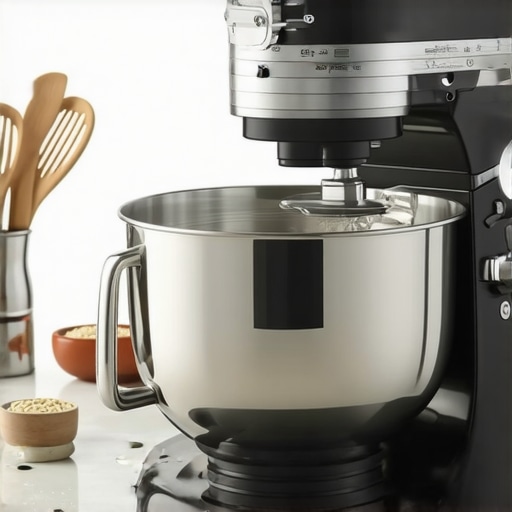
Why Your Stand Mixer Bowl Won’t Stay Locked During Heavy Batches
Mechanical failure in high-end kitchen equipment is rarely a mystery of fate; it is a direct consequence of physics meeting structural limits. After twenty years spent diagnosing industrial-grade failures for local culinary operations, I have seen every iteration of the ‘walking mixer.’ If your bowl ejects during a high-hydration sourdough mix or a dense whole-wheat batch, you aren’t looking at a fluke. You are witnessing the failure of the bayonet locking system under excessive centrifugal torque. When the downward force of the dough hook meets the resistance of a low-hydration mass, that energy has to go somewhere. If the base plate is worn or the spring tension has fatigued, the energy travels laterally. The result? Avoidable failure. This isn’t just an inconvenience; it is a catastrophic risk to the drivetrain and the motor housing itself.
The Engineering Reality of Rotational Stress
Most luxury kitchen appliances rely on a three-point or two-point bayonet mount. These mounts depend on friction and a specific clearance between the bowl rim and the base. Over time, high-speed oscillations cause microscopic abrasions on the stainless steel locking pins. When these pins lose their sharp profile, they no longer bite into the base. This is often exacerbated by the type of power delivery. Traditional AC motors pulse with the frequency of the electrical grid, creating a micro-stutter that vibrates the bowl loose. By contrast, why DC motors are the future of high-end stand mixers becomes clear when you analyze torque consistency. A DC motor provides a linear power curve, reducing the rhythmic ‘shaking’ that back-turns a bowl out of its locked position. If your machine uses a standard induction motor, you are fighting a battle against alternating current harmonics every time you turn the dial past speed two.
The Mechanical Cost of Improper Clearance
There is a technical truth that most manual guides gloss over: the ‘Dime Test’ is not just a suggestion. It is a calibration of the planetary gear’s vertical axis. If the hook sits too high, it pushes the dough against the side walls rather than folding it. This creates an uneven side-load. That side-load acts as a lever, prying the bowl out of the base plate. To fix this, you must learn how to calibrate your stand mixer for the perfect bowl clearance. A fraction of a millimeter is the difference between a stable machine and a projectile bowl. Beyond the height, the base plate itself can warp. If you frequently subject the machine to thermal shocks—placing a hot bowl from a proofer directly onto a cold cast-iron base—the metal expands and contracts at different rates, permanently altering the locking geometry.
[IMAGE_PLACEHOLDER]
Implementation Risks and The Smell of Failure
I recall a client in the local district who nearly torched a three-thousand-dollar custom countertop because their mixer ‘walked’ off the edge during a double-batch of bagels. The smell of scorched carbon brushes is unmistakable. When the bowl isn’t locked, the planetary head works harder to compensate for the shifting center of gravity. This leads to internal friction. You will feel the heat radiating through the top housing. If you ignore this, you risk the thermal cutoff failing. It is vital to know how to stop your stand mixer from overheating during heavy bread dough kneading before the grease in the gear housing begins to liquify and leak into your flour. High-torque tasks demand mechanical perfection, not ‘close enough’ locking.
Market Corrections and Structural Trends
Looking at the next 18 months, the industry is shifting toward heavy-gauge screw-down mechanisms and away from simple twist-locks for prosumer models. Regulatory standards for kitchen safety are tightening. We expect to see more integrated sensors that kill the motor if the bowl moves more than two millimeters from the home position. For the serious home chef, this means your current twist-lock machine is becoming a legacy system. Maintaining the integrity of your current attachments is vital. Check the wear on your accessories; using the wrong tool for the job often causes the vibration that starts the unlocking process. Often, the only attachments you actually need for a high-end stand mixer are the ones that maintain the machine’s balance during high-velocity rotation.
The Executive Verdict
If your bowl is popping out, do not just hold it down with your hand. That is a recipe for a repetitive strain injury or a broken gear. First, inspect the base plate for metal shavings; if they exist, replace the plate. Second, calibrate your head height. Third, if the machine is over five years old, the spring-loaded pin in the neck has likely lost its tension. This is a five-minute fix that most people ignore until the motor burns out. In the world of high-performance culinary tech, maintenance is the only path to longevity. For those using industrial quantities, consider a spiral mixer upgrade. If you stay with a planetary model, ensure the locking tabs are clean and dry. Grease is for the gears, not the locking base.
Frequently Asked Questions
Can I use a rubber mat to stop the vibration?
No. A rubber mat allows the entire chassis to move, which can actually increase the torque on the locking pins. Place the mixer on a solid, non-porous surface like quartz or granite for maximum stability.
Why does it only happen with bread dough?
Bread dough has high elasticity and low flow. It acts as a solid mass that resists the hook, transferring all that kinetic energy into the bowl’s connection points rather than absorbing it like a cake batter would.
Is a bowl-lift model better than a tilt-head for this?
Yes. Bowl-lift models secure the bowl at three points and use a physical lever to lock the assembly in place, making them far superior for heavy-duty kneading compared to the twist-lock base of tilt-head models.