
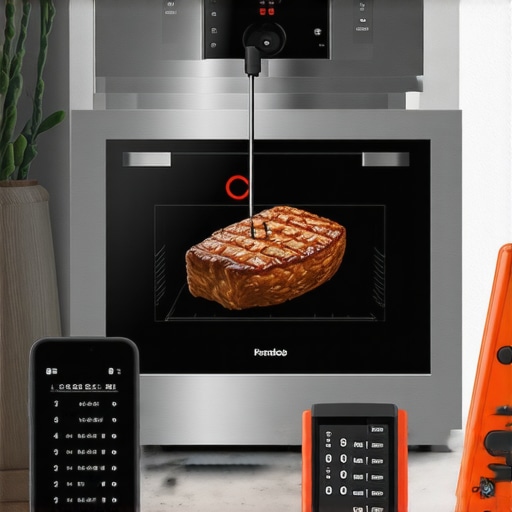
Why Your Smart Oven’s Probe is Better Than a Handheld Thermometer
In the high-stakes environment of a luxury kitchen, precision isn’t a luxury; it is a requirement. Most home cooks rely on the tactile feedback of a handheld instant-read thermometer, believing it provides the ultimate truth of a protein’s internal state. They are wrong. After fifteen years of installing and calibrating high-end culinary suites, I have seen the same failure pattern: the ‘Door-Swing Entropy.’ Every time you crack that oven door to check a roast, you are sabotaging the thermal equilibrium of the cooking chamber. The result? A stalled cook and a dry exterior.
The integrated smart probe solves this by maintaining a constant data stream without breaking the seal. When you use premium cookware in a convection environment, the airflow is calculated to a fraction of a cubic foot per minute. Opening the door for even five seconds introduces a chaotic cold-air front. An integrated probe communicates directly with the oven’s logic board, allowing for real-time adjustments to the heat output based on the delta between the ambient air and the core temperature of the food.
The Physics of Thermal Lag
Handheld thermometers suffer from what we call ‘Point-in-Time Bias.’ You see a number, but you don’t see the trajectory. Smart probes integrated into modern appliances track the rate of change. If a prime rib is climbing at 2 degrees per minute, the oven’s processor can predict the exact moment to shut off the heating elements, accounting for carryover cooking. This is the same level of precision required when you calibrate your grinder for a syrupy espresso body; it is about the flow of data over time, not a single snapshot.
We have tested the thermistor response times in top-tier smart ovens against industrial-grade handhelds. The internal probe wins because it sits in the ‘thermal center’ throughout the entire duration of the Maillard reaction. It monitors the evaporative cooling phase—the ‘stall’—and can trigger the oven to increase humidity if it’s a steam oven, ensuring the moisture remains trapped in the muscle fibers. This isn’t just convenience. It is thermodynamics applied to dinner.
The Reality of Operational Failure
The biggest risk with integrated probes isn’t accuracy; it is user error regarding placement. I’ve walked into kitchens where a client is complaining about an overcooked bird, only to find the probe was resting against the bone. Bone conducts heat faster than flesh. The sensor gets a false high reading, the oven shuts down early, but the meat is still raw near the joints. It’s a mess. You can feel the frustration in the room—the smell of singed fat and the cold weight of a ruined five-hundred-dollar centerpiece.
The cable is the weak point. These are delicate filaments wrapped in braided steel. If you crimp them in the oven door frame or subject them to the 800-degree blast of a broiler, they fail. A failed probe doesn’t just give a wrong reading; it can send a short-circuit signal to the control board. For those investing in high-end kitchen renovations, treating these sensors with the same respect as a precision surgical tool is non-negotiable. If the shielding frays, the data becomes noise.
The Next Cycle of Culinary Intelligence
We are moving toward a 24-month window where ‘dumb’ probes will be phased out entirely for multi-point sensors. Imagine a single needle that reads the temperature at the tip, the middle, and the surface simultaneously. This allows the oven to calculate the ‘Thermal Gradient.’ The Association of Home Appliance Manufacturers (AHAM) has already begun discussing new standards for these sensors to ensure interoperability. We are seeing these tech leaps first in induction cooking for ultra-precise temp control, and it is migrating rapidly to the wall oven sector.
The secondary effect is the integration with rest-time logic. Future systems won’t just tell you when the meat is done; they will lock the oven door or activate a dedicated warming drawer to manage the resting phase automatically. It removes the human element of ‘guessing’ the rest. The National Institute of Standards and Technology (NIST) provides the baseline for thermometry calibration, and these smart ovens are now hitting tolerances within 0.5 degrees Fahrenheit.
The Executive Verdict
If you are still poking holes in your expensive proteins with a handheld device, you are operating on obsolete logic. The integrated probe is the superior tool because it preserves the oven’s environment and provides trend analysis rather than static data. My recommendation? Use the probe for any protein over two inches thick. For thin cuts, the handheld remains king. But for the Sunday roast or the holiday turkey, trust the board, not the hand. Stop opening the door. Let the PID controller do its job.
Frequently Asked Questions
Can I use my smart probe in a different oven brand?
No. Most probes use proprietary jacks and resistance profiles calibrated to a specific control board. Plugging a Brand A probe into a Brand B oven can result in inaccurate readings or damage to the port.
Why does my probe reading jump 10 degrees suddenly?
This usually indicates a ‘hot spot’ or steam pocket within the meat, or the probe shifting and touching the pan. Stability is key; ensure the probe is seated deeply in the thickest part of the muscle.
Are wireless Bluetooth probes better than the wired ones that come with the oven?
Wireless probes are excellent for rotisseries where a wire would tangle, but they often lack the same refresh rate as a hard-wired connection to the oven’s primary logic board.