
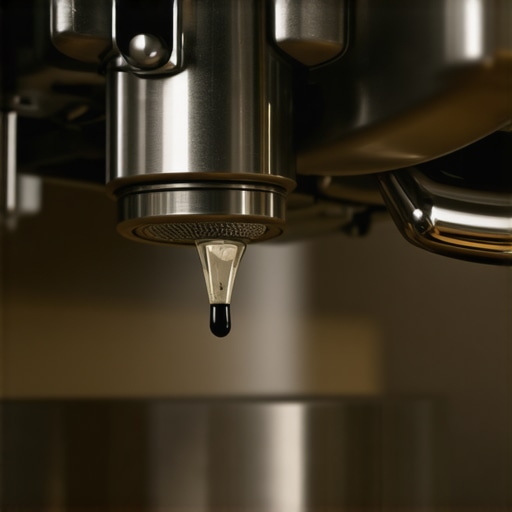
Why Your Espresso Shot Is Sputtering and the Simple Fix
Your high-end espresso machine is a hydraulic engine, not a kitchen toy. When that portafilter starts sneezing and spraying, it signals a catastrophic failure in your puck resistance. After fifteen years of diagnosing saturated group heads and rebuilding vibration pumps, I can tell you the machine is rarely the villain. The problem is almost always a localized pressure drop within the coffee bed itself. If the water finds a path of least resistance, it creates a high-velocity jet. This is the physics of channeling. You see a mess; I see an uneven density distribution that wasted a twenty-gram dose of expensive beans.
The technical reality centers on the 9 bars of force being exerted on the surface of your coffee. If your grind uniformity is off, that water will bypass the tightly packed particles to find any air pocket or clump. This is why you must avoid the puck prep mistake that causes constant channeling. Without a uniform density, the water treats the coffee bed like a sieve rather than a resistance-based filter. The result? Sputtering, bitter extraction, and a thin, watery body that lacks the syrupy lipids we expect from a true ristretto.
The Engineering Reality of Pressure Management
Every espresso shot is a battle between pump pressure and coffee resistance. When the pump hits its peak, any micro-fissure in the coffee puck becomes an exit ramp. This isn’t just about how hard you tamp. It is about particle distribution. If you are using a low-tier grinder, you are likely dealing with massive static-induced clumping. These clumps act as boulders in a stream, forcing water to flow around them and erode the surrounding finer particles. This erosion accelerates until the integrity of the puck collapses, leading to that characteristic sputtering spray.
You also need to look at your input. Many owners of luxury setups still buy pre-ground beans, which is a recipe for disaster. If you stop buying pre-ground coffee for your three thousand dollar machine, you gain control over the coarseness levels required to provide the necessary back-pressure. Without that control, the water will simply blast through the puck too fast, or if it is too fine and uneven, it will find one weak spot and erupt. It’s an issue of flow dynamics that no amount of fancy accessories can mask if the grind is fundamentally flawed.
Why Standard Methods Fail the Modern Home Barista
Traditional advice often suggests just tamping harder to stop the spray. This is a fallacy. Beyond a certain point, the coffee grounds are fully compressed and cannot be forced closer together. Increasing your tamping pressure past thirty pounds does nothing but strain your wrist. The real fix lies in the distribution of the grounds before the tamper even touches them. You need to break up the static clumps and ensure the basket is filled evenly from edge to edge. This is why precision scales for coffee and 0.1g accuracy are non-negotiable for anyone serious about consistency. If your dose fluctuates by even half a gram, your extraction timing and pressure resistance will change, causing your machine to behave differently every single morning.
I have seen luxury kitchens where the owner spent five figures on a machine but refuses to adjust the grinder setting that makes or breaks your morning latte. They want a one-size-fits-all solution, but coffee is an organic product that changes with humidity and age. As your beans off-gas CO2, the resistance they provide changes. If you don’t tighten your grind as the beans get older, the water will eventually find its way through far too easily, leading back to that dreaded sputtering. This is the operational risk of a static routine in a dynamic environment.
Market Corrections and the Future of Extraction
The industry is moving toward high-clarity, high-yield extractions that demand even more from our equipment. In the next 24 months, expect to see more machines with built-in flow profiling as standard. This tech allows the user to reduce pressure during the ‘danger zones’ of an extraction to prevent channeling before it starts. However, even the most advanced hidden valve problem can make your espresso taste like battery acid if the maintenance isn’t handled. We are seeing a shift where the user must become a mini-technician to keep these high-performance machines running at spec. The second-order effect is a rise in specialized repair services for the home market as complexity outpaces the average consumer’s DIY skills.
The Executive Verdict
If your shots are sputtering, do not buy a new machine. Instead, buy a better grinder and a WDT tool. The ‘Simple Fix’ is the elimination of voids. My recommendation is a ‘Buy’ on high-precision baskets and a ‘Hold’ on any machine upgrade until your distribution technique is mastered. If you are getting sprays, grind finer, distribute better, and weigh every single dose. Anything else is just guessing. According to the Specialty Coffee Association (SCA), water quality also plays a role in scale-induced pressure fluctuations, so ensure your filtration is up to par. Data from the National Coffee Association (NCA) suggests home consumption of premium espresso is at an all-time high; don’t let a messy shot ruin your investment.
Frequently Asked Questions
Does a bottomless portafilter cause more sputtering? No, it simply reveals the sputtering that was already happening inside your spouted portafilter. It is the ultimate diagnostic tool for checking your puck prep.
Why does my first shot always spray but the second one is fine? This is usually due to temperature instability or ‘dead’ grounds sitting in your grinder’s chute. Always purge a few grams of coffee before your first shot of the day.
Can a worn-out group head gasket cause sputtering? Yes, but that spray will usually come from the top of the portafilter, not the holes of the basket. If the spray is coming through the coffee, it’s a grind issue. If it’s leaking around the handle, it’s the gasket.
Is my pump pressure too high if it sputters? Most home machines are set to 12 bars at the factory to compensate for poor prep. Lowering this to 9 bars via the Over Pressure Valve (OPV) can often reduce sputtering by making the extraction less violent.