
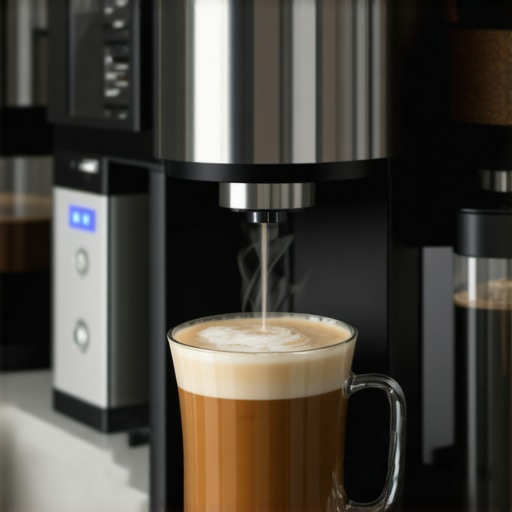
The Grinder Setting That Makes or Breaks Your Morning Latte
Your espresso tastes like battery acid or wet cardboard because you treat your grinder like a basic kitchen appliance rather than a precision engineering tool. Most enthusiasts obsess over the machine, the chrome, and the boiler. They are wrong. The real battle for a balanced morning latte is won or lost in the three microns of space between two spinning steel plates. After managing high-end kitchen installations for fifteen years, I have seen five-figure setups produce swill because the owner failed to respect the physics of particle distribution. Getting the grind wrong is not just a flavor issue; it is a financial drain on your specialty bean inventory.
The Physics of Extraction Resistance
Espresso is a game of hydraulic resistance. When you engage the pump, you are forcing hot water through a compacted puck of coffee at approximately 130 pounds per square inch. If your grind is too coarse, the water finds the path of least resistance, rushing through in a watery mess. The result? Sour, under-extracted thinness. Conversely, a grind that is too fine creates a literal brick. The water stalls, the motor groans, and you end up with a clogged espresso portafilter basket. The sweet spot is a specific micron range that allows for a 25 to 30-second extraction. You are looking for the consistency of powdered sugar, but with a slight, sandy grit when rubbed between your thumb and forefinger.
Technical truth: burr geometry dictates the ‘fines’ production. Flat burrs produce a more uniform particle size, favoring clarity. Conical burrs produce a bimodal distribution, which creates that heavy, syrupy mouthfeel essential for traditional lattes. If you are experiencing uneven espresso extraction, the culprit is often static electricity or heat expansion within the grinder housing rather than the setting itself. Metal expands when hot. If you are grinding back-to-back shots, your ‘setting 5’ at 8:00 AM is not the same as ‘setting 5’ at 8:15 AM.
The Reality of Thermal Drift
In the field, I have watched professionals struggle with the ‘clank’ of the motor as it fights through a dense bean. This is the stress test of your equipment. As the burrs spin at high RPMs, they generate friction. This heat softens the oils in the coffee beans, making them stickier. This stickiness changes how the particles pack together. Suddenly, your perfect setting starts producing paper-like flavors. This specific grinder setting error is often mistaken for stale beans. It is actually a failure to account for thermal drift.
According to the Specialty Coffee Association (SCA), water chemistry also plays a massive role in how these ground particles dissolve. If your water is too hard, it won’t matter how precise your grind is. I always recommend that my clients install an under-sink filter for better coffee water to ensure the chemical solvent (the water) can actually do its job. A high-torque motor is essential here. Cheap grinders use high-speed, low-torque motors that heat up instantly, ruining the grind consistency before the first drop of coffee even hits the cup.
Industry Shifts and Macro Trends
The industry is moving away from large hoppers toward ‘single-dosing.’ Why? Because beans sitting in a plastic hopper oxidize. Moreover, the weight of a full hopper actually pushes beans into the burrs differently than a nearly empty one. This is a second-order effect most consumers ignore. In the next 24 months, expect to see more grinders with integrated scales and AI-driven RPM adjustment to counteract bean density variations. We are entering an era of ‘smart’ resistance where the grinder adjusts itself based on the torque required to break the bean.
The Executive Verdict
If you are using a blade grinder, stop. You are not making espresso; you are making chopped dust. If you own a high-end burr grinder but your shots are inconsistent, check your retention. Old coffee stuck in the chute will stale and contaminate your fresh shot. My recommendation: Invest in a grinder with a DC motor for lower heat and higher torque. Dial in your grind until the stream looks like warm honey. If the flow starts as a drip, go one notch coarser. If it gushes, go two notches finer. Precision is not optional; it is the baseline.
Frequently Asked Questions
Why does my grind setting change daily?
Humidity. Coffee beans are hygroscopic, meaning they absorb moisture from the air. High humidity makes the beans softer, requiring a finer setting to maintain resistance.
Should I change the setting while the motor is off?
Never. Adjusting to a finer setting while the burrs are stationary can trap bean fragments between the plates, potentially stalling or damaging the motor. Always run the motor when adjusting ‘finer.’
How often should I deep clean the burrs?
For home use, every 4 to 6 weeks. Coffee oils go rancid. If you don’t clean the internal chamber, that ‘morning latte’ will always have a bitter, oily aftertaste regardless of the setting.