
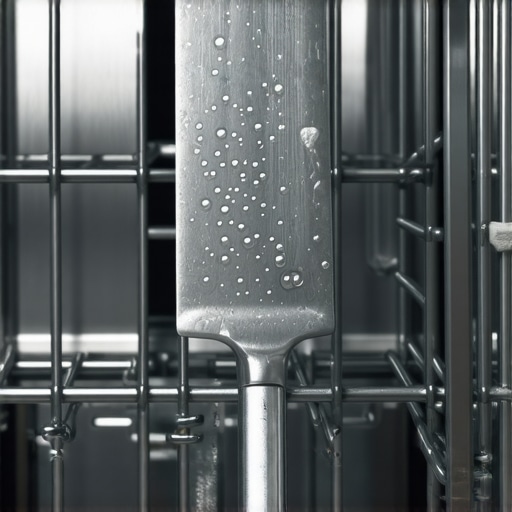
Why You Should Stop Putting Your Global Knives in the Dishwasher
Putting a Global knife in the dishwasher is a technical failure of maintenance. Most owners believe they are saving time. In reality, they are initiating a chemical and thermal assault on CROMOVA 18 steel. After fifteen years in the high-end kitchen industry, I have seen thousands of dollars in professional-grade cutlery reduced to jagged, pitted shrapnel. The issue is not just the edge. It is the molecular integrity of the tool. The result? Avoidable failure.
The Science of CROMOVA 18 Degradation
Global knives utilize a proprietary blend of Chromium, Molybdenum, and Vanadium. This steel is hardened to 56-58 HRC. While this allows for an acute 15-degree edge, it makes the steel susceptible to the caustic environment of a dishwasher. Modern dishwasher detergents are highly alkaline. They are designed to strip proteins and fats, but they also attack the passive chromium oxide layer of your blade. When this layer is breached, you get pitting. You can see it as tiny black spots. That is not dirt. It is the steel literally dissolving. Understanding the difference between cold-pressed and forged performance is vital here because the grain structure of Global’s stamped and heat-treated steel reacts differently to thermal shock than traditional German forged blades.
Thermal Stress and the Sand-Filled Handle
Global handles are unique. They are hollow and filled with sand to achieve a perfect balance. This is an engineering feat, but it becomes a liability in a 150-degree wash cycle. The air and sand inside the handle expand at different rates than the stainless steel exterior. Repeated cycles can weaken the weld points where the blade meets the handle. I once had a client bring in a G-2 chef knife where the handle had developed a hairline fracture simply from the internal pressure of years of high-heat drying. It is a physical risk. The steam also accelerates the oxidation of any microscopic contaminants left in the handle cavity. If you want your equipment to last, you must treat it like a precision instrument, not a spoon. This applies to all high-end gear, much like how professional kitchen appliances require specific operational protocols to maintain their ROI.
The Mechanical Violence of the Wash Cycle
The dishwasher is a violent place. High-pressure water jets move lightweight items. If your Global knife tip touches a ceramic plate or another stainless steel utensil during the cycle, the edge is gone. Steel at 58 HRC is brittle. It chips. A single microscopic chip becomes a stress concentrator. The next time you cut a butternut squash, that chip turns into a full-scale crack. I have watched the clank of the dishwasher rack ruin a factory edge in sixty minutes. It takes twenty minutes of stones to fix a mistake made in a one-hour wash. The economics do not make sense. Many chefs are moving toward even harder materials, and understanding the difference between carbon steel and cast iron reveals a similar truth: high-performance metals require manual intervention. There is no shortcut to quality.
Market Shifts and the Future of Maintenance
The industry is moving toward ‘Forever Goods.’ Consumers are tired of the disposable economy. In the next 18 months, I expect a surge in local sharpening demand as people realize their expensive Japanese steel is failing due to poor home habits. Regulatory changes in detergent chemistry are also making them more abrasive to compensate for lower water usage. This means your dishwasher is getting deadlier for your knives every year. The secondary market for used Global knives is already showing lower valuations for blades with ‘dishwasher spotting.’ It is a measurable loss in asset value.
The Executive Verdict
Stop. Hand wash your knives with mild soap and dry them immediately with a microfiber cloth. If your knife has already been through the dishwasher, check the edge for micro-chipping. If you feel a ‘burr’ or a catch when running your nail carefully along the side of the edge, the damage is done. You need a professional reset on a whetstone. For those in high-volume home kitchens, the strategy is simple: one ‘beater’ knife for the dishwasher-safe tasks and your Global set for the precision work. This preserves your capital investment and ensures your tools perform when the stakes are high.
Frequently Asked Questions
Q: Can I use the ‘Top Rack’ only?
A: No. The caustic chemicals and steam permeate the entire chamber. The location does not protect the metallurgy from chemical attack.
Q: Why does the box say ‘Dishwasher Safe’?
A: Marketing and engineering rarely speak the same language. It may not melt, but it will dull and pit. ‘Safe’ does not mean ‘Optimal.’
Q: How do I remove the rust spots from the dishwasher?
A: Use a non-abrasive metal polish or a specialized rust eraser. Do not use steel wool, as it will impregnate carbon steel particles into your stainless steel, making the problem worse.
Q: Does this apply to the Global Sai series too?
A: Especially the Sai series. The 3-ply clad construction has different layers of steel that can experience galvanic corrosion even faster than the standard CROMOVA 18 line.