
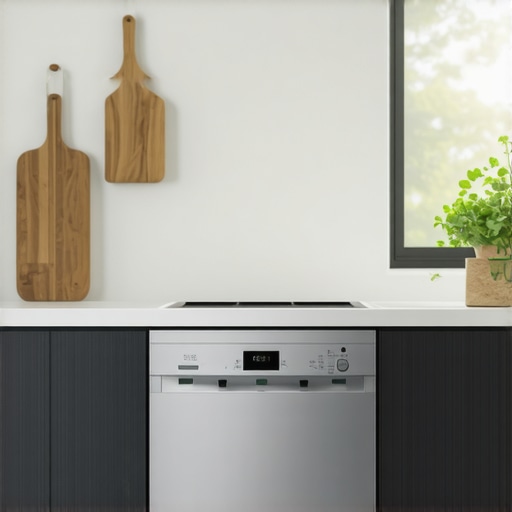
A standard freestanding dishwasher is a machine you slide into a gap. An integrated dishwasher is a component you engineer into your cabinetry. After 15 years in the luxury appliance sector, I have witnessed the same cycle: a homeowner balks at the $400 to $600 premium for professional installation and custom paneling, only to regret it three years later when their high-end kitchen feels like a collection of disjointed boxes. The cost isn’t a tax on luxury; it is a payment for structural stability and acoustic isolation. If you get this wrong, you don’t just lose money. You lose the structural integrity of your surrounding millwork. The stakes are simple: spend the money now or watch your custom gable panels warp under the stress of heat and moisture.
The Engineering Gap
Most consumers assume the internals of a high-end integrated unit are identical to their freestanding counterparts. They are wrong. The chassis of an integrated machine is designed for rigid mounting. It lacks the exterior aesthetic housing, meaning every millimeter of space is dedicated to insulation and dampening. When we talk about the pros and cons of integrated dishwashers you arent told, the discussion usually ignores the mounting flange. A freestanding unit vibrates against the floor; an integrated unit, properly anchored to the side cabinets and the underside of the stone, becomes part of the kitchen’s skeletal structure. This rigidity prevents the micromovements that eventually crack the silicone seal between your countertop and the wall.
Thermal Dynamics and Cabinet Decay
Heat is the silent killer of custom cabinetry. Integrated dishwashers utilize active drying systems that manage vapor better than the cheap vent-out systems found in big-box store models. The installation cost covers the precise application of vapor barriers and the alignment of the door tension system. If the technician skips the tension adjustment, the weight of a heavy custom panel will slowly strip the screws from the hinge housing. The result? Avoidable failure. This technical precision ensures that the heat stays inside the tub rather than bleeding into the porous wood of your expensive cabinets. For more on how heat and layout affect longevity, consider why most kitchen renovations fail the triangle rule, which often ignores appliance venting requirements.
Installation Risks That Sink Budgets
The smell of damp MDF is the first sign of a failed DIY or budget installation. In my years on site, I’ve seen hundred-thousand-dollar kitchens ruined by a single missing moisture strip. Freestanding units are designed for airflow. Integrated units are sealed. This means the tolerance for error is zero. You are paying for a professional to verify the plumb of the surrounding units. If the floor is even slightly off, the door of the dishwasher will not sit flush with the adjacent drawers. This leads to the ‘snag’—that irritating moment the door catches on the cabinetry every time it’s opened. We see similar lifespan issues in other built-in units, such as why most built-in microwaves fail after only five years due to poor ventilation and mounting.
Acoustic Decoupling Reality
There is a specific technical truth regarding decibel ratings. A 42dB integrated dishwasher is quieter than a 42dB freestanding unit in practice. Why? Because the cabinetry acts as a second acoustic barrier. However, this only works if the machine is decoupled from the floor. A specialist installer uses specific shims and isolation pads. Without these, the motor’s hum resonates through the entire kitchen island. The weight of the industrial grade steel tub, the clank of the internal manifold—these sounds are muffled by the density of the wood panel, but only if that panel is perfectly balanced against the door’s spring tension. We follow standards set by the Association of Home Appliance Manufacturers to ensure these vibration levels stay within luxury specs.
The Pivot toward Invisible Architecture
The local market is shifting. We are moving away from the industrial look and toward invisible architecture. In the next 24 months, I predict that exposed appliance faces will be the primary marker of a dated kitchen. High-end property values now hinge on ‘flow.’ When a potential buyer walks into a kitchen and sees a break in the cabinetry for a stainless steel dishwasher, they see a compromise. They see a project. An integrated unit maintains the visual line, which is why interior designers prioritize them despite the labor costs. This is no different than why why your cabinet lighting should always be warm white; it’s about the psychological cohesion of the space. According to reports from the National Kitchen & Bath Association, ‘concealed appliances’ remain a top-tier request for luxury renovations.
The Final Verdict
The recommendation is clear: Buy the integrated unit if you are investing in custom cabinetry. Hold off if you are just doing a surface-level refresh. If you are in a situation where your kitchen features bespoke millwork, the extra $500 for installation is actually an insurance policy for your cabinets. It is the only way to ensure the machine doesn’t physically destroy the wood around it through heat and vibration. The engineering reality is that these machines are built to last 10-15 years, but only if the mounting environment is as stable as the motor itself. Don’t let a budget installer handle a precision component.
Frequently Asked Questions
Can I reuse my old cabinet door for a new integrated dishwasher? Only if the dimensions and mounting points match exactly. Most luxury brands use proprietary sliding hinge systems that require specific panel thicknesses and weights.
Does the custom panel affect the drying performance? Yes. If the panel is too thick, it can prevent the door from opening automatically at the end of the cycle to vent steam, a common feature in Miele and Bosch units.
Why is the labor for integrated units so much higher? It involves carpentry as much as plumbing. The installer must align the door vertically and horizontally to match the reveal of your other cabinets, which can take several hours of fine adjustment.