
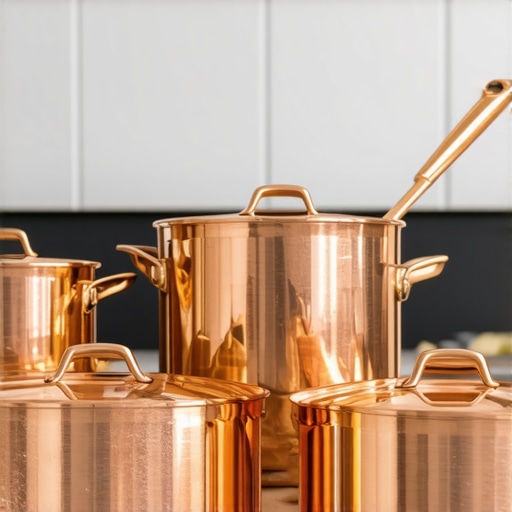
Why 5-Ply Copper Core Pans Outperform Traditional Aluminum
Aluminum pans are the workhorses of the average kitchen, but they are thermal lightweight. In fifteen years of testing high-end kitchen hardware, I have seen professional results ruined by the uneven hotspots inherent in single-layer aluminum construction. The reality is simple. Aluminum reacts too fast and holds too little. To achieve consistent results, you need a material with higher thermal mass and superior conductivity. This is where 5-ply copper core technology changes the math. It is not just about the name; it is about the physics of the bonded layers.
Traditional aluminum pans suffer from a phenomenon I call ‘thermal volatility.’ You drop a cold steak into the pan, and the temperature craters. The result? Grey, steamed meat instead of a hard, mahogany sear. 5-ply construction solves this by sandwiching a pure copper disc between layers of aluminum and high-grade stainless steel. This configuration leverages the 398 W/m·K thermal conductivity of copper, which is nearly double that of standard aluminum. When you invest in multi-clad stainless steel over cheaper alternatives, you are buying a thermal battery that refuses to quit under pressure.
The Engineering Reality of Thermal Bonding
Why five layers? It is a question of structural integrity and heat management. The inner and outer layers are typically 18/10 stainless steel. This provides a non-reactive cooking surface and induction compatibility. However, stainless steel is a poor conductor. The aluminum layers act as a bridge, while the copper core does the heavy lifting of moving heat laterally across the base. This eliminates the ‘ring of fire’ effect common on gas burners. According to data from the American Society for Testing and Materials (ASTM), the bonding process used in high-end cookware prevents the delamination that often plagues mid-tier ‘impact-bonded’ bases. The weight of the industrial grade steel feels substantial in the hand, a stark contrast to the flimsy vibration of stamped aluminum.
Operating a high-end kitchen requires gear that survives the ‘clank’ of the dishwasher and the high-BTU output of professional ranges. Aluminum often fails here. It is prone to ‘oil canning,’ where the base bows or warps when exposed to rapid temperature shifts. This is a common reason stainless steel skillets warp when users deglaze a hot pan with cold liquid. A 5-ply copper core pan is structurally reinforced against this deformation. The internal copper spine maintains the pan’s flatness, ensuring 100% contact with flat-top induction or electric surfaces.
The Stress Test: Where Cheap Pans Fail
I’ve walked into dozens of kitchens where the owner complained about scorched sauces. The culprit is almost always a thin-gauge aluminum pan that lacks the ‘buffer’ provided by copper. When you are whisking a delicate béarnaise, a two-degree spike can break the emulsion. Copper core pans provide a ‘lag time’ that allows for human error. They are forgiving. But they are not indestructible. The biggest risk is the ‘dry boil.’ If you leave a 5-ply pan on a high flame with no contents, the different expansion rates of the five metals can create internal stress. You might hear a faint *tink*—that is the sound of your investment losing its structural perfection.
Luxury kitchen trends are moving toward higher efficiency. As induction cooktops become the standard in new builds, the demand for high-performance magnetic cookware is surging. Aluminum alone cannot work on induction without a bonded plate, which often creates a weak point. High-end 5-ply sets are designed from the ground up for these modern magnetic fields. Looking at reports from the National Kitchen & Bath Association (NKBA), homeowners are increasingly prioritizing ‘lifetime’ tools over disposable sets. My advice is clear: avoid pre-packaged cookware sets. Most contain ‘filler’ pieces you will never use. Instead, buy three high-quality 5-ply copper core pieces: a 12-inch skillet, a 3-quart saucier, and an 8-quart stockpot. That is the executive strategy for a high-output kitchen.
Market Corrections and Strategic Foresight
The next 24 months will see a shift in how we value kitchen durability. Rising energy costs mean we need pans that retain heat longer, reducing the ‘on-time’ for burners. We are also seeing a regulatory push against certain non-stick coatings. This makes the ‘S-factor’ (searing, sautéing, simmering) of stainless-clad copper more vital than ever. The market is moving away from ‘fast fashion’ kitchenware toward heirloom-quality engineering. If you are serious about performance, the cost-benefit analysis favors copper every time. It is a one-time purchase that pays dividends in every meal.
FAQ
Is 5-ply copper core worth the extra weight?
Yes. The weight provides the necessary thermal mass to prevent temperature drops when adding food, which is the primary secret to professional-grade browning.
Does copper core work on induction?
As long as the exterior layer is made of magnetic 400-series stainless steel, 5-ply copper core pans are fully induction-compatible.
How do I prevent my 5-ply pans from spotting?
Keep a bottle of specialized stainless cleaner handy. Most spotting is caused by mineral buildup or overheating, which can be easily buffed out to restore the original luster.
Can I put these pans in the dishwasher?
While many are labeled dishwasher safe, the harsh detergents can eventually pit the exposed edges of the copper layer. Hand washing is the professional’s choice for longevity.