
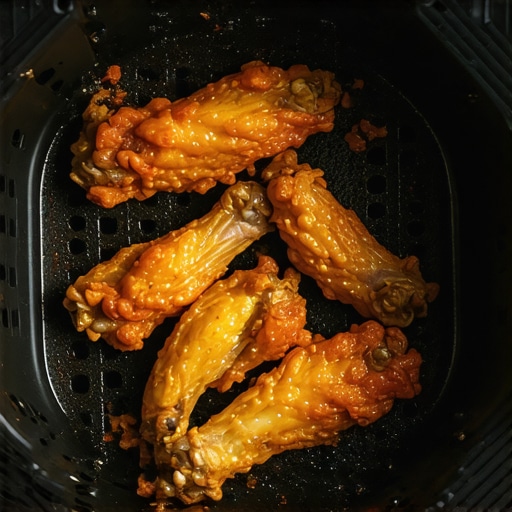
The Simple Trick for Crispy Air Fryer Wings Without Extra Flour
Flour is a crutch that ruins the potential of a high-velocity convection environment. Most home cooks treat their air fryer like a miniature oven, but the thermodynamics are entirely different. In my fifteen years of designing luxury kitchens and testing premium cookware, I have seen thousands of users settle for ‘good enough’ because they lack a basic understanding of skin desiccation. You do not need a dredge to find the crunch. You need to manipulate the pH level of the chicken skin and achieve total surface moisture removal. The result? A glass-like snap that shames any deep-fryer.
The Engineering Reality of Skin Desiccation
Air fryers function through extreme convective heat transfer. To maximize this, you must exploit the Maillard reaction without the insulating layer of starch. The actual trick involves a 24-hour dry brine using a specific ratio of kosher salt and aluminum-free baking soda. The baking soda raises the pH level on the skin, breaking down the peptide bonds and allowing the skin to blister and crisp more effectively. It creates tiny bubbles on the surface that increase the surface area exposed to the high-CFM airflow. When you use air fryers that actually crisp skin without turning chicken into rubber, the difference in texture is quantifiable. You aren’t just cooking; you are performing a controlled dehydration of the epidermis while rendering the underlying subcutaneous fat.
The Physics of the Drip Tray
A major failure point in the luxury kitchen is the management of lipid runoff. As the wings hit 165 degrees Fahrenheit, the fat liquefies. If your airflow is obstructed by a crowded basket, that fat pools, creating steam. Steam is the enemy of the crunch. You want the fat to depart the skin and hit the tray immediately. However, high-velocity air can pick up that fat and throw it against the heating element. This causes the dreaded acrid haze. If you find your kitchen filling with haze, you need to learn how to stop your air fryer from setting off the smoke alarm by managing the lipid smoke point. Precision is not optional here. You are balancing the convective heat coefficient against the smoke point of rendered chicken fat.
[image-placeholder]
Market Corrections and Technology Shifts
We are seeing a shift in the premium cookware sector toward higher wattages and dual-heat sources. The industry is moving away from simple resistive coils toward carbon fiber heating elements that provide faster infrared penetration. This evolution matters because it dictates how we prep our proteins. In the next 18 months, I expect ‘smart’ sensors to measure the humidity levels inside the basket in real-time, automatically adjusting fan speed to maintain the desiccation phase. Many users are already migrating toward dual heating air fryers for people who are tired of flipping their food, which optimizes the heat distribution on both the dorsal and ventral sides of the wing simultaneously. According to reports from the International Housewares Association, the demand for high-CFM kitchen appliances is at an all-time high, driven by the desire for professional-grade results at home.
The Executive Verdict
If you are still using flour to crisp your wings, you are lagging behind the technical curve. The strategy is simple: Dry brine with baking soda for 12 to 24 hours uncovered in the refrigerator. Use a wire rack to ensure 360-degree airflow. Set your equipment to 400 degrees Fahrenheit. Do not overcrowd. The air must circulate with zero impedance. This is the only way to achieve the technical standard required in a high-end culinary environment. For those building out a luxury kitchen in 2026, prioritize units with high static pressure fans. Buy the quality equipment once, or pay the price in mediocre results twice. Stop dredging. Start desiccation.
Frequently Asked Questions
Does the baking soda leave a metallic taste?
Not if you use the correct ratio. Limit the application to 1/2 teaspoon per pound of wings. The chemical reaction neutralizes the bitterness during the rendering process.
Can I use this method for frozen wings?
No. The moisture trapped in ice crystals prevents the pH shift required for the skin to blister. Thaw and pat dry with industrial-grade paper towels first.
What is the best oil for this process?
Avoid seed oils. A light spray of avocado oil—which has a smoke point of 520 degrees Fahrenheit—is the only way to ensure the heating element doesn’t produce carbon deposits.
Comments are closed.