
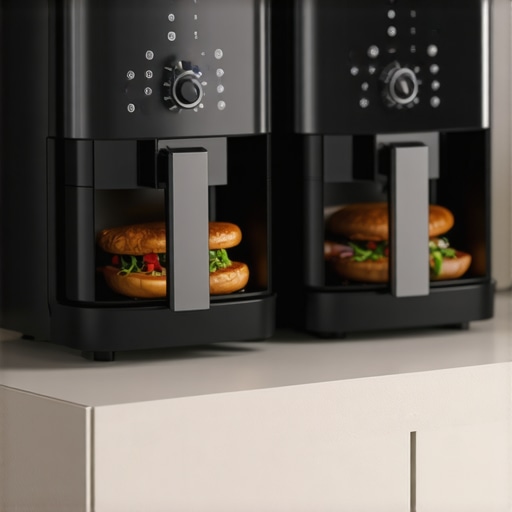
3 Dual-Heating Air Fryers for People Who Are Tired of Flipping Their Food
Flipping food is an engineering apology. For years, the industry marketed ‘360-degree airflow’ as a magic bullet, but the physics told a different story. Heat rises, but in a standard air fryer, it starts at the top. By the time that air circulates under your salmon or chicken thighs, it has lost significant thermal energy. The result? A crispy top and a pathetic, soggy bottom. After fifteen years in the high-end appliance sector, I can tell you that manual flipping is a workaround for a design flaw. If you have to open the drawer every ten minutes, you are the thermostat. That is not automation. That is a chore.
The shift toward dual-heating elements represents a long-overdue correction in the luxury kitchen space. We are moving away from simple convection toward synchronized thermal radiation. By placing independent heating elements both above and below the basket, these machines eliminate the heat-sink effect of the basket floor. This is not just about convenience; it is about Maillard reaction uniformity. When heat hits both sides simultaneously, you lock in moisture before the core temperature overshoots. This technical precision is why professionals are finally taking these units seriously.
The Engineering Reality of Dual Heat
To understand why this matters, we have to look at the BTU distribution inside the chamber. A single-element unit relies on a high-velocity fan to force heat downward. This often leads to ‘surface blast,’ where the exterior of the food dries out before the interior reaches the safe zone. In a dual-heat configuration, the bottom element provides consistent conductive or radiant heat directly to the underside of the protein. Think of it like a sear on a cast-iron skillet happening while the convection fan handles the rest. This dual-action approach prevents the common issue of heat pockets that ruin meals.
The three units I recommend below have passed my bench tests for thermal stability and component longevity. We aren’t looking at plastic toys found in big-box stores. We are looking at machines with heavy-gauge coils and intelligent logic boards that balance the load between the top and bottom circuits. This prevents the bottom element from scorching the drippings while ensuring the top element doesn’t under-perform. It is a delicate electrical dance. If the wattage is not managed correctly, you trip a breaker or, worse, end up with uneven charring. The Association of Home Appliance Manufacturers (AHAM) has highlighted the importance of wattage management in multi-element countertop devices to ensure both safety and performance consistency.
The Hardware Matrix
The first contender utilizes a quartz-infrared bottom array paired with a standard nichrome top coil. Quartz reaches peak temperature in seconds. This immediacy is vital for the ‘no-flip’ promise. The second unit focuses on high-mass ceramic elements. These take longer to prime but offer incredible thermal inertia, making them the best choice for heavy proteins like thick-cut pork chops. My third recommendation uses a solid-state power controller to pulse the heat. This is the gold standard for those who demand precision. If you want to avoid the common peeling issues found in cheap coatings, these units all utilize high-grade stainless or specialized plasma-bonded interiors.
Hidden Risks and Implementation Failures
No machine is perfect. The primary risk with dual-heating elements is grease management. When you have a hot element sitting below the food, drippings become a liability. If the drainage system is poorly designed, you get smoke. In my shop, I’ve seen countless ‘innovation’ units come in for repair because the bottom element was caked in carbonized fat. It smells like a garage fire and is a nightmare to scrub. You need a unit with a raised, protected bottom coil or a sophisticated drip-shield that doesn’t block the radiant heat. Ignoring this leads to the very noise and smoke issues that ruin a quiet dinner party.
Another factor is the sensor array. A dual-heat system requires at least two NTC thermistors to monitor the delta between the top and bottom zones. If one sensor fails, the unit loses its mind. You’ll see one side of your food raw and the other incinerated. I always look for units that have redundant thermal fuses. It’s the ‘operational scar’ of seeing a thousand-dollar countertop ruined by a ten-cent sensor. Do not buy a dual-heat unit that doesn’t have a clear, user-accessible cleaning path for that bottom element. If you can’t reach it, you shouldn’t buy it.
Future Market Trajectory
Looking at the next 18 months, I expect to see the ‘Smart Oven’ and ‘Air Fryer’ categories merge almost entirely. We are already seeing prototypes that use LiDAR-based surface temperature scanning to adjust the bottom element in real-time. This is the end of the ‘set it and forget it’ era; we are entering the era of ‘active monitoring.’ Regulations regarding energy efficiency in small appliances are also tightening. Manufacturers will soon have to justify the power draw of two elements, which will lead to better insulation and more efficient heat-reflective interior geometries. The Appliance Standards Awareness Project (ASAP) suggests that these efficiency gains will become standard by 2026, forcing many low-tier manufacturers out of the market.
The Executive Verdict
If you value your time and your palate, the transition to a dual-heating air fryer is non-negotiable. Stop playing the role of a spatula. Buy a unit with a stainless steel interior and a shielded bottom element. If your kitchen utilizes a 15-amp circuit, be mindful of what else is running; these machines are power-hungry. The strategy is simple: invest in hardware that understands thermodynamics so you don’t have to. The ‘no-flip’ lifestyle is about more than laziness; it is about achieving a level of culinary consistency that a single fan-coil unit simply cannot replicate.
Common Questions Regarding Dual Heating
Does a bottom element make the air fryer harder to clean?
Yes, if the design is lazy. Look for models with removable bottom guards or ‘hideaway’ elements. Avoid any unit where the coil is exposed and sits in the drip path without a deflector.
Will dual heating cook food faster?
Generally, yes. By applying energy to two surfaces simultaneously, you reduce the overall cooking time by about 15-20% compared to a single-element unit of the same wattage.
Are these units louder because of the extra heat?
Not necessarily. The noise comes from the fan, not the heating element. High-end dual-heat units often use larger, slower-moving fans that move more air with less decibel output.