
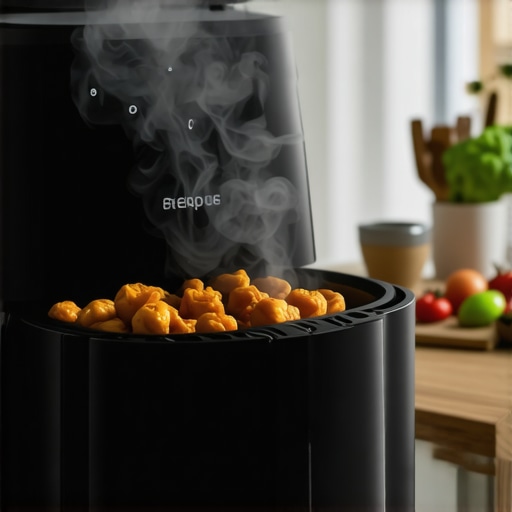
The Reason Your Air Fryer Smokes When Cooking Fatty Foods
Smoke billowing from a high-end air fryer isn’t just an inconvenience; it is a symptom of a fundamental thermodynamic conflict between high-velocity airflow and the flash point of animal lipids. After 15 years of diagnosing kitchen appliance failures, I can tell you that most owners treat their air fryers like a standard oven, but the physics inside that chamber are closer to an industrial blast furnace. The stake is clear: recurring smoke leads to carbonization on the heating element, which permanently degrades the appliance’s efficiency and poses a legitimate fire risk. If you are seeing blue or white smoke while air-frying bacon or ribeye, you aren’t just cooking; you are witness to a chemical reaction known as aerosolized grease combustion.
Kinetic Energy and Lipid Aerosolization
Standard ovens rely on slow radiant heat. Air fryers, conversely, utilize intense convection where a fan—often spinning at 2,500 to 3,000 RPMs—forces air through a localized heating coil. When you introduce high-fat foods, the heat liquefies the fat. Under normal circumstances, this would just drip. However, the high-velocity air shears these droplets into a fine mist. This lipid aerosol is then sucked upward by the intake or blown directly onto the exposed heating element. Once these microscopic fat particles hit a 400°F nickel-chromium coil, they surpass their smoke point instantly. The result? Instantaneous white smoke. For those looking for top-tier equipment that manages this better, air fryers revolution top models that redefine healthy cooking in 2025 show how baffle designs are evolving to mitigate this exact issue.
The Mechanical Element Exposure Problem
The design of the heating element is the primary culprit. Most consumer models place an unprotected, coiled filament directly above the food basket. As the fat rendered from a duck breast or a 80/20 beef burger begins to bubble and splutter, it enters the turbulent air stream. The smell of scorched lard is unmistakable. This isn’t just about the food you are cooking today. Over time, these lipids bake onto the coil, creating a thick, black carbon crust. This crust acts as an insulator, forcing the element to run hotter to achieve the same internal chamber temperature, which eventually leads to a burnout. Understanding the best way to clean greasy air fryer coils without chemicals is essential for anyone who regularly prepares high-fat proteins. A clean coil has a much higher tolerance for occasional splutter than one already coated in months of oxidized grease.
Thermal Thresholds of Common Fats
The chemistry of the fats themselves dictates the volume of smoke. Butter has a smoke point of roughly 350°F, while unrefined bacon grease sits even lower. If you set your air fryer to 400°F to get that crisp finish, you are operating 50 degrees above the point where those fats begin to decompose and gas off. This decomposition produces acrolein, a pungent gas that creates the stinging sensation in your eyes. It is an engineering reality: you cannot cook a substance at a temperature higher than its smoke point in a high-turbulence environment without generating a visible byproduct. Use the grease trap trick for cleaner kitchen air by adding a small amount of water or a slice of bread to the bottom drawer to catch and cool the drippings before they can be whipped into the air stream.
Industry Shifts and Strategic Foresight
The local market for luxury kitchenware is shifting toward integrated solutions. In the next 18 months, I expect to see a move away from standalone plastic-shell air fryers toward built-in steam-convection hybrids that utilize water vapor to weigh down fat particles. Regulatory bodies like the National Fire Protection Association (NFPA) are already looking at the safety profiles of countertop convection units due to the high frequency of ‘smoke incidents’ that trigger residential alarms. The smart money is on appliances that feature shielded elements or removable splash guards. Until those become the standard, the burden of maintenance falls on the operator. If your machine is already smelling like a campfire, you need to know the trick to getting odors out of your air fryer basket to prevent flavor transfer in your next meal.
The Executive Verdict
My recommendation is a ‘Hold’ on replacing your unit but a ‘Buy’ on better prep techniques. If you are cooking fatty foods, lower your temperature to 350°F and increase the duration. The physics of the machine won’t change, so you must change the variables of the input. Avoid using aerosolized cooking sprays which contain soy lecithin; this compound gums up the fan blades and heating elements faster than the fat from the food itself. The result? Avoidable failure. Clean your heating element after every five uses of high-fat cooking or face the inevitable hardware degradation. According to the American Oil Chemists’ Society (AOCS), the stability of fats under high heat is non-negotiable; respect the smoke point or accept the smoke.
Frequently Asked Questions
Is white smoke from my air fryer dangerous?
White smoke is usually just vaporized grease and is rarely an immediate fire hazard, though it can trigger smoke detectors and leave a lingering odor. However, black smoke indicates a mechanical failure or a piece of food actually burning on the element and requires an immediate shutdown.
Can I use parchment paper to stop the smoke?
Parchment paper can help catch grease, but it also restricts the very airflow that makes an air fryer work. If the paper isn’t weighted down, the fan can suck it into the heating element, creating a major fire risk. Use it sparingly and never during preheating.
Why does my air fryer smoke even when I’m not cooking fatty foods?
This is likely due to residual grease from a previous cooking session that has carbonized on the element. As the machine heats up, that old grease reaches its smoke point again. A deep clean of the internal coils is the only fix.