
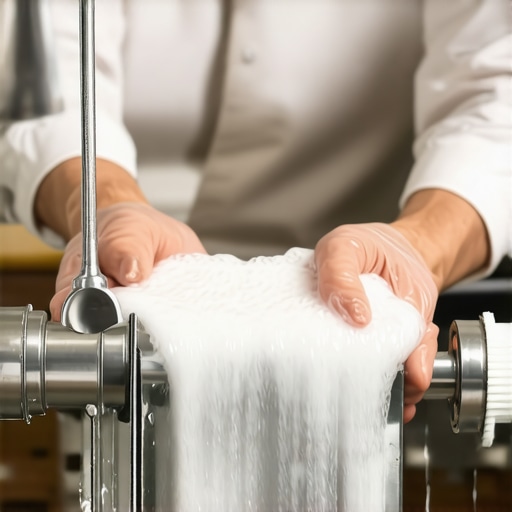
The Best Way to Clean a Professional Mandoline Slicer
Cleaning a professional mandoline is not a routine kitchen chore; it is a preservation of engineering. Most owners treat these high-precision instruments like common cheese graters. This is a mistake that leads to microscopic pitting and structural failure. After fifteen years of diagnosing hardware failures in the luxury kitchen sector, I have observed that the primary cause of blade degradation is not use, but improper sanitation. You are not just washing a tool. You are maintaining the structural integrity of a surgical-grade edge. The stakes are high. A dull or misaligned blade does not just ruin a julienne; it creates a significant safety hazard by increasing the force required to make a cut.
The Engineering Reality
To understand the cleaning process, you must understand the metallurgy. Most professional-grade mandolines use 18/10 stainless steel or high-carbon Japanese steel. These materials are chosen for their ability to hold an edge, not for their ability to withstand the harsh environment of a dishwasher. When you expose these metals to high-heat cycles and caustic detergents, you trigger thermal expansion. This expansion often exceeds the tolerances of the adjustment pins and the blade housing. The result? A once-perfectly calibrated tool that now produces uneven slices. This is similar to why clad stainless steel is better than disk bottoms in premium cookware; the uniform distribution of material matters during temperature shifts.
Technical Truth: Water trapped in the adjustment screw threads is the silent killer. Even if the frame is stainless, the internal spring mechanisms often are not. This leads to crevice corrosion, a localized attack that can seize the adjustment dial entirely. To prevent this, you need a cleaning protocol that prioritizes mechanical removal over chemical soaking. Forget the sponge. The fibers of a standard sponge catch on the blade edge, leaving behind micro-debris that can harbor bacteria. Use a stiff nylon brush. The brush allows you to reach the underside of the blade without risking your fingers. It also prevents the the knife sharpening error that blunts your edge faster, which often occurs when abrasive materials are dragged across the blade in the wrong direction.
The Implementation Risk
The messy reality of professional equipment is that it is dangerous when wet. I remember a local chef who tried to towel-dry a Bron Coucke mandoline. The towel caught. The blade, still razor-sharp, sliced through the cotton and into his palm. The weight of the industrial grade steel makes it unwieldy when soapy. This is the operational risk most guides ignore. To mitigate this, always clean the mandoline in its fully closed or ‘locked’ position. If your model lacks a lock, set it to the thickest setting to keep the blade edge as far from the guard rails as possible. Use cool water. Hot water causes the food starches—especially from potatoes—to gelatinize and stick to the metal, making them harder to remove. This is the same principle applied to maintaining other tools, much like the the simple move to keep your wood cutting board from warping by avoiding excessive heat and moisture.
Market Corrections and Regulatory Standards
According to the NSF International (nsf.org) standards for food equipment, tools must be ‘easily cleanable.’ However, the complexity of espresso machines and mandolines often challenges this definition. In the next 12 to 24 months, I expect to see a regulatory shift toward modular designs where the blade assembly can be completely decoupled from the frame without tools. This will reduce the second-order effects of bacterial growth in hidden crevices. We are already seeing this in the air fryers market, where manufacturers are moving away from permanent baskets to facilitate better hygiene. The ANSI (ansi.org) safety standards for hand-held slicers are also tightening, focusing on blade-guard interlocks that prevent cleaning while the edge is exposed.
The Executive Verdict
If you own a professional mandoline, buy a dedicated soft-bristle brush and a bottle of pH-neutral dish soap today. Avoid the dishwasher at all costs. The ‘Buy/Sell/Hold’ recommendation here is clear: Buy into the manual cleaning process; Sell the idea that ‘all stainless steel is dishwasher safe’; and Hold your equipment to a higher standard of maintenance. If you are in a high-volume environment, clean it every two hours of use to prevent acid-etching from vegetable juices. If you are a home enthusiast, clean it immediately after use and dry it with compressed air to clear the screws. This is the only way to ensure your investment lasts for decades rather than months.
Frequently Asked Questions
Can I use a vinegar solution to sanitize the blade? While vinegar is a natural sanitizer, its acidity can cause micro-pitting on high-carbon steel blades if not rinsed immediately. Stick to pH-neutral detergents for the primary clean.
Why does my mandoline blade look cloudy? This is usually a buildup of mineral deposits from hard water or starch residue. A quick wipe with a specialized stainless steel cleaner—or a dilute citric acid solution followed by a thorough rinse—will restore the finish.
Is it safe to air-dry a mandoline? Only if it is placed in a position where water can drain out of the adjustment mechanisms. Gravity is your enemy if water pools in the screw threads. I recommend patting the frame dry and using a hair dryer on a ‘cool’ setting for the internal parts.
How often should I sharpen the mandoline blade? Unlike a chef’s knife, mandoline blades are often difficult to sharpen at home. If you notice the ‘drag’ increasing, it is usually time to send the blade to a professional or replace the cartridge if it is a modular system.