
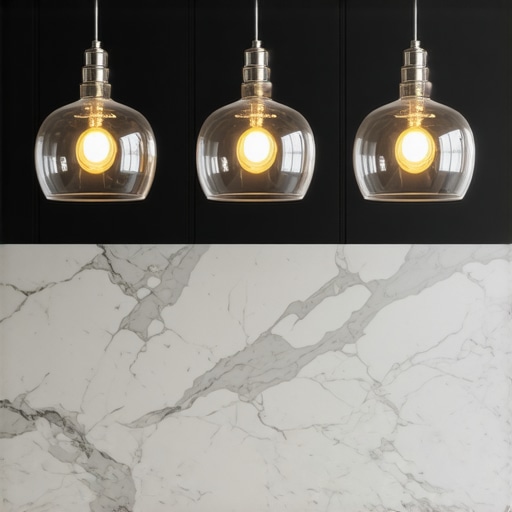
The Best Height for Hanging Pendant Lights Over a Kitchen Island
Illumination isn’t decoration; it is an engineering requirement. After 15 years designing high-end culinary spaces, I have seen million-dollar renovations ruined by a six-inch measurement error. A pendant light hung too high creates a disjointed cavern; hung too low, it becomes an anatomical hazard that blinds your guests. The stakes are clear: get the lighting right, or your premium marble island becomes an expensive shadow box. Modern homeowners often default to a generic ’30 inches above the counter’ rule found in basic blog posts. This is a technical simplification that ignores the physics of light dispersion and the ergonomics of human stature. To achieve a professional-grade result, we must look at the intersection of sightlines, ceiling height, and fixture scale.
The fundamental benchmark for a standard 36-inch high counter is to position the bottom of the luminaire between 30 and 36 inches above the surface. However, this range is only a starting point. If you are taller than 6 feet, a 30-inch clearance will cut directly through your line of sight. This creates a psychological barrier during meal prep. The goal is to clear the ‘active zone.’ For most luxury kitchens, we aim for the bottom of the pendant to sit exactly 72 inches from the floor. This provides a uniform horizon line across the room. Integrating the lighting trick that stops shadows on your prep area ensures that functional tasks like dicing and plating are not compromised by the body of the chef blocking the overhead source.
The Geometry of Sightlines
Measurement errors usually happen because people measure from the ceiling down rather than the counter up. This is a mistake. Your focus is the workspace. You must account for the ‘Eye Level Interference Zone.’ When standing at an island, your pupils should not be level with the bulb or the rim of the shade. If using an opaque or metal-shaded pendant, the bottom rim must be high enough that you can look across the island at a seated guest without ducking. If the fixture uses clear glass, you must prioritize the best lighting temperature for a gold accented kitchen to prevent the ‘filament glare’ that occurs with high-intensity LED bulbs at eye level.
We also have to consider the ‘Cone of Light.’ Every fixture has a beam angle. A pendant hung too high loses its intensity; the lumens scatter into the upper atmosphere of the room. A pendant hung too low creates a concentrated ‘hot spot’ on the granite that washes out the texture of the stone. The cost of failure is high. I once saw a client install three heavy industrial pendants at 28 inches. The result? A dark perimeter and a middle-island glare so intense it looked like a police interrogation room. We had to re-wire the entire ceiling at a cost of $4,000 to fix the structural mounting points. Avoid this. Map the beam spread before the first hole is drilled.
Ergonomic Failure Points
The smell of burnt wiring is a sound reminder that weight and height are linked. Heavy fixtures—those weighing over 25 pounds—require reinforced junction boxes. If a heavy pendant is hung too low on a long, thin cord, it is prone to swaying from HVAC air currents. This vibration is not just annoying; it puts stress on the electrical connections. You should also consider the ‘Head Strike Zone.’ In a kitchen with a second sink for prep, movement around the island is high-frequency. A low-hanging pendant becomes a physical obstacle during rapid movements. The weight of industrial grade steel hitting a forehead is a litigation risk you do not want in your home.
Market Corrections and Future Tech
The industry is moving away from static heights toward motorized adjustable systems. Within the next 12 to 24 months, we expect to see more smart-home integration where pendant heights can be adjusted via voice command for different scenarios—low for intimate dining, high for heavy-duty meal prep. Regulatory changes in energy efficiency also mean we are seeing thinner, lighter LED panels that allow for more creative heights without the bulk of traditional shades. Adopting the kitchen lighting strategy for perfectly even countertop visibility is becoming the standard for property appraisals. Homes with poor lighting geometry are staying on the market longer because the ‘vibe’ feels off, even if the buyer cannot articulate why.
If you are currently in the installation phase, follow the 72-inch-from-floor rule for standard 8-foot ceilings. If you have 10-foot or 12-foot vaulted ceilings, add 3 inches of height for every foot of additional ceiling. This maintains the visual proportions of the room. Do not allow your contractor to ‘eye-ball’ it. Use a laser level. Ensure the spacing between pendants is roughly 30 inches apart to prevent overlapping shadows. My final verdict? Buy fixtures with adjustable rods rather than fixed chains. Fixed chains are for the past; adjustable rods provide the rigid, clean aesthetic required for modern luxury environments. The strategy is simple: Measure twice, hang once, and always prioritize the chef’s line of sight over the catalog photo’s ‘suggested height.’
Common Lighting Questions
Does the size of the pendant change the hanging height? Yes. Large, voluminous fixtures need to be hung slightly higher (up to 38 inches above the counter) to prevent them from overwhelming the visual space of the kitchen.
How do I calculate the spacing between multiple pendants? Measure the length of the island, subtract the total width of all pendants, and divide by the number of pendants plus one. This ensures equal negative space on the ends.
Should pendants be at the same height as the range hood? Not necessarily. The range hood is governed by fire code (usually 30-36 inches), but your pendants should follow the 72-inch-from-floor rule to maintain a consistent horizontal plane across the room.
What if my island has different levels? Hang the lights based on the primary work surface. If you have a raised breakfast bar, the pendants should be adjusted relative to the higher surface to maintain the 30-36 inch clearance.