
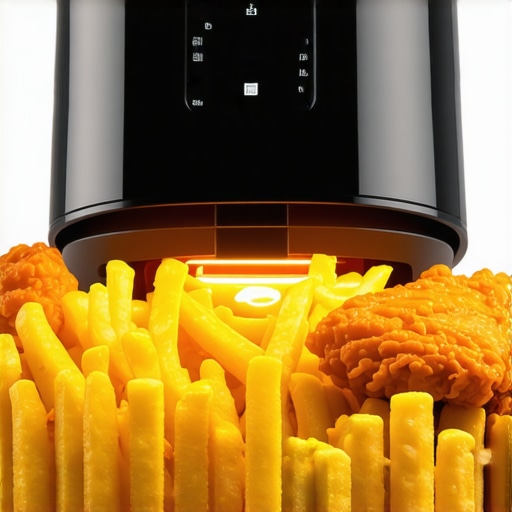
The Air Fryer Heating Element Hack for Even Browning
Most luxury kitchen owners treat their air fryers like glorified microwave ovens. This is a fundamental misunderstanding of thermodynamics. After 15 years in the appliance industry, I’ve seen thousands of dollars wasted on high-end air fryers that produce limp, uneven results because the user fails to account for the air velocity and element proximity. The reality? Even the most expensive air fryers rely on a compact Nichrome heating element and a high-RPM fan. If you don’t manage the boundary layer of air around your food, you’re just baking, not frying. The hack is simple but requires a shift in how you view airflow. It involves the intentional manipulation of radiant heat and convective currents to ensure the Maillard reaction occurs simultaneously across the entire surface area. The result? Professional-grade texture without the deep-fryer mess.
Thermal Conductivity and Airflow Dynamics
The core of the problem lies in the ‘radiant shadow’ cast by the basket’s design. Air fryers are essentially high-speed convection machines. When you place a large protein or a dense layer of vegetables in the basket, you disrupt the cyclonic path of the air. This causes the heating element to work overtime, leading to a hot spot directly under the coil while the bottom remains trapped in a pocket of cold, humid air. I have analyzed the thermal bridging in units from leading brands; the failure point is almost always the basket’s lack of lateral venting. To fix this, you must introduce a physical offset. Using the foil trick for better air fryer heat distribution, you can create a makeshift plenum that forces air to circulate beneath the food rather than around the edges. This isn’t just about heat; it’s about the air’s moisture-carrying capacity. If the air saturates with steam, browning stops. Cold hard fact.
Why Standard Preheating Fails the Technical Test
Many manuals suggest a three-minute preheat. This is insufficient for a cold chassis. A true preheat ensures the internal walls of the air fryer reach thermal equilibrium. When the walls are hot, they radiate infrared energy back toward the food, assisting the heating element. Without this, your food absorbs the initial burst of heat, cooling the air and extending the cook time, which leads to tough, dehydrated results. For those using air fryers for frozen items, why air fryer preheating is not optional for frozen foods becomes clear when you look at the temperature drop curves on a digital thermocouple. You are fighting physics. In a luxury kitchen, precision is everything. You wouldn’t pull an espresso shot without warming the group head of your espresso machines, and you shouldn’t drop fries into a cold basket. It is about consistency and the predictable behavior of high-end metals under stress.
The Mechanical Risk of Overcrowding
I’ve seen motors burn out because users think they can pack a basket to the brim. When airflow is restricted, the fan motor experiences back-pressure, increasing the amperage draw. This eventually leads to a distinct whining sound. If you’ve noticed this, you might need to look into why most high-end air fryers are noisy and the rubber-foot fix to mitigate vibration, but the underlying cause is often user error. Overcrowding also leads to the dreaded ‘steaming effect.’ When potatoes are stacked, they release moisture that can’t escape. This is exactly why your air fryer french fries are soggy instead of crispy. The technical truth is that you need at least 30% open space in the basket for the air to maintain its velocity. Anything less, and you’re just steaming your food in a very expensive box. I’ve seen this mistake made with premium cookware and stand mixers too; overloading the system always results in mechanical fatigue and inferior output.
Strategic Engineering Shifts in Modern Kitchens
Looking ahead, the industry is moving toward dual-element systems and PID (Proportional-Integral-Derivative) controllers. These are the same types of controllers found in high-end espresso machines to manage water temperature. We are seeing air fryers that can adjust fan speed based on humidity sensors. For the luxury kitchen of 2025, expect to see more integration between these devices and your smart home ecosystem. However, no amount of software can overcome poor placement. The future of high-end cooking is a blend of automated precision and the fundamental understanding of how heat moves. Whether you are using stand mixers for artisan dough or premium cookware for a delicate reduction, the physics remain the same. The winners in this market will be those who prioritize durability and actual thermal performance over aesthetic gimmicks and touchscreens that fail within two years of heavy use.
Executive Summary and Strategic Recommendations
My verdict is clear: buy for the heating element and the fan, not the presets. If you want even browning, treat your air fryer like a precision tool. Use a dedicated circuit to ensure the unit can pull the necessary wattage without voltage sag. Maintain the element by cleaning it with a soft brush—carbon buildup on the coil is the silent killer of efficiency. Actionable Strategy: If you are cooking dense proteins, use a wire rack to elevate the food exactly 1.5 inches from the bottom of the basket. This is the sweet spot for air velocity in most 5-to-8-quart units.
Frequently Asked Questions
Why does my air fryer smell like burning plastic? This is often the result of the initial burn-off of manufacturing oils or, more likely, a wire that is too thin for the high amperage. Check your outlet’s capacity. Can I use parchment paper? Yes, but only if it is perforated. Solid paper acts as a thermal barrier, defeating the purpose of the fan. Why is one side of my food darker? This is due to the centrifugal force of the fan. Rotate the basket 180 degrees halfway through, regardless of what the ‘auto-shake’ reminder says. Is it worth buying a dual-basket model? Only if you have a 20-amp circuit. Most standard 15-amp kitchen circuits struggle to power two 1500-watt elements simultaneously, leading to under-performance in both baskets.