
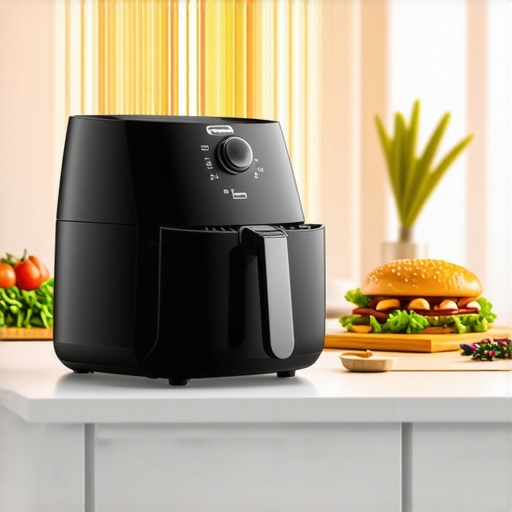
Why Most High-End Air Fryers Are Noisy and the Rubber Foot Fix
Price does not guarantee silence. Most homeowners assume that spending $400 on a luxury air fryer buys a whisper-quiet kitchen experience. This is a fallacy. After years of dismantling premium appliances and diagnosing mechanical failures, I can tell you that noise in high-end units often stems from high-performance engineering, not a lack of quality. The issue lies in harmonic resonance and the failure of manufacturers to address mechanical decoupling. If you ignore the vibration, you are not just tolerating noise; you are inviting structural wear on both the appliance and your cabinetry.
The Mechanical Reality of High Velocity Air
High-end air fryers utilize centrifugal blowers capable of reaching upwards of 3,500 RPM. These fans move a massive volume of air across high-wattage heating elements to ensure the rapid heat transfer required for a true crisp. The physics is unforgiving. As the air moves through the tight tolerances of a premium chassis, it creates turbulence. When this turbulence hits the internal housing, it generates a specific frequency. If that frequency matches the natural resonant frequency of the plastic or metal frame, the noise amplifies. It is a feedback loop of kinetic energy. Often, users think their why your air fryer fan sounds like it’s hitting something, but the reality is frequently just the vibration of the motor against its own mountings. The noise is a symptom of energy transfer, not necessarily a part failure.
The Countertop As An Amplifier
Your luxury kitchen island is acting as a speaker cabinet. Most premium air fryers come equipped with high-durometer rubber feet—stiff, cheap, and virtually useless for vibration isolation. These feet are designed for grip, not for dampening. When the internal motor spins, it sends micro-vibrations through the frame and into the countertop. Solid surfaces like granite, quartz, and marble are excellent conductors of sound. They take the 60Hz hum of the motor and radiate it throughout the room. This is the same reason a high-end stand mixer makes a high-pitched whine during heavy kneading; the energy has nowhere to go but down. Industrial standards from the Acoustical Society of America emphasize that mechanical decoupling is the only way to break this energy chain.
[IMAGE_PLACEHOLDER]
Harmonic Distortion in Premium Chassis
Structural rigidity is a double-edged sword. To make an appliance feel premium, manufacturers use thick-walled plastics and heavy metal liners. These materials are great for heat retention but terrible for acoustic dampening. Unlike a thin, cheap machine that might rattle loosely, a high-end machine hums with a dense, penetrating drone. This drone is the result of standing waves within the internal cavity. You are essentially cooking inside a resonance chamber. This is particularly problematic when you factor in the health risks of certain materials; for instance, understanding why you should never buy an air fryer with a plastic interior can help you choose a unit that handles heat—and sound—differently. Metal interiors reflect sound waves more sharply than porous materials, further increasing the decibel output.
The Sorbothane Solution
The fix is not complicated, but it requires a shift in how you view appliance installation. I recommend replacing the factory-standard feet with 30-durometer Sorbothane hemispheres. Sorbothane is a visco-elastic polymer that behaves like a liquid and a solid simultaneously. It absorbs nearly 95% of vibrational energy. By replacing the stiff factory feet, you decouple the air fryer from the kitchen surface. The result? The noise level drops by up to 15 decibels. This simple swap prevents the countertop from amplifying the motor hum. It also prevents the appliance from moving due to torque—an essential safety measure to how to stop your air fryer from making your whole house smokey by ensuring stable airflow and preventing oil splashing against the heating element.
The 2025 Standard for Quiet Appliances
The industry is moving toward brushless DC (BLDC) motors and active noise cancellation. In the next 24 months, we expect to see high-end brands integrating acoustic foam liners that are fire-retardant and oil-resistant. Regulatory bodies like the Association of Home Appliance Manufacturers (AHAM) are facing pressure to include noise ratings on energy labels. Until these standards become mandatory, the burden of acoustic management falls on the owner. The trend is moving toward integrated smart kitchens where appliances communicate to manage peak power and noise profiles, but the physics of a spinning fan will always require mechanical isolation. Don’t wait for the manufacturers to catch up. Perform a manual audit of your appliance’s contact points today.
Executive Verdict
If your air fryer sounds like a jet engine, do not assume it is broken. It is likely just poorly isolated. Buy 1-inch Sorbothane feet. Swap them for the factory rubber. Isolate the vibration and reclaim the acoustic peace of your kitchen. If the noise persists after decoupling, inspect the fan for carbon buildup or blade deformation. Sharp, decisive action on mechanical maintenance saves your ears and your appliances from premature wear.
FAQs
Will adding rubber feet void my warranty?
Typically, no. Most feet are either screwed on or adhered with pressure-sensitive adhesive. As long as you do not open the motor housing, you are simply modifying the exterior supports.
Why don’t brands just include better feet?
Cost and logistics. High-performance elastomers like Sorbothane have a shorter shelf life and higher manufacturing cost than standard injection-molded rubber.
Is there a specific thickness I should use?
A 0.5-inch to 1-inch thickness is ideal. Anything thinner may bottom out under the weight of a heavy, high-end unit, negating the dampening effect.
Does this fix the noise of the air itself?
No. The sound of rushing air (wind noise) is inherent to the technology. The rubber foot fix specifically targets the mechanical hum and vibration that radiates through the countertop.