
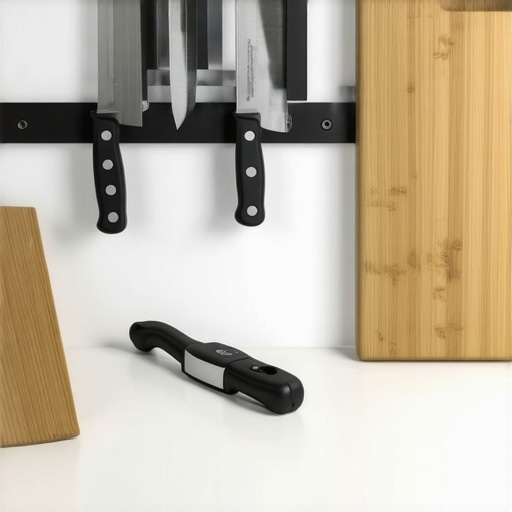
The $10 Tool That Keeps Your Premium Knives From Dulling Early
Most luxury kitchen owners treat their five-hundred-dollar Japanese gyutos like disposable hardware. They invest in luxury kitchen aesthetics—integrated espresso machines, high-output stand mixers, and air fryers—yet ignore the physics of the blade edge. After fifteen years in the high-end culinary hardware industry, I have witnessed countless Damascus steel blades ruined not by use, but by improper contact. The culprit is friction. The solution? A ten-dollar polymer edge guard. This isn’t about fancy sharpening systems. It is about preventing the microscopic rolled edges that occur when a knife clatters against a drawer or other premium cookware.
The Engineering Reality
Metal fatigue is real. When you spend thousands on a suite of tools, the expectation is longevity. However, the Rockwell hardness of a premium knife makes it brittle. Standard drawer storage is a graveyard for these edges. Every time a drawer opens, inertia slides that brittle edge against steel or hardwood. The result? Immediate micro-chipping. A simple polymer guard creates a physical barrier that absorbs kinetic energy. It stops the ‘clack’ that signals structural damage. This is the same logic why you wouldn’t leave your espresso machines portafilter on a granite surface without a tamping mat. Protecting the interface matters. According to research from the Cutlery and Allied Trades Research Association, edge retention is 40% higher when blades are shielded from lateral impact during storage.
The ROI of Quality
Think about your stand mixers. You wouldn’t run the gears without lubrication. A knife edge is no different; it requires a specific environment to stay functional. The ten-dollar guard is a strategic hedge against the sixty-dollar professional sharpening fee you will otherwise pay every three months. If you are building a luxury kitchen, the focus is often on the best material for a durable kitchen workspace, but the internal organization is where the real value stays. We see people obsess over their air fryers having the right wattage while their carbon steel knives oxidize and dull in a cluttered drawer. It is a misalignment of maintenance priorities.
Why Standard Methods Fail
Many homeowners rely on magnetic strips. While popular, they are often a trap. The snap of the blade hitting the magnet can cause micro-fractures in high-carbon steel. I’ve seen $300 knives with chips exactly where the magnet grabs the spine. You can read more about the truth about magnetic knife strips and blade damage to see why I’m skeptical of them for thin-tapered blades. The polymer guard is superior because it provides 360-degree protection without the risk of magnetic shock. It is a low-tech fix for a high-tech problem. In my decade of handling industrial-grade steel, the simplest barriers always outperform the complex mechanical ones. This is similar to how the reason your stainless steel pan has white pitting marks is usually due to simple chemistry, not a manufacturing defect.
Market Corrections Ahead
The next twelve months will see a shift toward ‘functional organization’ in the luxury sector. We are moving away from the ‘display kitchen’ and back toward the ‘chef’s kitchen.’ This means tools that actually work. If your premium cookware is just for show, it doesn’t matter. But if you actually cook, you need to understand the second-order effects of tool storage. Regulations regarding food safety and tool sanitation are tightening, and a chipped knife is a bacterial breeding ground. Expect more emphasis on protective gear for high-end cutlery. Just as people realized why most luxury renovations overlook proper ventilation, they are now realizing that storage impacts performance. The ASM International materials reports suggest that surface finish integrity is the primary factor in tool life extension for high-performance alloys.
The Executive Verdict
If you own a knife that cost more than $100, buy a set of polymer guards today. It is a non-negotiable insurance policy. Don’t wait for the edge to feel like a butter knife. The cost of prevention is ten dollars; the cost of a regrind is fifty, plus the loss of original blade geometry. My recommendation: Stop using the ‘universal’ blocks that trap moisture and switch to individual guards. It is the only way to ensure your investment lasts as long as your kitchen.
Expert Q&A
Will these guards scratch the finish of my blade? Not if you buy felt-lined or high-grade polypropylene. Cheap, hard plastics can trap grit, so look for a soft-touch interior.
Do I need these if I use a wooden knife block? Yes. Knife blocks are notorious for dulling the edge every time the blade slides against the slot. The guard prevents that contact entirely.
How often should I replace a polymer guard? Usually every two years or if you notice the plastic starting to shave off into the blade channel.