
How to Get Rid of the Metallic Taste in Your New Espresso Machine
Buying a high-end dual-boiler or a heat-exchange espresso machine represents a significant investment in your daily ritual. However, that first shot often reveals a harsh, metallic tang that ruins the profile of expensive, single-origin beans. This isn’t a defect. It is the reality of modern manufacturing. After fifteen years of diagnosing thermal inconsistencies and flavor profile failures in luxury kitchens, I can tell you that a ‘factory-new’ machine is essentially a pressurized vessel of industrial leftovers. You are tasting residual machining lubricants and the lack of a proper oxide layer on the copper or brass internals. Acceptance is the first step toward a clean cup. Ignoring this flavor won’t just ruin your morning; it indicates that your machine’s hydraulic path is currently coated in particulates that shouldn’t be in your body.
The Engineering Reality of Machining Residuals
Every espresso machine, from a prosumer E61 group head model to the most advanced luxury kitchen setups, undergoes extensive manufacturing. Tubes are bent, boilers are brazed, and fittings are threaded. During these processes, manufacturers use cutting fluids and lubricants to keep the metal from overheating or galling. While most of this is cleaned at the factory, traces remain tucked in the crevices of the boiler or the threads of the group head. The metallic taste is often the result of copper leaching or the dissolution of these organic compounds into the hot water. In high-pressure environments, the water acts as a solvent, stripping these contaminants into your portafilter. The goal is to achieve passivation—the formation of a stable, inert oxide layer on the metal surfaces that prevents further leaching. Until this occurs, the metal is ‘reactive.’
The Thermal Flush Protocol
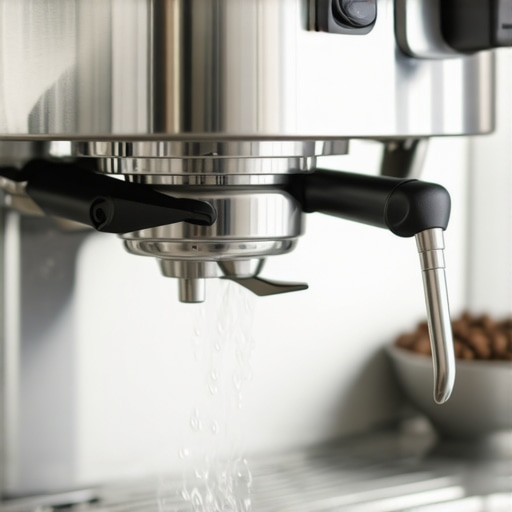
To fix this, you must go beyond the basic ‘rinse’ mentioned in the manual. Start with a deep reservoir flush using filtered water with a specific mineral content. Distilled water is too aggressive and will actually increase the metallic leaching by trying to ‘pull’ ions from the boiler walls. You need water with about 50-100 ppm of hardness to help the metal stabilize. Run at least three full reservoirs through the steam wand and the group head. This isn’t just about volume; it’s about heat cycles. The thermal expansion and contraction of the metal help dislodge micro-particulates. If you still notice a sharp acidity, you might be confusing the metal with the reason your first espresso shot of the morning always tastes sour, which is often a temperature management issue rather than a material one. The weight of the industrial grade steel in your machine requires several ‘sacrificial’ shots to properly coat the internals with coffee oils, which act as a secondary barrier.
[IMAGE_PLACEHOLDER]
Implementation Risks and the Messy Reality
I have seen owners get desperate and use vinegar or harsh descalers on a brand-new machine. This is a strategic error. High-acid solutions can strip the zinc from brass fittings or pit the surface of aluminum boilers, leading to permanent damage and an even stronger metallic flavor. I remember a client in a high-rise who used an industrial-grade cleaner on his new Italian machine; the smell of acrid, burnt chemicals filled the kitchen, and we had to replace the entire boiler because the internal plating had begun to flake. The risk of over-cleaning is as high as the risk of under-cleaning. If your machine has a dual-boiler system, ensure you are flushing both the brew boiler and the steam boiler separately. Sometimes a clogged steam tip can trap these metallic-tasting waters, reintroducing them every time you purge the wand. Use your nose. The steam should smell like nothing—if it has a ‘hot metal’ scent, you haven’t flushed enough.
Market Corrections and Material Standards
The industry is slowly shifting toward lead-free brass and high-grade stainless steel to satisfy evolving health regulations like those from the Specialty Coffee Association. Stainless steel is far less reactive but has lower thermal conductivity, meaning the engineering must compensate with better heating elements. In the next 12 to 24 months, expect to see more ‘smart’ machines that include a pre-programmed ‘Break-in Cycle’ to automate this flushing process. We are also seeing a push for more transparent material sourcing, as consumers demand to know exactly what alloy their water is sitting in for 24 hours a day. High-end manufacturers are increasingly using ‘pickled’ boilers, which are pre-treated with acid baths at the factory to remove scale and oxidation before shipping, but even these require a home-level flush to ensure total purity.
The Executive Verdict
If you are tasting metal, do not panic, but do not ignore it. My recommendation is a three-stage approach: First, perform a high-volume flush (3-4 reservoirs). Second, pull five ‘trash’ shots using cheap beans to coat the group head with lipids. Third, if the taste persists, check your water chemistry using an ASTM International standard testing kit; the problem is often the water interacting with the metal, not just the metal itself. If you’ve tried everything and the taste is more like scorched tires, you may be dealing with why your espresso tastes like burnt rubber, which usually points to a group head gasket issue or a severely overheated heating element. Precision is everything. The result of cutting corners is a cup that tastes like a workshop floor rather than a luxury experience.
Frequently Asked Questions
How many liters of water should I flush through a new machine? At least 4 to 6 liters for a standard prosumer machine, divided between the steam wand and the group head. Can I use bottled water to stop the metallic taste? Only if it is spring water with moderate mineral content. Avoid distilled or RO water without remineralization, as it can be corrosive. Is the metallic taste dangerous? Generally, no. It is usually copper or machining oils in minute quantities, but it is a sign that the machine is not yet chemically stable for food preparation. Should I use a backflush detergent on day one? No. Detergents are for removing coffee oils. On day one, you want to build up a light layer of coffee oils, not strip them away. Does the taste go away on its own? Yes, typically after 20-30 real shots, as the internal surfaces become ‘seasoned’ with coffee fats and water minerals.